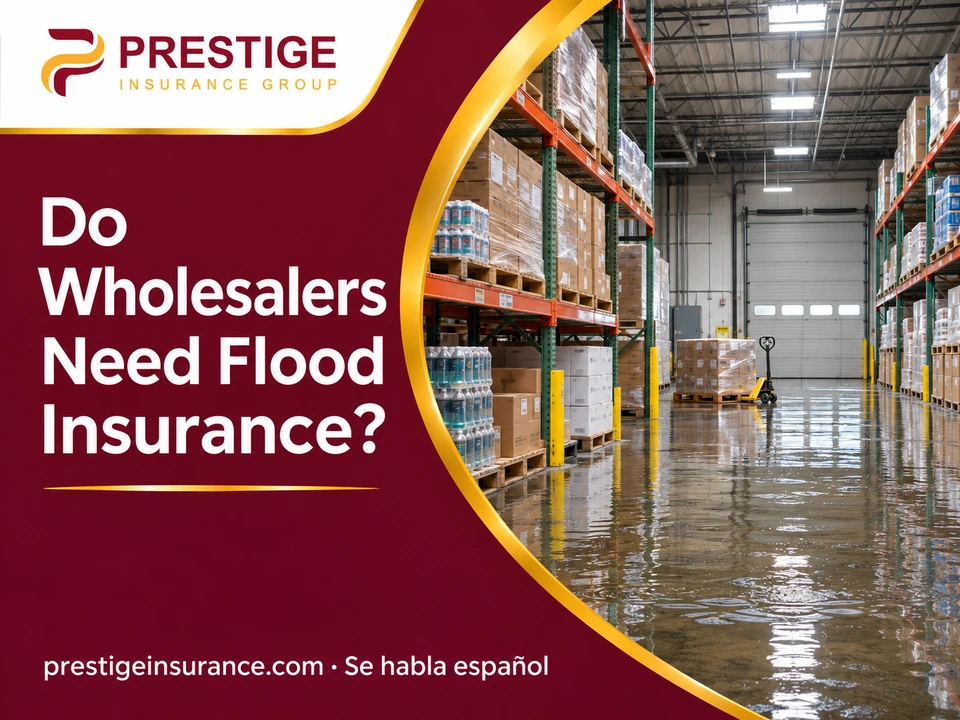
A food and beverage distributor in Hialeah leases a unit in an industrial park near the Palmetto Expressway. Late summer is its busiest stretch: the racks are full ahead of the holiday season, a container from Colombia is sitting at a third-party warehouse waiting for space, and two trucks are out on deliveries. A slow-moving storm stalls over Miami-Dade, water rises through the park overnight, and by morning the bottom two pallet levels are standing in it. The owner’s first call is to the property insurer, and the answer is the one most wholesalers hear for the first time after a flood: the policy excludes it.
For a wholesale or distribution business, flood is not mainly a building problem. The building usually belongs to a landlord. The exposure is the inventory, which is worth more than anything else the business owns, moves constantly and peaks at the worst time of year, along with the income that stops when the stock is gone. A flood program for a wholesaler has to be built around those two things.
Your property policy does not cover flood
Standard commercial property forms exclude flood, surface water and storm surge, and that exclusion applies to your stock as much as to the building. Wind damage from a hurricane is a property claim; water that rises from the ground is a flood claim, and without flood coverage it has nothing behind it. Our article on what flood insurance does not cover walks through where the lines fall. A location outside the high-risk zones still floods when heavy rain overwhelms drainage; the zone only decides whether a lender requires coverage.
Inventory is the exposure, and it moves
A wholesaler’s inventory value is rarely steady. It builds before peak seasons, drops after them, and can swing sharply when a large order or an import shipment lands. A policy written at the average value leaves you underinsured at the peak, which is often hurricane season. Written at the peak, you pay for coverage you do not need for much of the year.
Two approaches address this. A reporting form lets you declare inventory values periodically, usually monthly, with the premium adjusted to what you actually carried, though it only works if reports are filed accurately and on time. A peak season endorsement raises the limit for the months when stock builds. Whichever you use, the flood coverage needs to follow the same values as the property coverage, or the gap shows up exactly when the water does.
Where the NFIP stops and private flood begins
The federal flood program writes non-residential contents coverage up to 500,000, and for many distributors that figure covers a fraction of the stock on hand. It also pays nothing toward lost income. Private flood and excess flood policies fill the space above the federal limit or replace it altogether, often with higher limits and broader terms, and some include business income options the federal program does not offer. Private markets can also restrict new policies or increases when a named storm is approaching, so the time to set limits is well before the season, not when a system appears in the Gulf. Our article on what commercial flood insurance costs explains what drives the premium on each side.
Stock that is not in your building
Wholesalers rarely keep everything under one roof. Product waits at a third-party logistics warehouse, sits at a port facility, moves on trucks and containers, or is held on consignment at a customer’s location. Each of those situations raises its own question. A policy that covers stock at your premises may not cover it at another location, or may cover it only up to a small sublimit. Goods in transit fall under inland marine or cargo forms, and those forms vary in how they treat flood: some include it, some exclude it, some limit it. And if you hold goods that belong to customers or suppliers, whether your policy covers property of others in your care is a separate line item. The warehouse operator’s insurance usually protects the warehouse operator, not the owner of the goods, so read the storage agreement before assuming anyone else is responsible.
Business income: the loss the federal program ignores
After a flood, a wholesaler loses more than inventory. Orders cannot ship, customers turn to other suppliers, and fixed costs keep running while stock is replaced. The NFIP does not pay business income or extra expense at all. Business interruption coverage on a property policy does not respond to a flood either, because the flood exclusion carries over to it. If income protection matters, it has to come from a private flood policy that includes it.
Dependence works both ways. If a key supplier’s facility floods, your shelves empty even though your building stays dry. If a major customer floods and stops ordering, your sales drop. Contingent business income covers some of these situations under some forms, and whether it extends to flood is a question worth asking specifically.
Leased space: who insures what
Most distributors lease. The landlord typically insures the building, and the tenant insures its own inventory, equipment, racking and improvements it paid for. Read the lease closely. Some leases make the tenant responsible for improvements or for the cost of repairs after certain losses, and some require the tenant to carry flood coverage at specified limits. Racking systems, forklifts, conveyors, refrigeration and office build-outs are often the tenant’s property, and they belong on the tenant’s flood schedule. Our article on flood insurance for wholesale warehouses covers the building side for owners and the storage practices that follow from it.
Getting stock off the floor
The most effective flood control in a distribution facility costs little: keep inventory off the floor. Pallets, racking with the first beam set high enough, moisture-sensitive stock stored on upper levels, and a written plan for moving high-value product before a storm all reduce what floodwater can reach. Underwriters ask about these practices, and they shape both the terms you are offered and the size of the claim if water comes in anyway.
Lenders and inventory financing
If your inventory secures a line of credit or other financing, the lender has an interest in it. Loan agreements often require property coverage on the collateral, sometimes flood coverage by name, and a lender loss payee or similar endorsement. A flood loss on uninsured inventory can trigger a default on top of the loss itself. Confirm what your loan documents require, and make sure the flood policy is written to match. For the broader program, see our wholesaler and distributor insurance page.
Worth confirming on your policy
-
Whether your inventory is covered for flood at all, and at what limit
-
Whether the flood limit reflects your peak season values, through a reporting form or a peak season endorsement
-
How much stock sits above the NFIP non-residential contents limit, and whether private or excess flood covers it
-
Whether inventory at third-party warehouses, ports or customer locations is covered for flood
-
How your inland marine or cargo form treats flood for goods in transit
-
Whether property of others in your care, including consignment stock, is covered
-
Whether any policy pays business income after a flood, including contingent business income
-
What your lease requires you to insure, including racking, equipment and improvements
-
Whether your loan documents require flood coverage on inventory and a lender endorsement
For more, see our commercial flood insurance page, our articles on whether commercial property needs flood insurance and when importers and wholesalers are treated as manufacturers, and our warehousing and logistics insurance page.
Talk to us
Prestige Insurance Group works with wholesalers, distributors and importers across Florida, from Doral and Hialeah to Central Florida and Tampa. We compare federal and private flood options across the companies we work with, check the flood zone and elevation information for your location, and coordinate flood coverage with your property, inland marine and business income coverage so inventory is protected wherever it sits. We also line up the timing so coverage is in force before the season, not after a storm is named.
Call the office nearest you. Se habla español.
-
Miami: 305-969-8776
-
Orlando: 407-993-2331
-
Stuart: 772-247-3788
This article is general information, not legal advice. Coverage forms, contract terms and carrier appetite vary and change over time. Prestige Insurance Group, Florida agency license L057894.