A homeowner in Kendall takes eighteen inches of water through the house. She has flood insurance, the claim is accepted, and the payment still leaves her well short. The seawall behind the property is damaged and not covered. Neither is the pool equipment, the landscaping or the fence. The finished ground-level room the family uses as a den is covered only for a handful of items, and the four months she spends in a rental while the house is repaired are not covered at all.
Flood insurance covers less than most people assume, and its gaps are less intuitive than the ones on a homeowners policy. Most of them follow the same logic: a flood policy is built around the structure and what is inside it, at the level where people live, and much of what a flood actually damages falls outside that frame. Knowing where those lines are is what lets you close them before a storm rather than discover them in the claim.
Loss of use is the largest gap
The single exclusion that surprises nearly everyone is temporary housing. The National Flood Insurance Program does not cover additional living expenses, so if the home is uninhabitable after a flood, the cost of a hotel or a rental while it is repaired is yours. That would matter less if flood repairs were quick, but they rarely are. Drying, mold remediation, permitting and reconstruction routinely take months, and after a regional event they take longer, because every flooded home in the area needs the same contractors at the same time. Some private flood policies include loss of use, which is one of the clearest practical differences between the two markets and worth asking about by name.
Almost nothing outside the building
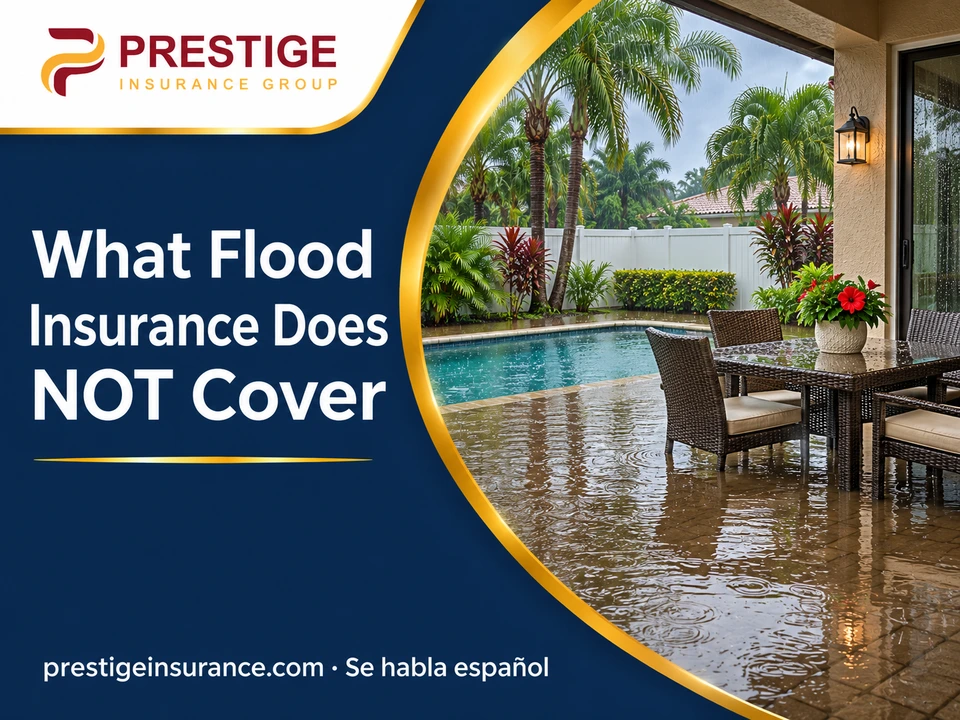
Flood coverage stops, for the most part, at the walls. Under the federal program, property outside the building is largely excluded, and that list is long: seawalls, bulkheads, docks and piers, fences and gates, decks, patios and walkways, swimming pools and pool equipment, landscaping, trees and irrigation, septic systems and wells. For a waterfront home, that describes a substantial part of what the owner paid for, and it is why a canal-front property can be fully insured on the building and still face a large uninsured loss. Our article on storm surge and excess flood insurance for waterfront homes looks at how owners of those properties structure their coverage.
The ground level is restricted
Under the federal program, areas below the lowest elevated floor receive limited coverage. In Florida that rarely means a true basement. It usually means the ground level of an elevated home, an enclosure under a raised house or a crawl space. In those areas, the policy generally covers the structural elements and essential equipment, such as the air conditioning, the water heater, the electrical panel and certain permanently installed machinery. It generally does not cover finished walls, flooring and ceilings there, or most personal property stored there beyond a narrow list. The practical result is that a ground-level room finished out as living space is often the part of the house most likely to flood and least likely to be covered. Our article on what flood insurance covers in Florida explains how these areas are treated.
Vehicles go to the auto policy
Cars, boats, trailers and motorcycles are not covered by flood insurance, no matter where they were parked. A flooded car is a comprehensive claim under the auto policy, and a household that dropped comprehensive coverage on an older car has no recovery at all. That is one of the most common uninsured losses after a flood, and it is easy to check before a storm. The same is true for boats, which belong on a boat policy, and collector cars, which our article on flood damage and branded titles on collector vehicles covers in detail.
Mold the owner could have prevented
Mold after a flood is generally covered only when the policyholder could not reasonably have prevented it. In practice, an owner who could reach the property and did not begin drying it out may find the mold portion of the claim reduced or denied. That creates an uncomfortable obligation in the days after a flood, when the property may be hard to reach and everything else is urgent. What supports the claim is documentation: photos of the condition, a record of when the property became accessible and the date drying and mitigation began.
Business income, valuables and records
Income from a business run out of the home is not covered under a residential flood policy, and the same gap exists on commercial flood. The federal program covers the building and contents, not the income lost while a business is closed, and business income coverage for flood generally requires a private placement. Cash, precious metals, stocks and other valuable papers are excluded or tightly limited, and valuables such as jewelry, art and collectibles are capped at a low combined limit under the NFIP. Contents are also paid at depreciated value rather than replacement cost, which is a difference from most homeowners policies worth understanding before you assume the two behave alike.
Earth movement, even when flooding caused it
Sinkholes, land subsidence and other earth movement are excluded even where flooding contributed to them. The line between flood damage to a structure and damage caused by the ground beneath it shifting is not intuitive, and it is a real source of denied claims in parts of Florida with unstable soils. Certain collapse of land along a shoreline caused by erosion or waves is an exception, which is one more reason to read the policy rather than assume.
Where private flood fills the gaps
For several of the gaps above, the private market offers something the federal program does not. Depending on the carrier, a private policy may include loss of use, replacement cost on contents, higher building limits and broader coverage for ground-level areas, and where limits fall short on either, excess flood can sit on top. Comparing the two on premium alone misses the differences that matter after a loss, and our comparison of NFIP and private flood insurance walks through them. Timing matters too, since a new NFIP policy generally takes thirty days to take effect, as our article on three details to check when buying flood insurance explains.
Worth confirming on your policy
-
Does your policy pay for temporary housing if the home is uninhabitable?
-
Are seawalls, docks, pools or fences part of what you would need to replace?
-
Does any part of your home sit below the lowest elevated floor, and what is covered there?
-
Do your vehicles carry comprehensive coverage?
-
Do you run a business from the home, or keep valuables that need separate coverage?
-
Are the building and contents limits enough, or capped by the program?
Talk to us
Prestige Insurance Group writes flood coverage for homeowners and businesses across Florida, through both the federal program and the private market. If you carry flood and have never compared it against a private option, that comparison is worth having, because the differences show up in exactly the places listed above, and they show up after the water is gone. Learn more on our flood insurance page, or see do I need flood insurance in Florida.
Call the office nearest you. Se habla español.
-
Miami: 305-969-8776
-
Orlando: 407-993-2331
-
Stuart: 772-247-3788
This article is general information, not legal advice. Coverage forms, program rules and carrier appetite vary and change over time. Prestige Insurance Group, Florida agency license L057894.