


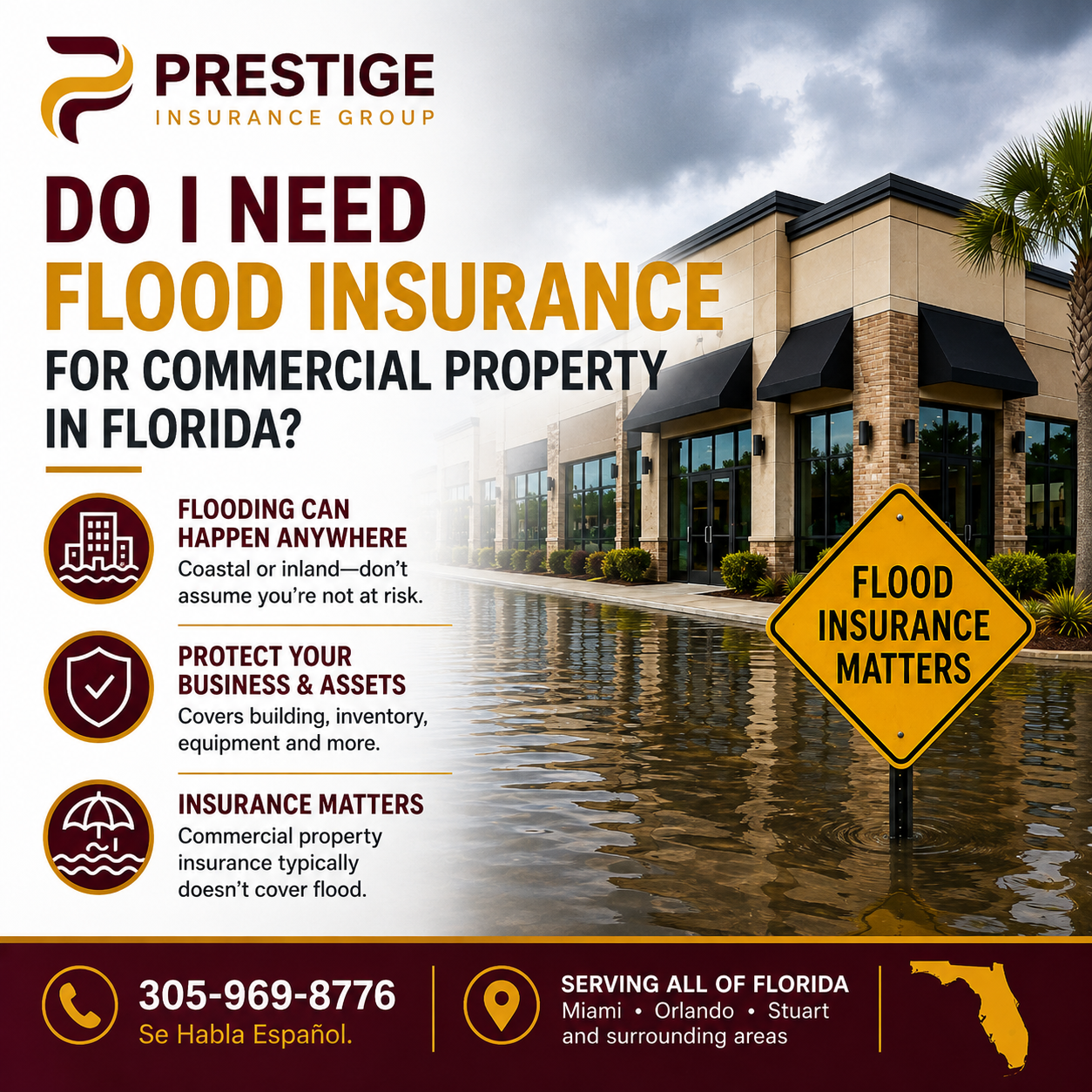
Do You Need Flood Insurance for Commercial Property in Florida?
The question of whether a Florida commercial property needs flood insurance shouldn’t start with whether a lender requires it. A better starting point: what would happen financially if this property flooded and there were no flood insurance in place?
For a business or investor, that could mean damage to the building itself, destroyed inventory, damaged machinery, ruined tenant improvements, and an extended interruption to operations. For a landlord, it can also mean tenant spaces sitting unusable while rental income stops. And critically, standard commercial property insurance generally doesn’t cover any of it — flood is excluded from most commercial property policies by default, which is exactly why it needs to be evaluated as its own decision rather than assumed to already be handled.
Flood Risk Isn’t Defined by the Flood Zone Alone
The most common misconception is that only properties in designated high-risk flood zones need to think about this. Flood maps matter — they influence lending requirements and insurance pricing — but they aren’t a clean line between properties that can flood and properties that can’t. Flooding regularly affects properties FEMA classifies as lower risk. A warehouse full of inventory can suffer a devastating flood loss regardless of its official flood-zone classification, and the same goes for a shopping center, restaurant, office building, or apartment property.
The flood zone is one input into the analysis. It isn’t the whole analysis.
Florida’s Flood Exposure Takes More Than One Form
“Florida flooding” tends to conjure storm surge from hurricanes, and that’s a real and serious exposure, particularly along the coast — but it’s far from the only mechanism. Heavy rainfall can overwhelm drainage systems on its own. Rivers and canals rise. Water accumulates rapidly in low-lying areas regardless of proximity to the coast. A slow-moving tropical system can dump extraordinary rainfall well inland without ever making a direct hurricane strike nearby.
This matters because Florida’s commercial development spans very different exposure profiles: South Florida combines coastal storm surge with heavy rainfall risk; Southwest Florida faces Gulf surge on top of rainfall; Central Florida is inland but still vulnerable to tropical systems and intense thunderstorms; North Florida carries its own mix of river, rainfall, and coastal exposure. There’s no single Florida flood scenario, which is exactly why “am I near the coast” isn’t a sufficient question on its own.
A Hurricane Can Cause Both Wind Damage and Flood Damage — And They’re Not the Same Claim
One concept worth internalizing: a hurricane isn’t one insured event, it’s several possible mechanisms of damage happening at once. Wind can tear open a roof. Rain then enters through that opening. Separately, storm surge or accumulating surface water can enter the building from ground level entirely independent of the wind damage. To the property owner, this can feel like one loss. To the insurance program behind it, wind and flood are typically separate coverages — sometimes from entirely different policies — and that distinction becomes very consequential after a major storm. Purchasing hurricane wind coverage does not automatically mean flood is included.
What Actually Counts as “Flood” in a Policy
Even the word “flood” has a specific, narrower meaning in an insurance contract than in everyday conversation. Under the NFIP’s commercial form, flood generally means a temporary condition where normally dry land is inundated by overflowing water or the rapid accumulation of surface runoff — the actual policy language controls what qualifies. A pipe that bursts inside the building is a different event than surface water entering from outside; a roof leak is different again; sewer backup may be treated differently depending on what caused it. Not every water event is a “flood” in the insurance sense, which is why the source of the water matters as much as the fact that water got in.
Building Coverage and Contents Coverage Are Separate Questions
For a property owner, flood exposure starts with the structure — electrical systems, plumbing, HVAC equipment, permanently installed fixtures — but for many businesses, the bigger exposure is what’s inside the building. Inventory, machinery, furniture, and equipment can represent a larger financial stake than the structure itself, especially for a wholesaler with merchandise stored near floor level or a manufacturer dependent on specialized machinery. NFIP commercial flood policies treat building coverage and contents coverage as genuinely separate — protecting one doesn’t automatically protect the other.
This distinction matters even more for commercial tenants, who often don’t own the building at all but do own everything inside it. A landlord’s flood policy protects the landlord’s building; it does nothing for a tenant’s furniture, computers, machinery, or inventory. Tenants operating from warehouses, shopping centers, and industrial spaces should never assume the building owner’s coverage extends to what they’ve brought into the space — and landlords shouldn’t assume tenants understand this either. Clear lease requirements around insurance responsibility, reviewed before a loss rather than discovered after one, prevent a lot of the confusion that shows up when a shopping center floods and multiple businesses are affected at once.
NFIP vs. Private Flood — And the Gap Both Sides Should Know About
Florida commercial property owners typically have two paths to flood coverage: the National Flood Insurance Program, and private flood insurance markets. They shouldn’t be treated as interchangeable. NFIP coverage follows standardized federal terms, with its own limits, deductibles, and conditions for building and contents separately. Private markets can offer different structures, limits, and valuation provisions depending on the insurer — and “private” doesn’t automatically mean “better,” any more than “NFIP” automatically means “sufficient.” Each policy needs to be evaluated on its actual terms.
One gap is worth calling out specifically because it surprises a lot of business owners: standard NFIP commercial flood coverage does not include business interruption or loss-of-use coverage. A business can have a fully paid, valid NFIP flood policy covering the physical building and contents, and still have zero coverage for the months of lost income while the location is unusable. For a business or a landlord depending on the property’s income, that gap between “the building got repaired” and “the business survived the interruption” is often the more consequential one. Private flood policies may offer different options here, but it should never be assumed — it has to be specifically confirmed.
Elevation, Drainage, and Prior Flooding Tell You More Than a Flood Zone Map
Two commercial buildings in the same neighborhood can carry very different flood risk. One might sit slightly higher with effective drainage; the other might sit at a low point where water regularly accumulates. Where a property’s electrical and mechanical equipment is physically located — ground-level mechanical room versus elevated — can be the difference between a manageable loss and a catastrophic one.
A few practical questions tend to reveal more than a flood-zone designation: Where does the parking lot drain, and does water move toward or away from the building? Are entrances and loading areas elevated or at grade? Has the property flooded before, and if so, what changed afterward? A prior flood doesn’t automatically make a property a bad investment — but repeated minor drainage problems, water marks on exterior walls, or tenant reports of past water intrusion are exactly the kind of evidence worth asking sellers and existing tenants about before a purchase, not after.
A Lender Requirement Isn’t the Same as a Complete Risk Analysis
When financing is involved, a lender may require flood insurance as a condition of the loan — and that requirement exists to protect the lender’s financial interest in the property, which is narrower than the owner’s actual exposure. An owner typically has more at stake: equity in the building, dependent rental income, or business-critical equipment and inventory that a lender’s minimum requirement was never designed to address.
Cash buyers face the same underlying decision without a lender forcing the question. A commercial property without a mortgage floods exactly as easily as one with financing — the only difference is that an uninsured owner absorbs the consequence personally rather than transferring it. For a financially strong investor, deliberately retaining some flood risk can be a reasonable strategy. The distinction that matters is between a business owner who decided to retain that risk with eyes open, and one who assumed the commercial property policy already handled it and only discovers otherwise after a loss. The first is risk management; the second is an accident.
Deductibles and Valuation Matter as Much as the Premium
Comparing flood proposals by premium alone misses most of what actually determines the outcome of a claim. The deductible determines how much of a loss the owner absorbs before the policy responds — a larger deductible can lower premium but shifts more risk back onto the owner, and the right balance depends on financial resources and risk tolerance rather than a universal answer. Valuation provisions determine how a covered loss actually gets calculated, which can matter as much as the stated policy limit. The way to compare two flood proposals isn’t “which is cheaper” — it’s “what does each one actually transfer to the insurer, and what am I retaining either way.”
Insurance Transfers Risk; Physical Mitigation Reduces It
Insurance is a financial tool — it doesn’t stop water from entering a building. Where practical, physical steps can meaningfully reduce the severity of a future loss: elevating inventory off warehouse floors, relocating vulnerable electrical or mechanical equipment above ground level, maintaining drainage rather than letting it degrade, and protecting records and critical documents. These measures work alongside insurance, not instead of it — the properties that recover fastest from a flood usually did both.
So, Do You Need It?
There’s no single answer that applies to every Florida commercial property — the right decision depends on location, building condition, what’s stored inside, financing, and the owner’s financial capacity to absorb a loss without help. But the decision shouldn’t be reduced to a flood-zone designation or a lender’s minimum requirement. A more useful set of questions: Could water realistically reach this property? How much physical property is at risk, and how is it positioned? How hard would this business be to relocate temporarily? How long could operations or rental income realistically be interrupted? Could the owner absorb that loss without insurance?
Those questions turn flood insurance from a compliance checkbox into an actual business decision — which, for most Florida commercial property owners, is the right way to be making it.
Prestige Insurance Group works with Florida businesses, landlords, and commercial property owners to evaluate flood exposure alongside the rest of their property insurance program. Call 305-969-8776 or request a quote online to have your flood exposure reviewed, or contact our Miami office directly.