


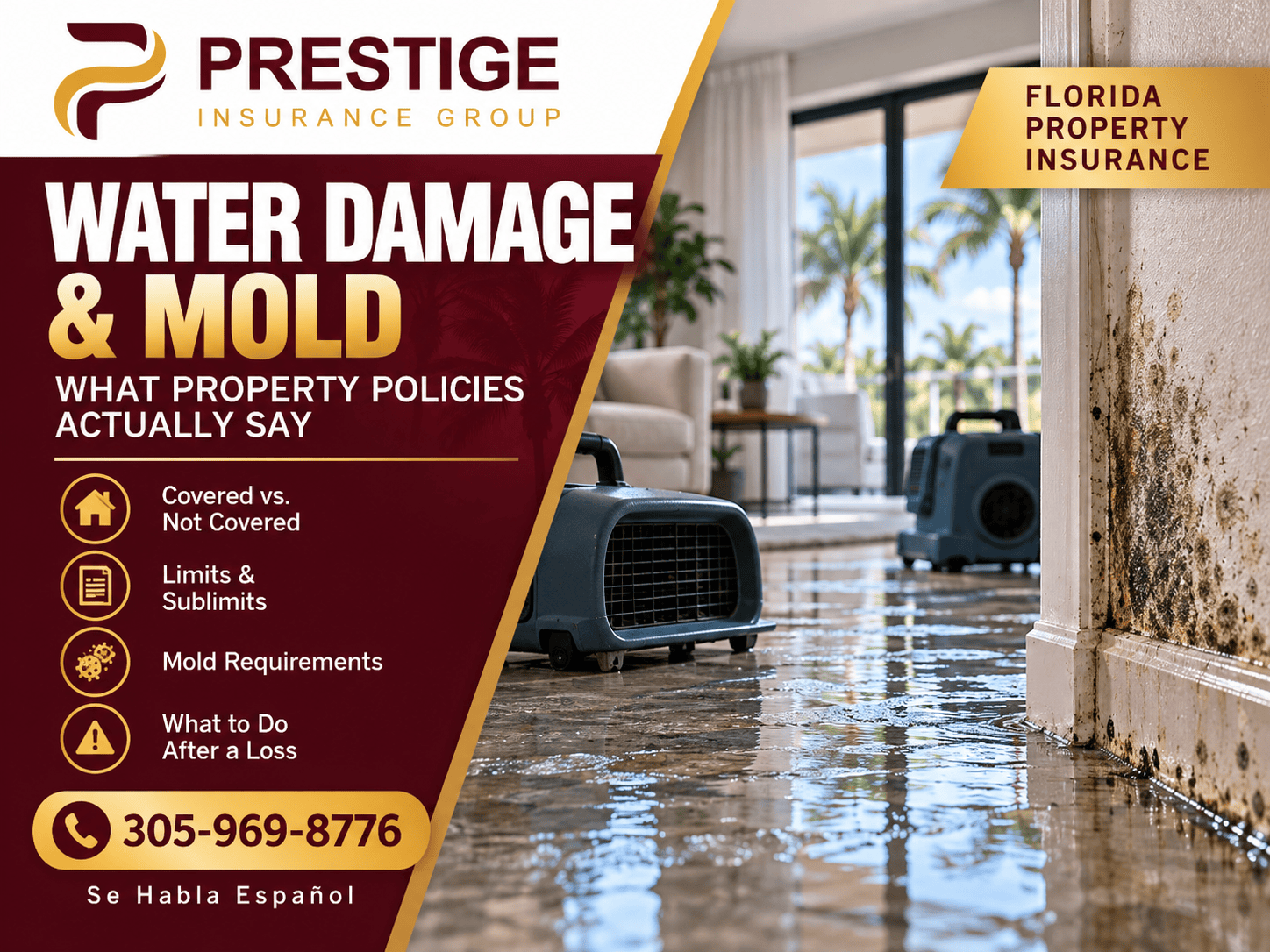
Water is the most frequent large claim in Florida property insurance, and it is not close.
Not wind. Not fire. Water — and most of it does not come from a storm. A supply line, a water heater, a washing machine hose, an air conditioning condensate line, a failed valve, a roof leak nobody noticed. In a condominium tower it reaches the units below. In an empty house it runs until somebody visits. In a restaurant or a dental practice it destroys the build-out that cost more than everything else in the space.
And of all the property claims that get disputed, water produces the most arguments — because the coverage turns on a distinction that is easy to state and hard to prove.
Sudden and Accidental, or Gradual
Every property policy covers water damage that is sudden and accidental. None of them cover water damage that developed gradually.
A pipe that bursts on Tuesday is a claim. A pipe that has been weeping behind a wall for eight months is maintenance, and the resulting damage is excluded — even though the owner did not know, and even though the damage looks identical once the drywall comes off.
That is the line almost every disputed water claim in Florida falls on, and the carrier examines which side it landed on using evidence the property either has or does not have.
What tends to decide it: staining patterns and their extent, the condition of the material around the failure, whether mold is present and how established it is, maintenance records, and how long the property was unoccupied. An owner who can show the failure was recent has a claim. One who cannot is arguing.
Two practical consequences follow. Document the condition of your property while it is in good condition, because photographs taken today establish what existed before. And report a water loss immediately rather than after you have investigated it, because the timeline is part of the evidence.
Where the Sublimits Sit
Even where a water loss is clearly covered, the amount recoverable is frequently capped in ways owners do not expect.
Non-weather water damage carries its own sublimit on many Florida homeowners policies now — a separate, lower limit that applies to a burst pipe or an appliance failure but not to a hurricane. Carriers introduced these because water losses were driving results, and a policy with a substantial dwelling limit can carry a water sublimit that covers a fraction of a serious loss.
Mold is sublimited almost universally, and the number is usually modest. This matters more in Florida than anywhere else, and it gets its own treatment below.
Seepage and leakage over a period of time is excluded rather than sublimited on most forms — that is the gradual damage exclusion described above.
The cost of tearing out and replacing to reach the failure is treated differently across forms. Some policies pay to access the failed component; some pay to repair the resulting damage but not to reach the cause; and the difference on a slab leak or a pipe behind tile is substantial.
Reading those provisions before a loss is worth an hour. Reading them after is a conversation about what you cannot recover.
Why Mold Is a Separate Problem
Mold sits in an unusual position because it appears in three different places in an insurance program, and it is restricted in all of them.
On the property policy it is typically sublimited, and the sublimit frequently covers testing and limited remediation rather than a serious remediation project.
On the liability policy it is frequently caught by the pollution exclusion, because most general liability forms define pollutant broadly enough to include mold and bacteria. That matters for landlords, property managers, associations, and any business facing a claim from a tenant, a resident, or an employee alleging health effects.
And it is excluded from many specialty forms by endorsement, which owners discover when they look.
The Florida climate is what makes this consequential rather than academic. Humidity does not need a leak to produce mold — a closed building with the air conditioning off will develop it, which is why the vacancy and seasonal-home problem is really a mold problem. Add a water loss that was not dried properly and the timeline compresses from months to days.
Our companion piece on what Florida property policies say about mold covers the provisions in detail.
The First 48 Hours Decide the Claim
More than in almost any other loss, what happens immediately after a water event determines the outcome — and the two things that matter most are drying and documentation.
Drying, because the clock is short. Mold can establish within a couple of days in Florida conditions. A water loss that is dried properly within that window is a water claim. One that is not becomes a water claim plus a mold claim, and the mold half runs into the sublimit.
Documentation, because the carrier was not there. Photographs before anything is moved, the source identified, and the mitigation invoices retained are what establish both the cause and the reasonableness of what you spent.
Policies generally require reasonable steps to prevent further damage, which means calling a mitigation contractor is not just sensible — it is frequently a policy obligation. Our first 48 hours after a water loss piece covers the sequence.
What Actually Prevents It
The controls in this category are unusually effective, which is not true of every peril.
Automatic water shutoff devices eliminate the failure mode rather than reducing it. A sensor detects flow that does not match normal use and closes the main. Several carriers now credit them and some are moving toward requiring them on unoccupied and seasonal property, which is a fair signal of how well they work.
Supply line replacement. Braided stainless lines on toilets, sinks, washing machines, and refrigerators are inexpensive and they fail far less often than the rubber lines they replace.
Water heater age. Most fail between eight and twelve years, and most fail by leaking rather than dramatically. Replacing on age rather than on failure is one of the cheapest loss prevention steps available.
Air conditioning condensate maintenance, which in Florida runs constantly and clogs.
Climate control in empty buildings, since humidity alone produces mold.
Someone checking unoccupied property, on a schedule, with the water shut off at the main between visits.
For habitational and commercial property owners, these are also underwriting answers. A property that can describe a supply line replacement program and shutoff devices presents differently from one that cannot.
Where This Hits Hardest
The exposure is universal but the consequences differ by property type.
Condominium buildings and associations face the worst version, because water travels vertically and a single unit failure reaches several others plus the common elements. The allocation between the unit owner’s HO-6, the association’s master policy, and loss assessment coverage is where these claims get complicated. See condo building insurance.
Apartment and habitational owners deal with frequency — many units, ageing plumbing, and in older South Florida buildings, cast iron that corrodes from the inside and fails without warning. See apartment and habitational insurance.
Restaurants and dental practices concentrate value in a build-out, and a water loss above a leased suite reaches all of it. See restaurant insurance and dental office insurance.
Vacant and seasonal property faces the severity version, because nothing stops the water and nobody is there to notice. See vacant home insurance and vacant building insurance.
Short-term rentals sit between the two — occupied frequently but by people who will not notice a slow leak and may not report one.
Worth Confirming on Your Policy
-
Is non-weather water damage sublimited, and at what amount?
-
What is the mold sublimit?
-
Does the policy pay to access the failed component, or only to repair the resulting damage?
-
What does the form say about seepage over a period of time?
-
If the property is ever unoccupied, what does the vacancy provision restrict?
-
Do you have an automatic water shutoff device, and is there a credit for one?
-
For a condominium: what does the association’s master policy cover, and what is your loss assessment limit?
Let’s Look at the Sublimits
Prestige Insurance Group works with homeowners, condominium owners, associations, apartment and commercial property owners, restaurants, medical and dental practices, and short-term rental operators across Miami, Hialeah, Doral, Kendall, Coral Gables, Fort Lauderdale, West Palm Beach, Stuart, Orlando, Tampa, and Jacksonville.
The two numbers worth finding on your declarations page are the non-weather water sublimit and the mold sublimit. Most owners have never looked at either, and they are what determines what a water loss actually recovers.
Miami 305-969-8776 · Orlando 407-993-2331 · Stuart 772-247-3788
Se Habla Español.
Related Reading
General information only, not legal advice. Policy forms, sublimits, and exclusions vary significantly by carrier; refer to your policy for the terms that apply to your property.