

Many Florida business owners assume product liability exposure belongs to whoever actually operates the factory. If a product is made overseas, sold under a private label, and simply imported and distributed — the thinking goes — the real liability should stay with the manufacturer who built it, not the company that sells it.
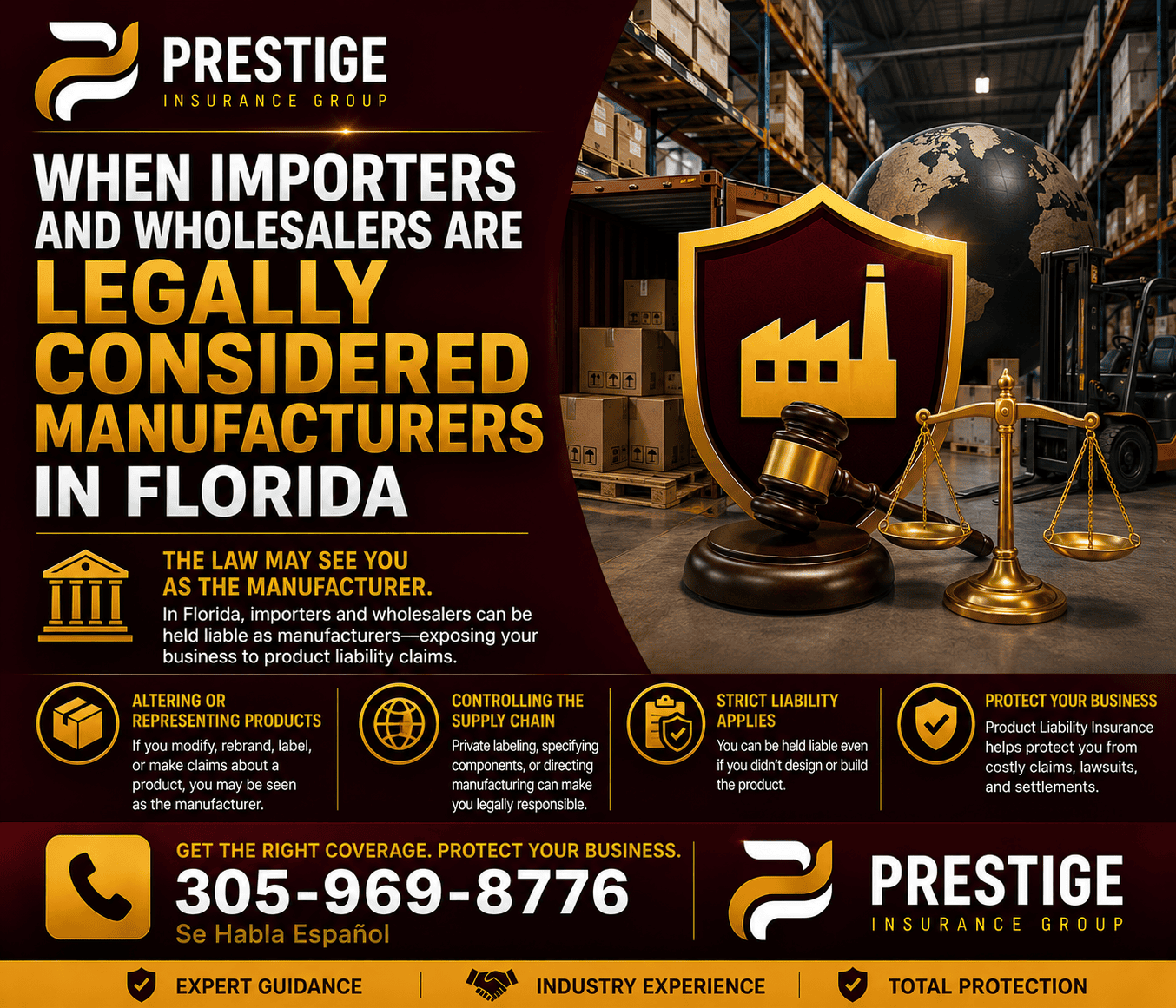
Florida law sees it differently. If your business imports a product manufactured overseas, puts your own brand name or label on it, and sells it as your own — you can be legally treated as the manufacturer for insurance and liability purposes, even though you never operated a production line.
At Prestige Insurance Group, we help importers, wholesalers, and private-label businesses throughout Florida understand this exposure and evaluate insurance solutions designed around it. Learn more about our Manufacturer Insurance solutions.
The Apparent Manufacturer Doctrine
This isn’t an informal industry assumption — it’s an established legal doctrine with real teeth. The “apparent manufacturer doctrine,” codified in Section 400 of the Restatement (Second) of Torts, states that “one who puts out as his own product a chattel manufactured by another is subject to the same liability as though he were its manufacturer.” Florida courts recognize this doctrine directly: a brand-name company that licenses its name or trademark to another manufacturer — or simply relabels a product made by someone else — can be held liable for defects in that product, even though it never touched the design or production process.
The doctrine originated more than a century ago, when retailers known as “house-branders” or “house-labelers” put their own name on goods manufactured by someone else. Courts recognized a basic fairness problem: if a company presents a product to the public as its own, the customer has no real way to identify the true manufacturer. It’s therefore considered fair to hold the company that concealed the true manufacturer’s identity to the same standard as if it had made the product itself.
How Courts Decide If You’re an “Apparent Manufacturer”
Courts generally apply what’s known as the “objective reliance test”: would an ordinary, reasonable consumer look at your product’s labeling, packaging, and advertising and reasonably conclude that your company manufactured it? If the answer is yes, your business can be held to the same liability standard as the actual factory that produced it — regardless of where that factory is located or how much control you actually had over production quality.
This test matters enormously for private-label businesses. Simply placing your label on an outsourced product, without any disclaimer identifying the actual manufacturer, is often enough to trigger apparent manufacturer liability.
The Stream of Commerce Doctrine Adds Another Layer
Florida businesses face a second, related legal framework worth understanding directly: the “stream of commerce” doctrine. This doctrine holds that any business participating in placing a product into the marketplace can be held legally responsible if that product causes harm — you do not need to have manufactured the product to be named in a lawsuit over it.
For Florida importers specifically, this means that if your company imports goods from a foreign manufacturer, you may be treated as the domestic face of that product for liability purposes. This is particularly significant given how many overseas manufacturers are difficult or effectively impossible for an injured consumer, or their attorney, to actually pursue — leaving the Florida-based importer as the practical target of a lawsuit even when the actual manufacturing defect occurred thousands of miles away.
Why This Matters More in Florida Specifically
Florida’s role as one of the largest import and export hubs in the country makes this exposure genuinely common rather than theoretical. Businesses importing products through Miami, Port Everglades, Jacksonville, and Tampa routinely relabel, repackage, or private-label goods manufactured overseas before distributing them throughout the United States. Florida Statute 768.81(1)(d) defines a “products liability action” broadly, covering damages caused by the “manufacture, construction, design, formulation, installation, preparation, or assembly of a product” — language broad enough to reach companies that participated in bringing a defective product to market, not exclusively the entity that physically assembled it.
Real Business Types That Face This Exposure
This isn’t limited to companies that formally call themselves manufacturers. Private-label brands selling products under their own name, regardless of who actually produced them, carry this exposure directly. Importers who are the first point of U.S. distribution for an overseas-manufactured product often become the practical defendant when the original manufacturer is difficult to locate or sue. Wholesalers and distributors who relabel or repackage products under their own branding take on similar exposure. And companies licensing their name or trademark to a third-party manufacturer can be held liable for defects even without ever touching the product physically.
Strict Liability Makes This Exposure Even More Significant
Florida applies strict liability principles to product liability claims, meaning an injured plaintiff does not need to prove negligence — only that the product was defective and that the defect caused their injury. This matters directly for apparent manufacturers: a private-label company facing a claim cannot necessarily defend itself simply by proving it exercised reasonable care, since strict liability doesn’t require the plaintiff to establish a breach of duty in the first place. The defect itself, combined with the company’s status as the apparent manufacturer, can be enough.
How Businesses Can Protect Themselves
The apparent manufacturer doctrine doesn’t mean private-label businesses are without options. Clear disclosure identifying the actual manufacturer on packaging and labeling can help reduce, though not eliminate, exposure under the objective reliance test. Carefully drafted indemnification and defense agreements with the actual overseas or domestic manufacturer can shift financial responsibility contractually, even when liability exposure remains legally shared. Verifying the actual manufacturer’s own insurance coverage, financial stability, and legal reachability matters directly — an indemnification agreement with a manufacturer that has no assets or is genuinely unreachable in a U.S. court provides limited real protection. And maintaining product liability insurance sized to reflect actual manufacturer-level exposure, not distributor-level exposure, is the most direct way to close the gap between the legal risk and the insurance program actually in place.
Why Standard Distributor Insurance May Not Be Enough
Many private-label importers carry general liability or distributor-level insurance without recognizing that their real legal exposure resembles a manufacturer’s, not a distributor’s. A distributor-level policy may carry lower limits, narrower product liability terms, or exclusions written with a pure pass-through distribution model in mind — not a business that Florida courts may treat as the apparent manufacturer of record. Reviewing coverage with this distinction specifically in mind is genuinely important, since discovering the gap during an active lawsuit is far more costly than addressing it in advance.
Frequently Asked Questions
Do I need to physically manufacture a product to be sued as its manufacturer? No. Under the apparent manufacturer doctrine and the stream of commerce doctrine, businesses that import, relabel, or brand a product as their own can be held to manufacturer-level liability standards.
Does a disclaimer on packaging eliminate this exposure? It may reduce exposure under the objective reliance test, but it does not automatically eliminate liability, particularly if the disclaimer isn’t prominent or clear.
Can I rely on an indemnification agreement with my overseas manufacturer instead of carrying manufacturer-level insurance? An indemnification agreement can help, but it’s only as strong as the manufacturer’s ability to actually pay and its reachability in U.S. courts — many businesses find this insufficient on its own.
Does Florida require proof of negligence in these cases? No. Florida applies strict liability to product liability claims, meaning a plaintiff only needs to show the product was defective and caused harm, not that the apparent manufacturer was negligent.
What types of businesses does this affect most? Private-label brands, importers who are the first U.S. point of distribution, and wholesalers or distributors who relabel or repackage products under their own name all face this exposure directly.
Protecting Your Business From Manufacturer-Level Exposure
If your business imports products manufactured overseas and sells them under your own label, understanding that Florida law may treat you as the legal manufacturer — not simply the distributor — is one of the most important insurance decisions you can make before a claim ever arises.
Prestige Insurance Group helps Florida importers, wholesalers, and private-label businesses evaluate insurance solutions sized to their real legal exposure, not just their operational role.
Contact Prestige Insurance Group today to discuss manufacturer-level insurance protection for your import or private-label business:
Miami: 305-969-8776 Orlando: 407-993-2331
Se Habla Español.