


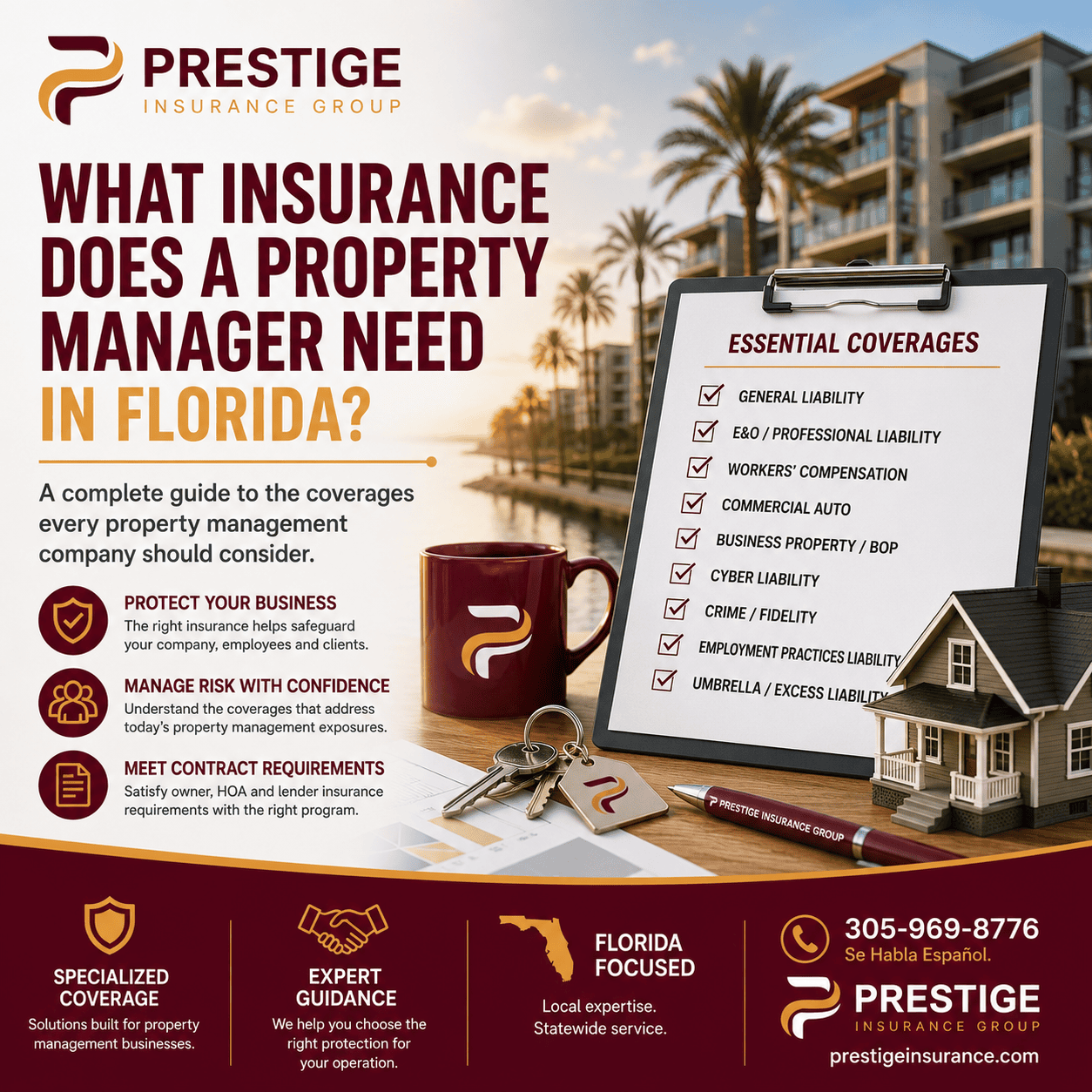
What Insurance Does a Property Manager Need in Florida?
Property management isn’t one business — it’s several different ones that happen to share a job title. One Florida property manager might run a small office overseeing fifty single-family rentals for individual investors. Another might manage several thousand apartment units with leasing staff, maintenance employees, and company vehicles. A third specializes in HOAs and condominium associations. A fourth manages vacation rentals for owners scattered across the country.
All of them are “property managers.” None of them necessarily need the same insurance program. Coverage should follow the actual operation — what’s managed, what services are performed, whether there are employees, whether the company handles client money — not just the words on a business application.
Two Separate Insurance Questions
The most common misunderstanding is treating property manager insurance as protection for the buildings being managed. It isn’t, and that’s worth being precise about: the building owner needs insurance protecting the real estate itself — commercial property, general liability, loss of income. The management company needs insurance protecting its own business and the responsibilities it takes on managing property for someone else.
Those are genuinely separate questions. A well-insured building doesn’t protect the manager from an allegation that it mishandled a lease or missed a maintenance recommendation. And the manager’s own policy doesn’t insure the building it manages. Confusing the two is where a lot of coverage gaps start.
Exposure Changes With the Business Model
Long-term residential management creates mostly professional exposure — leasing, screening, rent collection, maintenance coordination, financial reporting to owners. Most of the serious claims here trace back to decisions, not accidents: did the manager respond appropriately, was a lease deadline missed, was the owner kept informed.
Apartment management adds a physical, operational layer on top of that professional one. Employees may work on-site daily; maintenance staff enter units; residents and visitors use common areas constantly. That means professional and operational claims can happen simultaneously and involve completely different coverage.
HOA and condominium management changes who the client actually is — not one owner, but a volunteer board representing an entire community. That creates its own friction points around what authority belongs to the board versus what’s been delegated to management, and the management agreement needs to draw that line clearly.
Short-term rental management compresses everything. New guests every few days instead of one tenant per year means faster response expectations, more frequent vendor visits, and less room for delay when something goes wrong.
Commercial property management brings more sophisticated leases, more expensive building systems, and often contractual insurance requirements imposed by the client — specific liability limits or additional insured status written into the management agreement itself, which needs review before signing, not after a claim reveals the company’s policy can’t actually satisfy it.
The Core Coverage a Property Manager Should Actually Consider
General Liability covers the operational side of the business — bodily injury, property damage, and related claims arising from the company’s own operations, like a visitor injured at the leasing office. It’s foundational, but it’s not “slip-and-fall insurance” in a broader sense than that — it doesn’t cover allegations about how a professional decision was made.
Errors & Omissions (Professional Liability) is where those professional-decision allegations land — a missed inspection, mishandled lease administration, a maintenance recommendation that went unheeded. This is arguably the most important policy for most property managers precisely because so much of the job is decisions rather than physical labor, and the exposure exists even when nobody was hurt and nothing was damaged — a purely financial allegation is still a real claim. We go into this coverage in much more depth in our dedicated E&O guide for Florida property managers, including the claims-made structure and why retroactive dates matter when switching carriers.
Workers’ Compensation becomes relevant the moment the company has employees — and the classification should reflect what those employees actually do. An office-based leasing agent and a maintenance technician performing plumbing and electrical repairs represent very different exposure, even at the same company. Companies that gradually let in-house maintenance staff take on more complicated work than they started with should revisit this classification, since the operation may no longer match what the carrier originally underwrote.
Commercial Auto matters for company-owned vehicles; Hired and Non-Owned Auto matters when employees use personal vehicles for property visits and inspections — which is common even at companies that own no vehicles at all. An accident doesn’t stop being an auto claim just because the employee was driving to inspect a managed property.
Cyber Liability has become close to unavoidable given how much of the business — applications, leases, owner banking details, rent payments — moves through electronic systems now. Coverage should match what the company actually holds and depends on, and it should sit behind real security practices (multifactor authentication, payment-verification procedures for any changed banking instructions) rather than substitute for them.
Crime/Fidelity coverage addresses a different problem than E&O: employee theft and dishonesty specifically, as opposed to an honest professional mistake. This distinction matters more for companies handling substantial client funds — rent, deposits, owner reserves — where the policy needs to be reviewed specifically for how it treats money that belongs to someone else, not just the company’s own property.
Employment Practices Liability (EPLI) becomes more relevant as headcount grows — discrimination, harassment, retaliation, and wrongful termination allegations are a different category entirely from tenant or owner disputes, and they scale with the number of hiring, disciplinary, and termination decisions a growing company makes.
Business property coverage protects what the management company itself owns — office computers, furniture, equipment — which is easy to overlook given how much attention goes to managed buildings. It’s worth being clear this doesn’t extend to any property being managed for a client; that’s the owner’s responsibility.
Umbrella or Excess Liability adds limits above the underlying policies once a company’s size, contracts, or claim severity outgrows its base limits — but it’s worth confirming exactly which underlying policies the umbrella actually sits over. E&O, cyber, crime, and EPLI often need their own limits or separate excess arrangements rather than being automatically covered by a general umbrella.
Additional Insured Status Isn’t a Substitute for Your Own Policy
Property owners sometimes add the management company as an additional insured under their own liability coverage — genuinely useful when structured properly, but easy to over-rely on. That status doesn’t turn the owner’s policy into the manager’s complete insurance program; the management company still has its own employees, professional services, technology, and financial exposures that one client’s policy was never designed to cover. And a company with dozens or hundreds of clients can’t realistically depend on each individual owner’s coverage as its risk-management strategy — it needs its own program, with additional-insured relationships as a supplementary layer where appropriate.
Vendor Insurance Is Part of the Program Too
Property managers coordinate a lot of outside contractors, and every one of those relationships is a point where the manager’s judgment can get questioned later — if a contractor causes damage, the next question is usually why that contractor was hired. Verifying appropriate insurance for the work being performed, and documenting that verification, is what separates “we hired a qualified, insured contractor and it still went wrong” from “we never checked.” It’s worth being precise, too: a contractor’s insurance protects the contractor’s exposure, not the property manager’s — each party in the relationship needs its own coverage doing its own job.
Contracts Can Require More Than the Law Does
Whether a particular coverage is legally required is only one part of the question. Client contracts, lender requirements, and management agreements often impose their own insurance obligations — specific limits, additional insured status, particular endorsements — independent of any statutory minimum. The more useful question isn’t “is this legally required,” but “does the actual exposure in this business justify carrying it, regardless of what’s mandated.”
Insurance Should Grow With the Business — Deliberately, Not by Accident
Coverage gaps rarely open because someone deliberately under-insured. They open gradually: a company starts managing vacation rentals without updating the carrier, maintenance employees take on more complicated repairs than originally described, staff start driving personal vehicles regularly for work without anyone flagging hired/non-owned auto, client fund volume grows past what the crime policy contemplated, or the portfolio expands into commercial properties while the E&O policy still describes a residential-only operation. None of these individually looks dramatic. Together, they can leave real exposure uninsured.
An annual review is the right moment to catch this — not just checking whether revenue or payroll changed, but asking what actually changed operationally: new employees, new vehicles, new property types, new geographic markets, new contractual requirements from a major client. That’s a more useful question than simply renewing last year’s policy.
The Bottom Line
There’s no single insurance package that fits every Florida property manager, because “property manager” describes several genuinely different businesses. The right starting point is describing the operation accurately — what’s managed, what services are actually performed, who’s employed and what they do, how much client money moves through the company, and what contracts require — and building coverage around that rather than a generic checklist.
Prestige Insurance Group works with Florida property managers — from small residential operations to firms managing apartment communities, HOAs, commercial properties, and vacation rentals — to build insurance programs around how each business actually operates. Call 305-969-8776 or request a quote online to have your property management insurance program reviewed, or contact our Miami office directly.