


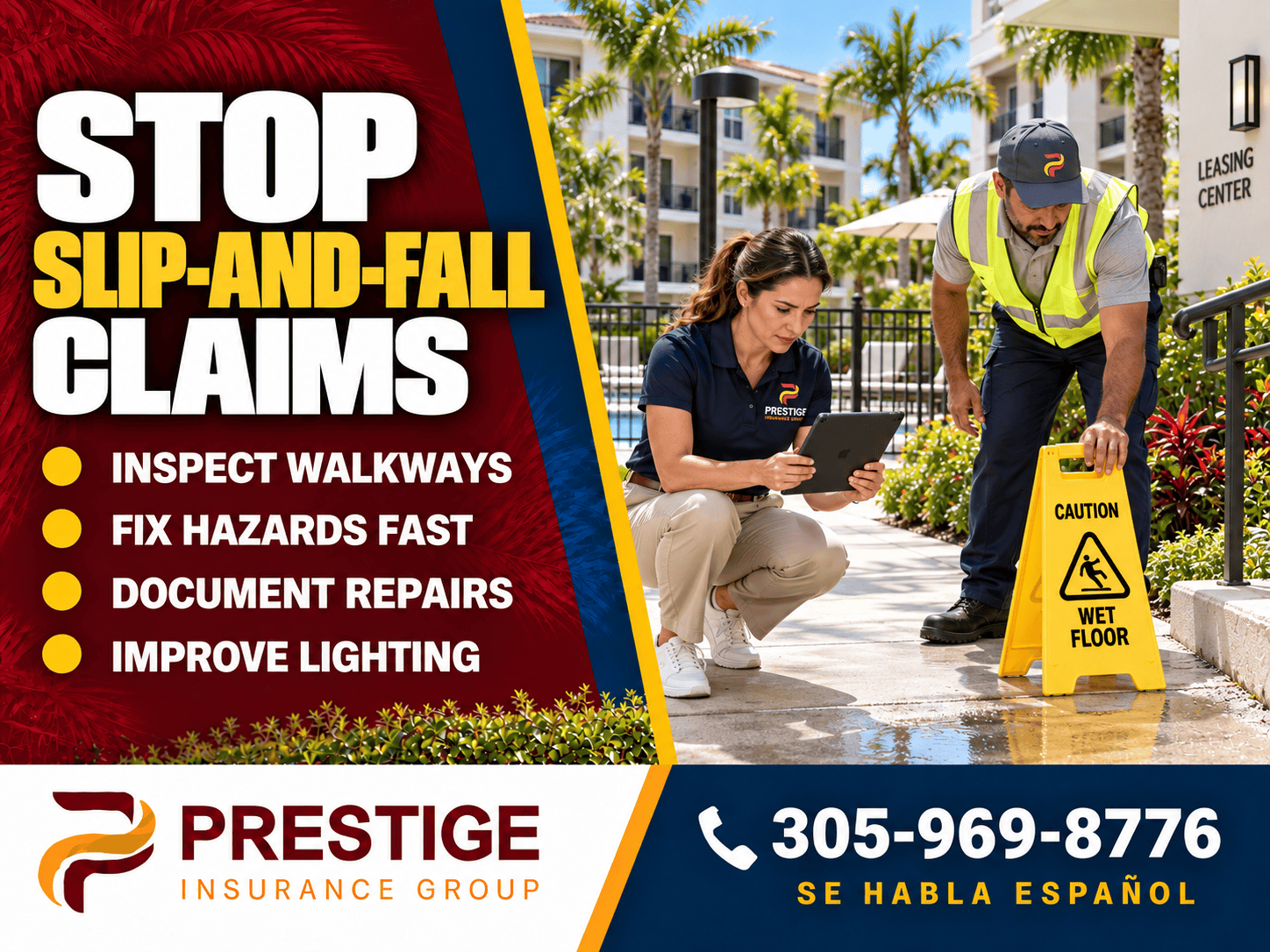
Slip-and-fall accidents are easy to dismiss as routine premises liability claims until one occurs at an apartment community, condominium association, retail property, or other building under professional management. A wet lobby, slippery pool deck, recently cleaned hallway, worn stair surface, leaking air-conditioning system, or water tracked through an entrance can quickly turn into an injury allegation involving the property owner, property manager, maintenance contractor, or several parties at the same time.
For Florida property managers, the issue is larger than simply carrying General Liability insurance. Insurance is an important financial protection, but it does not replace the procedures a property management company uses to identify hazards, correct problems, document maintenance, and demonstrate what was being done before an accident occurred.
This distinction becomes particularly important after a serious injury. Months or years later, the question may no longer be whether a floor looked slippery. Attorneys, insurers, experts, and property owners may be examining inspection records, maintenance logs, photographs, cleaning procedures, incident reports, contractor agreements, and other evidence to determine what happened and how the property was being managed.
That makes slip-and-fall prevention both a safety issue and a risk-management issue.
In Florida, the Question Is Usually What You Knew
There’s a specific reason documentation carries so much weight in these cases, and it’s worth understanding before building a program around it.
For a fall caused by a transitory foreign substance — something on the floor or the walkway that shouldn’t have been there — Florida law requires the injured person to prove the business had actual or constructive knowledge of the condition and should have corrected it. Constructive knowledge is generally established by showing the condition existed long enough that it should have been discovered, or that it occurred regularly enough to be foreseeable.
That standard is why timestamps matter. An inspection log showing a walkway was checked twenty minutes before a fall answers the central question in the case. No log at all leaves the claimant’s version of the timeline unopposed. Our article on liability insurance for shopping centers covers how that standard plays out in a claim.
Everything below is, in effect, a way of being able to answer that question.
Why Florida Properties Have Significant Slip-and-Fall Exposure
Florida creates an unusual combination of conditions for property managers. Heavy rain can bring substantial amounts of water through building entrances within minutes. Pool areas and exterior walkways are routinely exposed to moisture. Humidity and condensation can contribute to wet surfaces. Landscaping irrigation can affect sidewalks and common areas. Restaurants and retail tenants can create additional pedestrian traffic and spill exposures.
Different flooring materials can also behave very differently when wet. A surface that provides adequate traction under dry conditions may perform differently after water, cleaning products, grease, contaminants, or other substances are introduced. A floor can also change over time because of wear, maintenance practices, coatings, polishing, or remediation.
This is why walking through a property and deciding that a floor doesn’t seem slippery is not a risk-management program. Property managers should think about the entire environment in which residents, guests, employees, contractors, and members of the public move through the property.
Entrances, elevators, stairways, parking garages, breezeways, laundry rooms, pool areas, clubhouses, mailrooms, trash areas, bathrooms, commercial tenant spaces, and pedestrian routes between buildings can all present different conditions.
Documentation Can Become Critical After a Claim
One of the most valuable things a property management company can have after an accident is a clear record of what occurred before and after the incident.
Consider two properties with identical slip-and-fall allegations. At the first, management cannot locate inspection records. Nobody remembers when the area was last inspected. Maintenance procedures were informal. There are no photographs of the area before the accident, and employees disagree about who was responsible for checking it.
At the second, management can produce documented inspection procedures, maintenance records, employee responsibilities, vendor agreements, photographs, corrective-action records, and an incident report showing what was found immediately after the accident.
Those circumstances can create very different claims environments even when the alleged injuries are similar. Documentation does not guarantee that a lawsuit will be prevented or successfully defended, but it provides evidence when the circumstances surrounding a claim are investigated.
Property managers should therefore treat documentation as part of everyday operations rather than something created only after an accident occurs.
Floor Testing Can Provide Objective Information
Some property owners and managers go beyond visual inspections by using professional floor-safety testing.
Instead of relying on someone’s subjective opinion about whether a surface feels slippery, specialized equipment can measure characteristics associated with the slip resistance of a walking surface under specified testing conditions. Methods used by qualified floor-safety professionals can include equipment such as the British Pendulum and BOT-3000E.
The important concept for a property manager is not the name of a particular machine. It is the difference between an undocumented assumption and a measurable process.
Professional testing may help establish baseline information, identify surfaces requiring further attention, evaluate conditions after remediation, or document part of a broader walkway-safety program. When remediation is performed, re-testing can provide additional information about the condition of the surface afterward.
Testing should be performed and interpreted by appropriately qualified professionals using applicable procedures and standards. Property managers should also avoid assuming that one successful test eliminates premises liability or guarantees that an accident cannot occur. Floor testing is one component of a broader program, not a substitute for it.
A Strong Program Goes Beyond Testing
Slip-and-fall prevention should not become a situation where management tests a floor once, files the report away, and assumes the problem has been solved.
Properties change constantly. Rain comes through entrances. Residents spill liquids. Vendors perform work. Cleaning products change. Flooring ages. Pool traffic increases. Roof or plumbing leaks occur. Air-conditioning equipment creates condensation. Landscaping contractors operate irrigation systems. Mats move, become saturated, or deteriorate.
A useful walkway-safety program therefore combines physical inspections, maintenance procedures, employee responsibilities, hazard reporting, corrective action, documentation, and appropriate professional assistance.
Employees should know who is responsible for inspecting common areas and what happens when a hazardous condition is discovered. A problem should not remain unresolved because one employee assumed another was handling it. When an immediate repair is impossible, management should have procedures for protecting or restricting the affected area while a permanent correction is arranged.
Cleaning Procedures Deserve Particular Attention
Cleaning is intended to make a property safer and more attractive, but improper cleaning procedures can create their own problems.
Different flooring materials may require different products, concentrations, equipment, and maintenance techniques. Residue can affect a surface, and using an inappropriate product may alter how a floor performs. Cleaning an area during heavy pedestrian traffic creates temporary exposure while the surface remains wet.
Property managers should understand what their janitorial contractors are using and whether those procedures are appropriate for the flooring being maintained.
Contracts with cleaning and maintenance vendors also deserve careful review from an insurance standpoint. Property managers should obtain appropriate Certificates of Insurance and determine whether the vendor insurance requirements established by the property owner or management agreement are actually being followed.
A certificate alone should not be treated as proof that every contractual requirement or potential claim is covered. The underlying policies, endorsements, contractual obligations, additional insured requirements, and indemnification provisions all matter. Our article on why apartment buildings require vendor certificates of insurance covers what a certificate actually proves and what it doesn’t.
What Happens When Someone Actually Falls?
Even a well-maintained property can experience an accident. When one occurs, the actions taken immediately afterward may become important.
Management should have an established incident-response procedure so employees are not improvising during a stressful situation. Appropriate medical assistance should be requested when necessary, and the immediate area should be evaluated for conditions requiring attention.
The circumstances should also be documented promptly. Depending on the situation, that may include photographs or video of the area, weather conditions, the condition of the walking surface, witness information, surveillance footage, maintenance history, inspection records, and information concerning employees or contractors working in the area.
Existing surveillance video should be preserved when appropriate rather than allowing a normal recording system to overwrite potentially relevant footage. This is one of the most common and most costly failures after an incident, because systems overwrite on a loop measured in days while a claim can surface months later.
Employees should document facts rather than speculate about fault. Determining legal responsibility is not the job of the employee completing an incident report. Serious incidents should also be reported promptly in accordance with the applicable insurance policy and the organization’s established procedures.
Property Managers and Owners Need Clear Responsibilities
Property managers frequently operate buildings they do not own, which creates another layer of complexity.
The management agreement should establish responsibilities for maintenance, inspections, repairs, vendor management, and insurance. When management identifies a condition requiring capital improvements or owner authorization, communication with the property owner should be documented.
This becomes especially important when a property manager recommends a repair and the owner delays or declines the work.
A documented escalation process can be particularly valuable in these circumstances. Known hazards should not disappear into telephone conversations, text messages, or assumptions about who was supposed to handle the problem.
Property managers should also understand where their responsibilities end and those of the owner, association, tenant, maintenance contractor, or other vendor begin. Those distinctions can become extremely important after an accident. Our article on property manager insurance requirements for Florida apartments covers how those agreements should be written.
Insurance Is the Backstop, Not the Safety Program
Property managers should carry insurance appropriate for the services they perform and the contracts they enter into.
General Liability is particularly important for bodily injury and premises-related allegations, but it should not be viewed in isolation. Depending on the operation, a property management company may also need Professional Liability and E&O, Workers’ Compensation, Commercial Auto, Cyber Liability, Employment Practices Liability, Crime and Fidelity coverage, and Umbrella or Excess Liability.
Property owners and associations have their own insurance requirements as well.
The exact structure depends on who owns the property, who controls the premises, what the management agreement requires, the types of properties being managed, employees, vehicles, vendors, and other exposures.
More importantly, insurance does not make poor risk management irrelevant. When a serious slip-and-fall claim occurs, an insurer may have to defend an allegation even when the property manager ultimately did nothing wrong, and on most general liability forms those defense costs are paid in addition to the limit. Organized documentation and established procedures provide valuable information to the people responsible for investigating and defending the claim.
Creating a More Defensible Risk-Management Culture
The strongest property management operations treat risk management as an ongoing process rather than a checklist completed once a year.
Employees understand their responsibilities. Inspections actually occur. Problems are documented. Vendors are monitored. Known hazards are escalated. Repairs are followed through. Incident information is preserved. Management periodically reviews whether its procedures are actually working.
For certain properties, professional walkway assessment and measurable floor testing may add another layer of information to that process.
The objective is not to create a property where nobody can ever fall. No property manager can guarantee that.
The objective is to establish a consistent process for identifying foreseeable problems, responding appropriately, and maintaining records showing what the organization was doing to manage its premises exposure. When the question later becomes what you knew and when, those records are the answer.
For Florida apartment communities, commercial properties, condominium associations, HOAs, hotels, restaurants, and mixed-use properties, that approach is far more valuable than waiting until an attorney’s letter arrives to start reconstructing what happened.
Insurance for Florida Property Management Companies
Prestige Insurance Group works with Florida property managers and real estate businesses to evaluate insurance programs based on their actual operations, contracts, properties, employees, and liability exposures.
We can review General Liability, Professional Liability and E&O, Workers’ Compensation, Cyber Liability, Employment Practices Liability, Crime and Fidelity, Commercial Auto, Umbrella, and other coverage that may be appropriate for a property management operation. Learn more on our Property Manager Insurance page.
To review your program, contact Prestige Insurance Group:
Miami 305-969-8776 · Orlando 407-993-2331 · Stuart 772-247-3788
Se Habla Español.
Related Reading
-
Property Manager Insurance Requirements for Florida Apartments
-
Why Apartment Buildings Require Vendor Certificates of Insurance
-
Who Is Liable for Vendor Injuries at Apartment Buildings in Florida?
This article is for general informational purposes only and is not legal advice. Florida premises liability law, testing standards, and contractual obligations vary and change over time; consult a qualified Florida attorney about your procedures and any specific incident, and refer to your policy for the terms that apply to your operation. Prestige Insurance Group, Florida agency license L057894.