


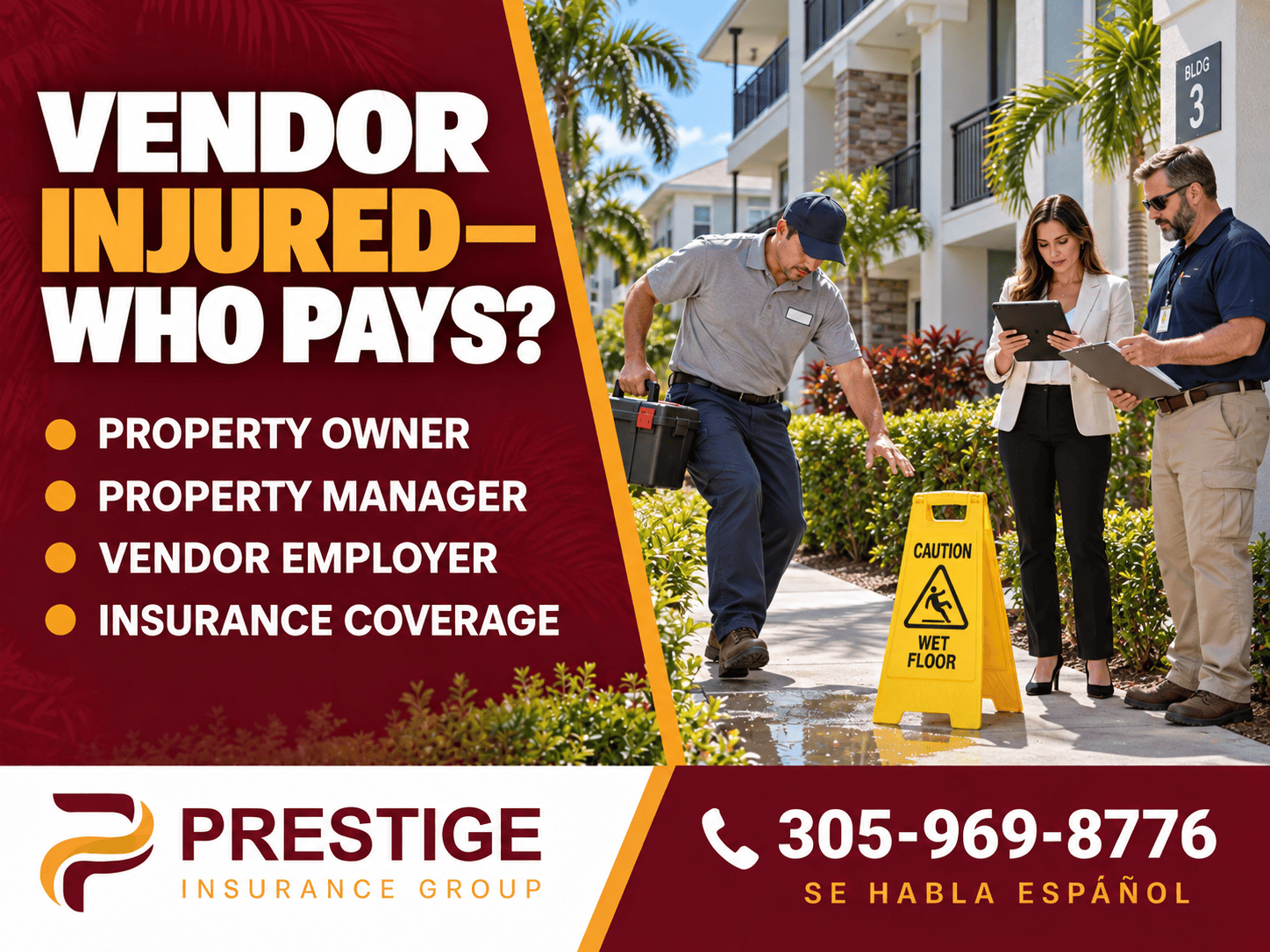
A roofer falls from a ladder at a Hialeah apartment building on a Tuesday morning. He set the ladder himself, on a surface he chose, doing work the owner had no part in directing. Eight months later the owner is named in a lawsuit alleging that the walkway was uneven, that the lighting near the service entrance was inadequate, and that the owner knew about both.
That is how vendor injury claims usually arrive at an apartment building. The vendor’s own conduct is rarely the question the owner ends up answering.
For the coverage foundation this article builds on, see our Apartment Building & Habitational Insurance resource.
Being Named in a Lawsuit and Being Legally Responsible Are Different Questions
This is the distinction that matters most. A vendor’s own negligence — using a ladder improperly, mishandling equipment, ignoring a known hazard specific to their own work — doesn’t automatically shield the property owner from being named in the resulting claim. Injured workers commonly allege that the property itself contributed to the accident: inadequate lighting, an unsafe walking surface, a hazardous condition the property owner knew or should have known about, or inadequate supervision of the work being performed.
Whether those allegations hold up is a separate question from whether they get filed. Even a claim that ultimately fails requires a real defense first, which is where the general liability policy’s duty to defend does most of its work in an ordinary year. On most commercial general liability forms, defense costs are paid in addition to the limit rather than eroding it.
Property Condition Is Often the Actual Point of Contention
Vendor injury lawsuits at apartment buildings frequently center less on the vendor’s own conduct and more on the condition of the property they were working on. Poor lighting in a stairwell, an unmarked hazard near a work area, a walkway that wasn’t properly maintained, or a failure to warn a vendor about a known dangerous condition can all become the basis for a premises liability claim against the property owner — independent of whatever the vendor themselves did or didn’t do correctly.
The defense is built the same way it is for a tenant fall: documented inspection routines, maintenance logs, work orders showing that reported conditions were corrected and when, and photographs. An owner who can show the walkway was inspected on a schedule and repaired when a problem was found is in a very different position from one relying on recollection.
Florida’s comparative negligence rules matter here too. A claimant found more than half at fault recovers nothing, and any recovery is reduced by their share of fault. For a vendor injury, the vendor’s own conduct — how the ladder was set, whether equipment was used properly, whether a known hazard was disregarded — is precisely the evidence that reduces or defeats the claim, and it comes from the incident report and any footage taken at the time.
Independent Contractor Status Doesn’t Eliminate the Owner’s Exposure
Property owners sometimes assume that because a vendor is an independent contractor rather than an employee, the owner bears no responsibility for what happens to that contractor on the property. That assumption oversimplifies a genuinely complex area of premises liability law. An owner can still face liability for hazardous conditions on the property itself, for failing to warn a contractor about known dangers, or for exercising enough control over how the work was performed that a court treats the relationship differently than a truly independent arrangement. Contractor classification affects the analysis — it doesn’t eliminate it.
A Vendor Without Proper Workers’ Compensation Creates a Different, Larger Problem
If an injured vendor was genuinely covered by their own employer’s workers’ compensation insurance, that coverage is often the primary avenue for the injury claim, which can meaningfully limit the property owner’s direct exposure. But if the vendor was improperly classified, uninsured, or working through an unlicensed subcontractor with no coverage of their own, the injured worker may have significantly more reason to pursue the property owner and manager directly — since there’s no workers’ compensation system standing between the injury and a lawsuit against whoever else was present.
There is a second consequence owners rarely anticipate. Florida’s workers’ compensation system can treat an uninsured subcontractor’s employees as the statutory employees of the party above them in the chain, which is why general contractors verify coverage so carefully. For an apartment owner hiring trades directly, the practical lesson is the same: an uninsured vendor is not simply a vendor without insurance, it is a vendor whose injured workers have to look somewhere, and the owner is the nearest party with assets.
This is also where exemptions cause trouble. A one-person vendor operating under a workers’ compensation exemption is not insured for their own injuries, so a certificate showing an exemption is not the same as a certificate showing coverage. It’s worth knowing which one you have on file.
Certificates of Insurance Are Evidence, Not a Substitute for Verification
A certificate of insurance shows that a policy existed at a point in time — it doesn’t guarantee the coverage was still active on the date of an incident, that limits were adequate, or that the policy actually included the protections the property manager assumed it did.
Before a vendor begins work, the certificate should be checked against actual policy dates and limits, and the vendor agreement should specify what’s actually required: general liability insurance, workers’ compensation for the vendor’s own employees, and additional insured status naming the property owner and manager on the vendor’s own policy, ideally with primary and non-contributory wording and a waiver of subrogation. Additional insured status is what actually extends some of the vendor’s coverage to protect the property owner; the certificate alone doesn’t do that.
Tracking matters as much as collecting. Policies renew, carriers change, and a certificate gathered when a vendor was first engaged says nothing about whether coverage was in force on the day of an incident two years later. Requirements should also scale with the work — a landscaper and a roofer do not present the same exposure and should not carry identical limits.
Hold-Harmless Agreements Support Risk Transfer, but They’re Not a Complete Solution
A written vendor agreement including hold-harmless or indemnification language can shift some financial responsibility toward the vendor when their own negligence causes an injury, and that’s a genuinely useful risk-management tool. But this kind of contractual language has real limits — it generally can’t fully insulate a property owner from liability for the property’s own condition, and it’s only as valuable as the vendor’s actual ability, and insurance, to make good on it. A hold-harmless clause backed by an uninsured vendor is largely symbolic.
Larger and Older Properties Carry More of This Exposure, for Predictable Reasons
Larger apartment communities simply have more ongoing vendor activity — routine maintenance, larger common areas, more building systems requiring service — which creates more total opportunities for a vendor injury to occur. Older buildings compound this: aging stairways, older electrical and plumbing systems, and more frequent repair work all increase both the volume of vendor visits and the likelihood that a property condition genuinely contributes to an incident. Neither of these is a reason to avoid vendor work, but both are reasons to apply more consistent vendor-verification discipline as a property’s size or age increases.
General Liability and Umbrella Coverage Respond to Different Layers of This Exposure
General liability insurance is the primary coverage responding to a vendor injury claim naming the property owner or manager, addressing defense costs and covered settlements or judgments up to the policy limit. Given how quickly a serious injury claim’s value can exceed a standard underlying limit, commercial umbrella coverage deserves real consideration for larger properties, older buildings, or operations with heavier ongoing vendor and contractor activity — it provides additional limits above the underlying policy rather than replacing it, and it generally follows the underlying policy’s exclusions.
When a Vendor Is Injured on the Property
The first hour shapes the claim. Get medical help if it’s needed, then photograph the area and the conditions before anything is moved or repaired, including lighting and the work area itself. Take a written incident report with the date, time, exact location, what the vendor was doing, and the names of anyone who saw it. Preserve any camera footage immediately rather than leaving it on a system that overwrites. Report the incident to your carrier even if nobody has claimed an injury, because these claims routinely arrive many months later.
Then pull the vendor’s file — the agreement, the certificate, and the additional insured endorsement — because the tender to the vendor’s carrier is only as good as the documentation behind it.
What This Means for Building the Right Program
Vendor injury exposure at an apartment building is managed through a combination of consistent contract practices — verified certificates, appropriate additional insured requirements, written agreements — and adequate insurance limits sized to the property’s actual size, age, and vendor activity level. Neither piece alone is sufficient; a property with excellent vendor documentation but inadequate liability limits, or strong insurance but no consistent vendor verification process, is only partially protected.
Prestige Insurance Group helps Florida apartment owners and property managers evaluate liability coverage against their actual vendor and contractor exposure. To review coverage for vendor-related liability at an apartment building, contact Prestige Insurance Group:
Miami 305-969-8776 · Orlando 407-993-2331 · Stuart 772-247-3788
Se Habla Español.
Related Reading
This article is for general informational purposes only and is not legal advice. Florida premises liability, workers’ compensation, and contractor classification law is complex and changes over time; consult a qualified Florida attorney about your vendor agreements and any specific incident, and refer to your policy for the terms that apply to your property. Prestige Insurance Group, Florida agency license L057894.