

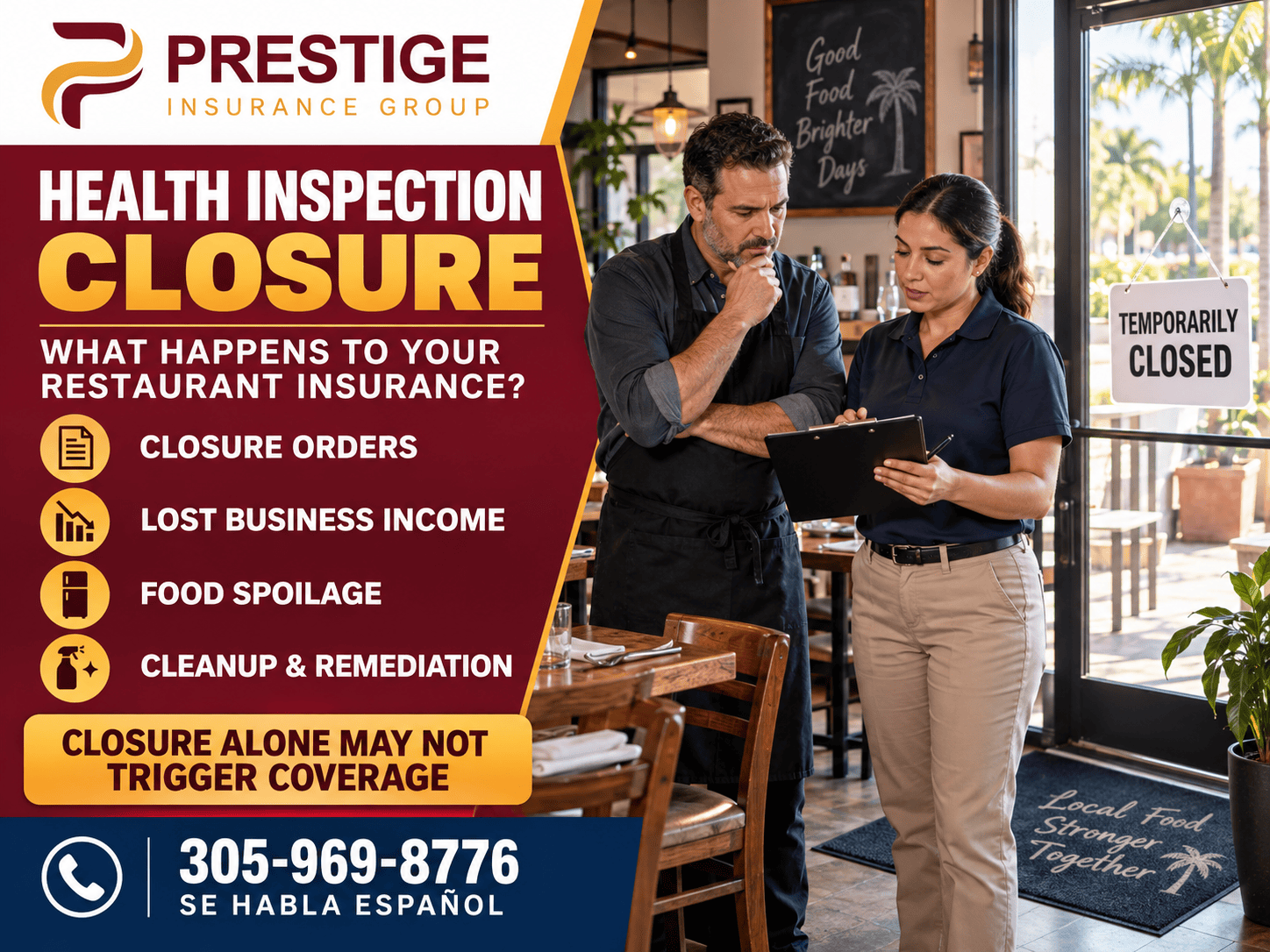
An inspector walks into a kitchen in Hialeah on a Thursday morning and finds a cooler holding at fifty-two degrees, a hand sink blocked by a stack of sheet pans, and evidence of roaches.
The restaurant is ordered closed the same day. It reopens the following Tuesday after a re-inspection.
Five days of no revenue, a weekend gone, staff paid or lost, and a public record of the closure that shows up when anyone searches the name.
The owner calls his agent to see what the policy does. The answer is almost certainly nothing, and understanding why is the first step toward the coverage that would help.
Business Income Requires Physical Damage
This is the provision that decides it.
Business income coverage responds when a covered cause of loss causes direct physical damage to the property, and that damage suspends operations. Fire, a burst pipe, wind — those are physical damage events, and the policy pays the income lost while the property is repaired.
A health department closure involves no physical damage. Nothing burned, nothing broke, nothing was destroyed. The premises are physically fine and legally unusable, and a standard business income form does not contemplate that.
The same logic explains why a power outage at the utility, a road closure, or a public health order also fall outside the standard form. The trigger is physical damage at your location, and most closures are not that.
Where Coverage Does Exist
Three places, and each has conditions.
Spoilage and equipment breakdown. If the closure followed a refrigeration failure, the equipment breakdown coverage responds to the mechanical failure and spoilage coverage responds to the product lost. Those are real and they are frequently missing from restaurant programs. Note the sequence, though — this pays for the food and the compressor, not for the days closed.
Utility services interruption, where an off-premises power or water failure caused the problem. The endorsement extends coverage to failures at the utility rather than at your building, and it typically comes in two parts: direct damage covering spoiled product, and a time element covering lost income. Read whether your form excludes overhead transmission lines, because in Florida that exclusion removes much of the reason to carry it.
Contamination or food-borne illness coverage. Some carriers offer an endorsement specifically for closures ordered by a health authority following contamination, illness, or the discovery of a communicable condition. It is not standard, it is not available everywhere, and for a restaurant it is the one product actually written for this problem. Ask for it by name.
What Actually Closes Restaurants
The violations that produce emergency closures in Florida are consistent, and most are systems rather than accidents.
Temperature control. Coolers and walk-ins holding above safe temperature, hot holding below it, improper cooling of cooked product. This is the single most common serious finding and it is usually equipment plus process rather than negligence in the moment.
Vermin. Roaches and rodents, where evidence of activity rather than a single sighting triggers action.
Hand washing and sanitation. Blocked or missing hand sinks, no hot water, no soap or towels.
Sewage and plumbing. Backups, cross-connections, and anything that puts waste water near food or surfaces.
No certified manager on duty, which is an administrative finding that can still stop service.
None of those is insurable. All of them are manageable, and the management is what keeps the closure from happening.
What Reduces the Risk
Log temperatures, and keep the logs. Coolers, walk-ins, hot holding, and cooling. Twice a day, written down, with a name attached. This is the single most useful habit in a restaurant kitchen and it serves three purposes at once — it catches equipment failing before it fails, it demonstrates a process to an inspector, and it defends a foodborne illness claim if one ever arrives.
Service the refrigeration on a schedule rather than when something goes wrong. A walk-in that has been drifting for weeks fails on the busiest night, and the inspector arrives the next morning.
Have a pest control contract and keep the service reports. Reactive treatment after evidence is found is a much worse position than a documented program.
Keep a certified food manager on every shift, not on the schedule.
Self-inspect using the state’s own criteria. The inspection form is public. Walking the kitchen against it monthly finds what the inspector would find, while you can still fix it.
Know your re-inspection path. If a closure happens, the speed of reopening depends on how quickly the corrections are made and documented. That is a process worth understanding before you need it.
Reputation Is the Longer Cost
Florida inspection results are public and searchable, and closures get picked up by local news and by review platforms.
The five days of lost revenue are recoverable. A search result showing an emergency closure, sitting on the first page of your restaurant’s name for months, is a different kind of damage — and no insurance product addresses it.
The response that works is speed and visibility: correct everything, reopen fast, and be straightforward about it publicly rather than hoping nobody notices.
What Restaurant Owners Should Confirm
-
Does your business income coverage require physical damage, and do you understand what that excludes?
-
Do you carry equipment breakdown and spoilage separately?
-
Do you carry utility services interruption, and does it exclude overhead transmission lines?
-
Is contamination or food-borne illness coverage available from your carrier?
-
Are temperature logs kept, signed, and retained?
-
Is refrigeration on a service schedule?
-
Do you have a pest control contract with retained service reports?
-
Is a certified food manager on every shift?
-
When did you last self-inspect against the state’s criteria?
Restaurant Insurance in Florida
Prestige Insurance Group works with restaurants across Miami, Hialeah, Coral Gables, Doral, Fort Lauderdale, Orlando, and Tampa, from neighborhood operations to full-service and fine dining.
If you want to know what your policy would actually do during a closure, send the declarations page. Whether business income requires physical damage, and whether anything on your program responds without it, takes a few minutes to answer.
Call the office nearest you. Se habla español.
Miami: 305-969-8776 Orlando: 407-993-2331 Stuart: 772-247-3788
General information only, not legal advice, and not food safety guidance. Coverage forms, endorsements, and availability vary by carrier and by policy. Florida food service inspection requirements and enforcement procedures are administered by the applicable state agency and are subject to change; confirm current requirements with that agency. Refer to your actual policy for the terms that apply to your business.