
A grease fire starts at one stall in a Wynwood food hall on a Saturday night. It is contained to that stall. Nobody is hurt, and fourteen other vendors have no damage at all.
The hall closes for five weeks.
Those fourteen operators have intact equipment, intact inventory, and no revenue. Their business income coverage requires direct physical damage to their property, and there was none. Most of them discover this in week two.
Food halls concentrate a set of exposures that neither a restaurant policy nor a retail policy was designed for, and the gaps sit in the same places every time.
Your Loss Can Start at Someone Else’s Stall
This is the defining exposure and the one most vendors have never considered.
A standard business income form responds to a covered cause of loss producing physical damage to your property. In a food hall, the event that closes you is frequently damage to somebody else’s — a fire two stalls over, a burst line above the common area, a failure in shared infrastructure.
Two coverages address it.
Contingent or dependent property business income, which responds when your loss results from damage to a property you depend on. In a food hall, that dependency is structural rather than incidental.
Civil authority coverage, where an official action prohibits access. Narrower, time-limited, and requiring damage to property other than yours — which in this setting is frequently satisfied.
Neither is automatic. Both have to be asked for, and a vendor signing a license agreement without them is accepting that a neighbor’s mistake closes their business with no recovery.
The Operator and the Vendors Insure Different Things
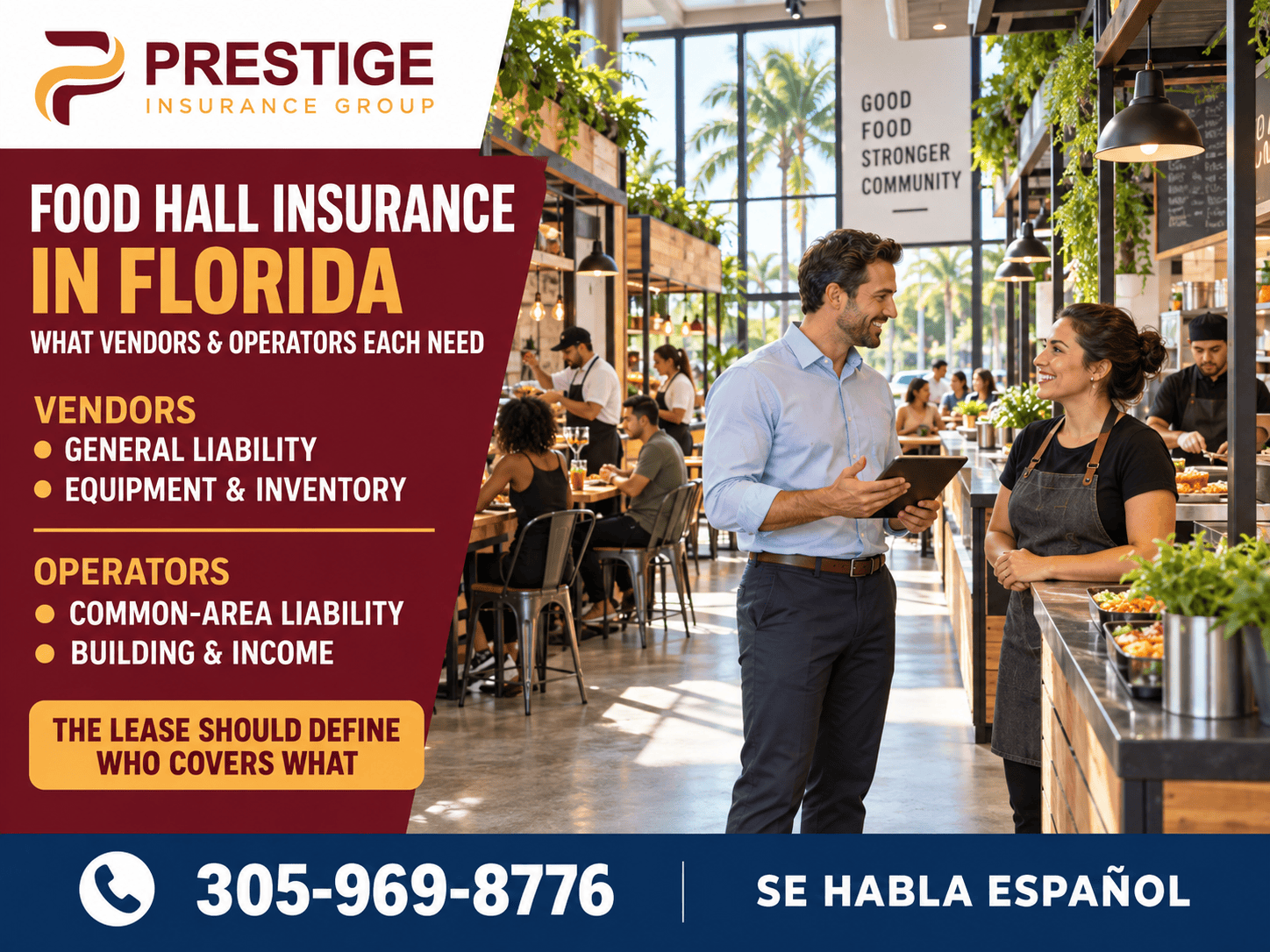
The hall operator carries the building or the leasehold, the common areas, the shared infrastructure, and liability for everything that happens in the parts nobody individually occupies — the seating area, the restrooms, the entrances, the corridors.
That is closer to a lessor’s risk and shopping center exposure than to a restaurant exposure, with an operational layer on top wherever the operator runs a central bar, provides shared equipment, or manages a commissary.
Each vendor carries their own general liability, their own equipment and build-out, their own products liability for what they serve, their own workers’ compensation, and their own business income.
The seam between them is the common seating area, and that seam is where the arguments happen.
A Fall in the Common Area Names Everyone
A guest slips near the seating, holding food from stall seven.
The operator’s premises liability is the primary target, because the operator controls the floor. The vendor is frequently named too, because the guest was carrying their product and came from their counter.
Which is why the operator’s insurance requirements exist and why vendors should read them rather than forwarding them to an agent with instructions to make it go away.
Expect stated minimum limits, the operator named as an additional insured by endorsement rather than as a certificate holder, primary and non-contributory wording, a waiver of subrogation, and frequently an umbrella. Those come from endorsements, and a certificate showing a name in a box does not create them.
Expect an indemnity clause as well. Many license agreements require the vendor to indemnify the operator broadly, and the obligation can reach further than the policy does.
Shared Infrastructure Is Shared Risk
Food halls are built around common systems, and that changes both the exposure and the claim.
Hood and suppression systems are frequently shared across multiple cooking stations. If the system is not rated for what a vendor installs beneath it, or the cleaning interval does not match the volume of cooking, the risk belongs to everyone under that hood.
Grease traps, ductwork, and ventilation are usually the operator’s, and their condition affects every vendor.
Walk-ins and cold storage are sometimes shared, which raises a question nobody asks until it matters: if a shared cooler fails, whose spoilage coverage responds, and does each vendor’s policy contemplate product stored outside their own leased footprint?
Power and utilities are common, which means an outage empties every cooler in the building at once. Utility services interruption is one endorsement and it matters fifteen times over here.
Vendors should know what is shared, what is theirs, and who is responsible for maintaining each piece — before signing rather than after a loss.
Foodborne Illness in a Shared Setting
A cluster of illness reports traced to a food hall is a harder investigation than one traced to a single restaurant.
Guests frequently eat from more than one stall. Shared seating, shared condiment stations, and shared restrooms complicate the epidemiology. And an outbreak investigation that cannot isolate a source implicates the building rather than a vendor.
Two consequences.
Every vendor needs their own records — temperature logs, receiving documentation, cooling and reheating records, and employee illness documentation. In a shared setting, the vendor who can produce a clean file is the one who gets excluded from the investigation.
Products and completed operations must be on each vendor’s policy. Confirm it is included rather than excluded.
A closure ordered by the health department affects the whole hall, which brings the business income problem back around — no physical damage, so no standard response.
Licensing and the Short Term
Food hall vendors typically operate on license agreements rather than leases, frequently for six or twelve months.
That raises two insurance questions.
Who owns the build-out. If the vendor paid for the counter, the equipment installation, and the finishes, those are improvements and should be on the vendor’s property schedule. If the operator provided a turnkey stall, they are the operator’s. A short term does not change who owns the improvement, and vendors routinely fail to schedule work they paid for.
Each vendor needs their own licensing. Food service licensing generally attaches to the operator of the food business, and shared-kitchen and commissary arrangements have their own requirements. Confirm your specific setup rather than assuming the hall’s license covers you.
Workers’ Compensation Applies Per Entity
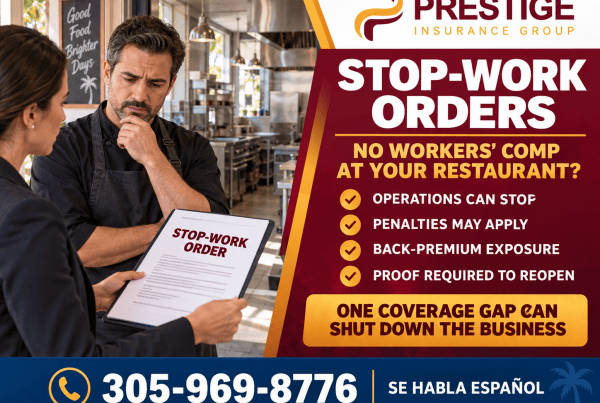
Florida requires coverage for non-construction employers at four or more employees counting part-time, and the threshold applies to each business separately.
A vendor with two full-time and two part-time employees is at four. The hall operator’s coverage does not extend to a vendor’s staff, and an investigator visiting the building will look at each operation on its own.
A stop-work order issued to one vendor closes that stall. Issued to the operator, it closes the building.
Liquor Depends on Who Holds the License
Most food halls run a central bar operated by the hall rather than by the vendors, which puts liquor liability with the operator.
Where vendors serve alcohol themselves, or where a vendor’s license permits service at their own counter, that exposure sits with the vendor and general liability excludes it entirely.
Assault and battery belongs in the same conversation for halls that operate late or host events. The provision appears as full coverage, a sublimit with defense costs frequently counted inside, or an exclusion — and for a venue with a bar and evening programming, it decides more than the limit does.
What Food Hall Vendors Should Confirm
-
Do you carry contingent business income for a loss originating at another stall?
-
Do you carry civil authority coverage, and what are its trigger and time limit?
-
Does your license agreement require endorsements you may not have?
-
Does it contain an indemnity clause, and does anything cover it?
-
Is your build-out scheduled as improvements on your property coverage?
-
Is products and completed operations included?
-
Do you carry spoilage, and does it cover product in shared cold storage?
-
Do you carry workers’ compensation, and are you at four employees counting part-time?
-
Do you keep your own temperature, receiving, and employee illness records?
What Food Hall Operators Should Confirm
-
Does the program cover common areas, shared infrastructure, and any central bar you operate?
-
Do you hold current certificates from every vendor, with actual endorsements?
-
Do you verify them at renewal rather than only at move-in?
-
Who maintains the shared hood, ductwork, and grease systems, and are the records retained?
-
Do you carry business income for a closure caused by a single vendor’s loss?
-
Is liquor liability in place for the central bar, and do you have assault and battery coverage?
-
Do your license agreements allocate responsibility for shared systems clearly?
Food Hall and Restaurant Insurance in Florida
Prestige Insurance Group works with food halls, individual vendors, restaurants, and hospitality operations across Miami, Wynwood, Miami Beach, Little Haiti, Doral, Fort Lauderdale, Orlando, and Tampa.
If you are a vendor about to sign a license agreement, send it to us with your declarations page before you sign. The insurance requirements and the indemnity clause are both in there, and both are easier to address in advance than to discover at a claim.
Call the office nearest you. Se habla español.
Miami: 305-969-8776 Orlando: 407-993-2331 Stuart: 772-247-3788
General information only, not legal advice. Coverage forms, exclusions, endorsements, and carrier appetite vary and change over time, and requirements vary by license agreement. Florida food service licensing and workers’ compensation requirements are subject to change; confirm current requirements with the applicable agency. Refer to your actual policies and agreements for the terms that apply to your business.