


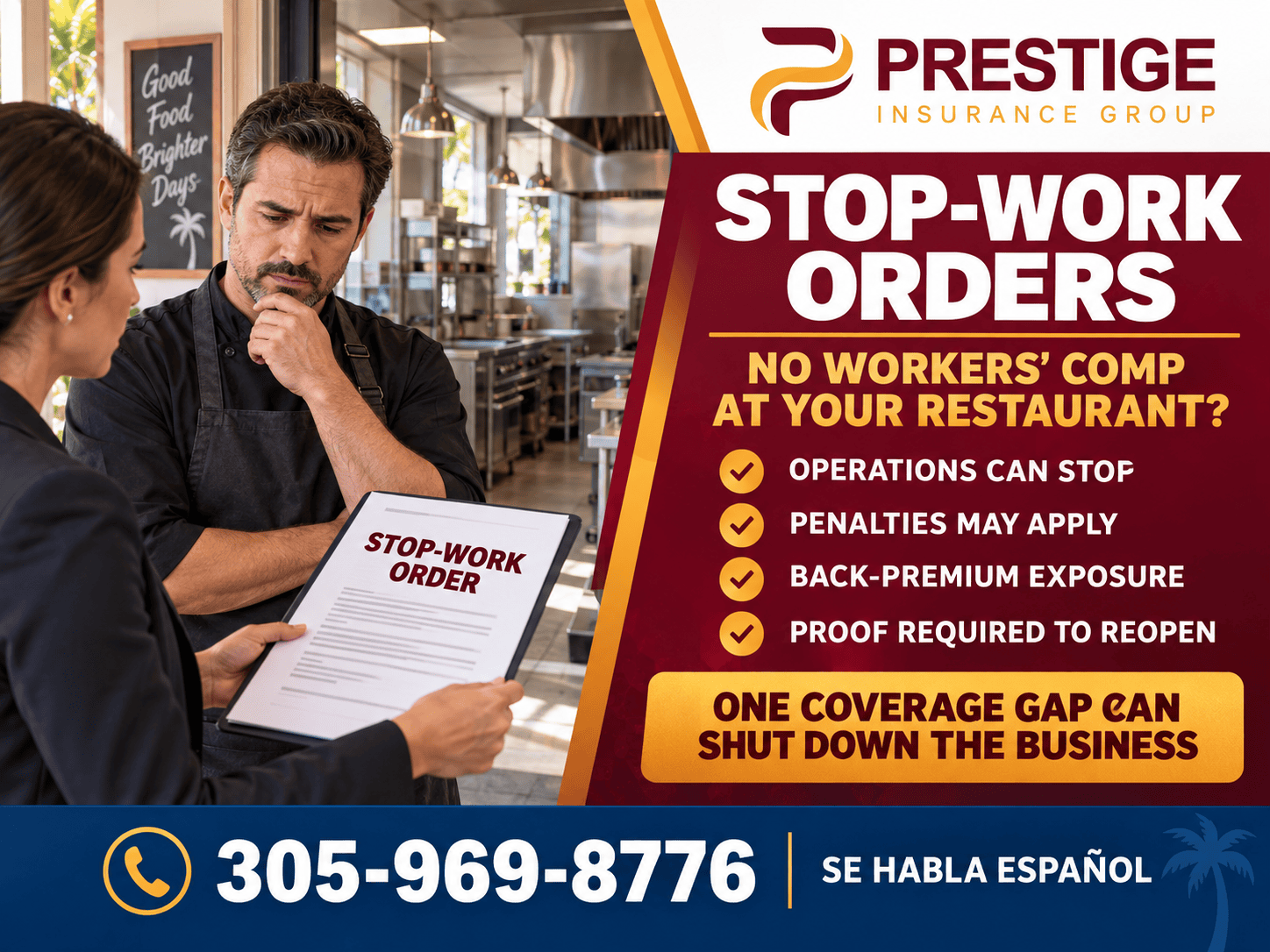
An investigator from the Division of Workers’ Compensation walks into a restaurant in Hialeah on a Wednesday afternoon, asks to speak to the owner, and counts the people working.
There are six. Three full-time in the kitchen, two part-time servers, and a dishwasher the owner has been paying in cash.
The restaurant has no workers’ compensation policy, because the owner believed the threshold was four full-time employees.
A stop-work order is posted on the door the same day. The restaurant closes immediately and does not reopen until the order is released, and nothing on the insurance program pays for a single hour of that.
The Order Takes Effect Immediately
A stop-work order requires the business to cease all operations at the site. It is posted at the location, it is a public record, and it applies until the Division releases it.
For a restaurant that means the doors close that afternoon. Food spoils. Staff go home without knowing when they return. Reservations, catering commitments, and a weekend of revenue disappear.
Release requires coming into compliance — obtaining coverage — and satisfying the penalty, either in full or through a payment agreement that includes a down payment. That process takes days at best and can run considerably longer if the paperwork is not straightforward.
The Penalty Is Calculated From What You Did Not Pay
Florida calculates the penalty as a multiple of the premium the employer should have paid over a look-back period.
The practical effect is that a restaurant which avoided coverage for two years does not pay two years of premium. It pays a multiple of it, and on a restaurant payroll that number is substantial.
The specific multiplier, the look-back period, and the down payment required for a conditional release are set by statute and rule and have been amended over time. Confirm the current figures with the Division rather than relying on what someone remembers from a few years ago.
Nothing Insures This
Worth being direct, because owners ask.
Business income requires direct physical damage from a covered cause of loss. A stop-work order involves no physical damage. The premises are physically fine and legally closed, and the standard form does not contemplate it.
Fines and penalties are generally excluded from liability policies as a matter of course.
Buying a policy after the order brings you into compliance going forward. It does not erase the penalty for the period you were uncovered, and it does not pay for the days you were closed.
This is the rare exposure with no insurance answer at all. The only protection is compliance.
Why Restaurants Get Caught
Five reasons, and they are consistent.
The threshold counts part-time. Florida requires coverage for non-construction employers at four or more employees, and part-time employees count. A restaurant with two full-time cooks and three part-time servers is over the line. Owners routinely count only full-time staff and conclude they are under it.
Cash payments do not remove someone from the count. A dishwasher paid in cash is an employee. The absence of payroll records makes the penalty calculation worse rather than better.
Kitchen staff on 1099. Paying a line cook as a contractor does not make him one. The state examines the actual working relationship — who sets the schedule, who supplies the equipment, who directs the work — and in a restaurant kitchen those answers rarely support contractor status.
Turnover masks the count. A restaurant that runs four people most weeks and six on busy ones is over the threshold on the busy ones, and the inspector counts on the day he visits.
The policy lapsed. This is the most avoidable version. A missed payment, a cancelled policy, a carrier non-renewal that nobody actioned, and the restaurant is uncovered without anyone deciding to be.
Where the Coverage Is Not What You Think
A PEO arrangement covers the workers the PEO actually pays. Staff outside that arrangement — someone hired directly, a family member helping out, a cash-paid dishwasher — are not covered by it, and an inspector counting bodies does not care how each one is paid.
A staffing agency’s coverage applies to the agency’s employees. Confirm the certificate is current, and understand that it does not extend to anyone you hired yourself.
Exemptions in non-construction businesses are limited to corporate officers and members meeting specific ownership criteria. They cover the person who filed and nobody else. An exemption does not reduce the employee count for threshold purposes in the way owners sometimes assume.
A certificate is not a policy. Certificates show coverage on a date. Confirming a policy is active and in force is a different check, and it is the one that matters on the day an investigator visits.
What Prevents It
Count correctly, including part-time and cash. If the number reaches four on any given week, you need coverage.
Classify honestly. A cook is an employee. So is a dishwasher and so is a server. The tax form does not determine it.
Confirm the policy is active rather than assuming. Check the effective dates, check that payments are current, and act on any cancellation or non-renewal notice the day it arrives rather than the week it expires.
Verify PEO and agency coverage in writing, and know exactly which workers each arrangement covers.
Keep payroll records. They are what establishes the correct figure if a penalty is ever calculated, and their absence makes every calculation less favorable.
Include it in the pre-opening checklist. A new restaurant hires up quickly, and the threshold is crossed during the week before opening more often than at any other point.
The Audit Is a Separate Matter
Restaurants with coverage encounter a different version of this problem at audit.
Workers’ compensation premium is based on payroll, and the policy is audited at the end of the term. Underreported payroll produces an additional premium bill months later, and misclassified employees produce a larger one — because the auditor applies the correct class code, not the one the policy was written on.
That is a bill rather than a closure, and it is still worth avoiding by reporting accurately from the start.
What Restaurant Owners Should Confirm
-
How many people work here, counting part-time and anyone paid in cash?
-
Is a workers’ compensation policy active today, with payments current?
-
Has any cancellation or non-renewal notice arrived that nobody actioned?
-
Is anyone in the kitchen being paid as a contractor?
-
If you use a PEO, exactly which workers does it cover?
-
If you use a staffing agency, is their certificate current?
-
Do you have an officer exemption, and do you understand what it does and does not do?
-
Are payroll records complete and retained?
-
Is payroll classified correctly between kitchen, service, and clerical?
Restaurant Insurance in Florida
Prestige Insurance Group works with restaurants across Miami, Hialeah, Coral Gables, Doral, Fort Lauderdale, Orlando, and Tampa, including operations that are difficult to place.
If you are not certain your workers’ compensation is active, or you are not sure how the threshold applies to your staffing, that is a short conversation and a considerably better one to have on a Tuesday than after an investigator visits.
Call the office nearest you. Se habla español.
Miami: 305-969-8776 Orlando: 407-993-2331 Stuart: 772-247-3788
General information only, not legal advice. Florida workers’ compensation coverage requirements, penalty calculations, look-back periods, exemption rules, and stop-work order procedures are set by statute and rule and are subject to change; confirm current requirements with the Florida Division of Workers’ Compensation and qualified counsel. Worker classification is a legal and factual determination. Refer to your actual policies for the terms that apply to your business.