

Landscaping insurance is not a policy. It is five of them, and the two exposures most likely to produce a large claim sit outside the one most landscapers think of first.
General liability is the foundation, and it covers the rock thrown by a mower into a windshield. It does not cover the equipment in your trailer, it does not cover your crew, and depending on the form it may not cover the chemicals you spray.
Here is what each piece actually does, and where each one stops.
General Liability: The Rock, and Not Much Else You Might Expect
General liability responds to bodily injury and property damage you cause to third parties. In this trade that means the thrown object, the damaged irrigation head at a neighboring property, the pedestrian struck by debris, the client who trips over equipment left on a walkway.
Three limitations matter more than the limit does.
Care, custody, and control. The policy excludes damage to property in your care — meaning the thing you were working on. Breaking the irrigation line you were hired to repair is a different conversation from breaking the one next door, and the exclusion is why.
The pollution exclusion. Most general liability forms contain one, and it can reach herbicides, pesticides, and fertilizers. Chemical drift onto a neighbor’s landscaping, or damage from misapplication, may fall entirely outside the policy. If your company applies chemicals, this needs a specific answer rather than an assumption — some carriers offer coverage through a herbicide and pesticide applicator endorsement, and others will not write the risk at all.
Your work. The policy does not pay to redo work that was performed incorrectly. If a planting fails because of how it was installed, replacing it is a business cost rather than a claim.
The FDACS Form Most Landscapers Have Never Heard Of
If your company applies any pesticide for compensation — including products sold over the counter — Florida licensing requirements under Chapter 482 apply, administered by the Department of Agriculture and Consumer Services.
That license requires proof of insurance filed by your carrier directly with the state, on FDACS Form 16004, Certification of Insurance. It is not an ACORD certificate. Your carrier completes and submits it, showing a combined single limit, with the insured address matching the licensed address.
Two consequences follow. Your agent has to know you need it, since not every carrier issues it quickly. And if the policy is cancelled or non-renewed, the carrier notifies the state — which turns a coverage lapse into a licensing problem.
One more distinction worth knowing: the Limited Commercial Landscape Maintenance certification permits application to ornamental plants and plant beds only. It does not authorize applications to turf, including weed-and-feed and broadleaf weed control. A company holding LCLM that treats a client’s lawn is operating outside its certification.
Workers’ Compensation: The Largest Line on a Crew Operation
Landscaping carries an elevated workers’ compensation rate for reasons that are obvious on any job site — blade equipment, heat, chainsaws, lifting, work at height, and traffic exposure.
Two operational points affect what you pay more than the rate itself.
Payroll separation. Administrative staff working in an office may be classified separately at a fraction of the field rate, but only where the records support it. Where they do not, the auditor applies the field classification to everyone, including the person answering the phone.
Subcontractor verification. If you subcontract irrigation, tree work, or hardscaping, you are responsible for confirming they carry their own coverage or hold a current exemption. If they do not, what you paid them can be added to your payroll at audit, and an injury to their crew can land on you.
Florida requires coverage for most non-construction businesses at four or more employees, counting part-time and seasonal workers.
Commercial Auto, and the Coverage Almost Nobody Has
Trucks, trailers, and utility vehicles are the auto exposure, and trailers in particular — a loaded trailer at highway speed is a serious accident waiting to be someone’s fault.
The gap most companies have is hired and non-owned auto, which responds when an employee uses a personal vehicle for work. Running to a supply house, picking up a crew member, driving from the yard to a property. A personal auto policy generally excludes business use, so the employee’s own coverage may not respond at all — and the business gets named regardless.
It is inexpensive and it is missing from a remarkable number of landscaping programs.
Inland Marine: Where the Equipment Actually Lives
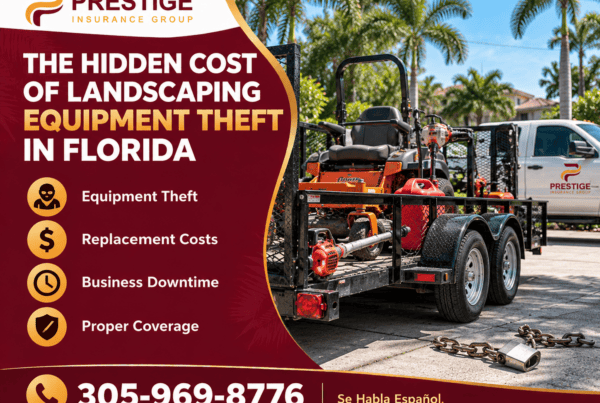
Commercial mowers, blowers, trimmers, skid steers, trenchers, aerators, irrigation equipment, and hand tools represent real money, and none of it is covered by general liability. Commercial property covers what sits at your yard. Everything that travels is inland marine.
Three questions determine whether the coverage works.
Where it applies. At the job site, in transit, in the trailer overnight, in the yard. Confirm all four.
How it settles. Replacement cost or actual cash value. A five-year-old commercial mower is worth very little depreciated and costs the same as always to replace.
What conditions attach. Trailer and equipment theft is persistent in South Florida, and many policies condition theft coverage on the trailer being locked, unhitched, or stored in a secured area. Read those conditions against where equipment actually sits overnight, not where the policy assumes it does.
Small equipment frequently carries its own sublimit, and that sublimit is often below what a crew loads onto a truck each morning.
Commercial Property, and the Yard
If you own or lease a yard, shop, or office, commercial property covers the structure, the contents, and — if you leased a space and improved it — the build-out, which belongs to you rather than the landlord.
Flood is excluded from every property policy and requires separate placement.
Tree Work Is Where the Policy Quietly Stops
Many landscaping policies restrict or exclude tree work, and the restrictions live in the endorsements rather than on the quote.
The common ones: a maximum working height, exclusion of complete tree removal, exclusion of chainsaw work above a stated height, and exclusion of crane or bucket truck operations.
A company that mows lawns and also climbs to prune a thirty-foot ficus is performing two jobs with very different risk profiles. The second is arboriculture, and it frequently requires its own classification and its own policy. After a storm this becomes urgent, since debris and hanging limb work arrives in volume and is the most dangerous version of the job.
More at arborist and tree service insurance.
What Contracts Add on Top
Condominium associations, HOAs, property managers, hotels, and shopping centers specify insurance in their contracts, and the requirements go beyond limits.
They want a certificate, stated minimums, and almost always the client named as additional insured — which is an endorsement rather than a line on a certificate. Some require a waiver of subrogation. Many require coverage maintained for a period after the service ends.
A commercial umbrella is frequently required as well, and it is worth knowing that an umbrella does not repair an exclusion beneath it. If tree work or chemical application is excluded on the primary, more excess limit does not reach it.
What Is Not Covered by Any of It
Faulty workmanship. Redoing work performed incorrectly is a business cost.
Wear and tear on equipment. Mechanical breakdown from age is maintenance, though equipment breakdown coverage can be added.
Employee theft, which requires crime or employee dishonesty coverage.
Plant failure. A tree that dies after planting is generally not a covered loss.
Work outside your declared operations. Irrigation installation, hardscaping, tree work, and lighting all have licensing and classification consequences, and adding a service without updating the policy is the most common way a business ends up insured and uncovered.
Worth Confirming on Your Policy
-
Does general liability cover chemical application, or does the pollution exclusion reach it?
-
Can your carrier file the FDACS 16004 if you need it?
-
What height limit applies to tree work, and does the policy exclude removals?
-
Is hired and non-owned auto in place?
-
Does inland marine cover equipment at job sites, in transit, and in the trailer overnight?
-
What theft conditions attach, and does your storage meet them?
-
Is office payroll separated from field payroll?
-
Do you collect subcontractor certificates before work begins?
-
Do your limits meet what your contracts require?
Landscaping Insurance in Florida
Prestige Insurance Group works with landscaping and lawn maintenance companies, irrigation contractors, and grounds maintenance operations across Miami, Hialeah, Doral, Kendall, Fort Lauderdale, West Palm Beach, Stuart, Orlando, Kissimmee, Tampa, and throughout Florida.
If you apply chemicals or do tree work, those are the two places to start — because both sit outside a standard landscaping policy more often than owners expect.
Miami 305-969-8776 · Orlando 407-993-2331 · Stuart 772-247-3788
Se Habla Español.
Related Reading
En español: Seguro para Empresas de Landscaping en Florida
General information only, not legal advice. Policy forms, exclusions, and endorsements vary by carrier. Confirm current pesticide licensing and certification requirements with the Florida Department of Agriculture and Consumer Services, and refer to your policy for the terms that apply to your operation.