


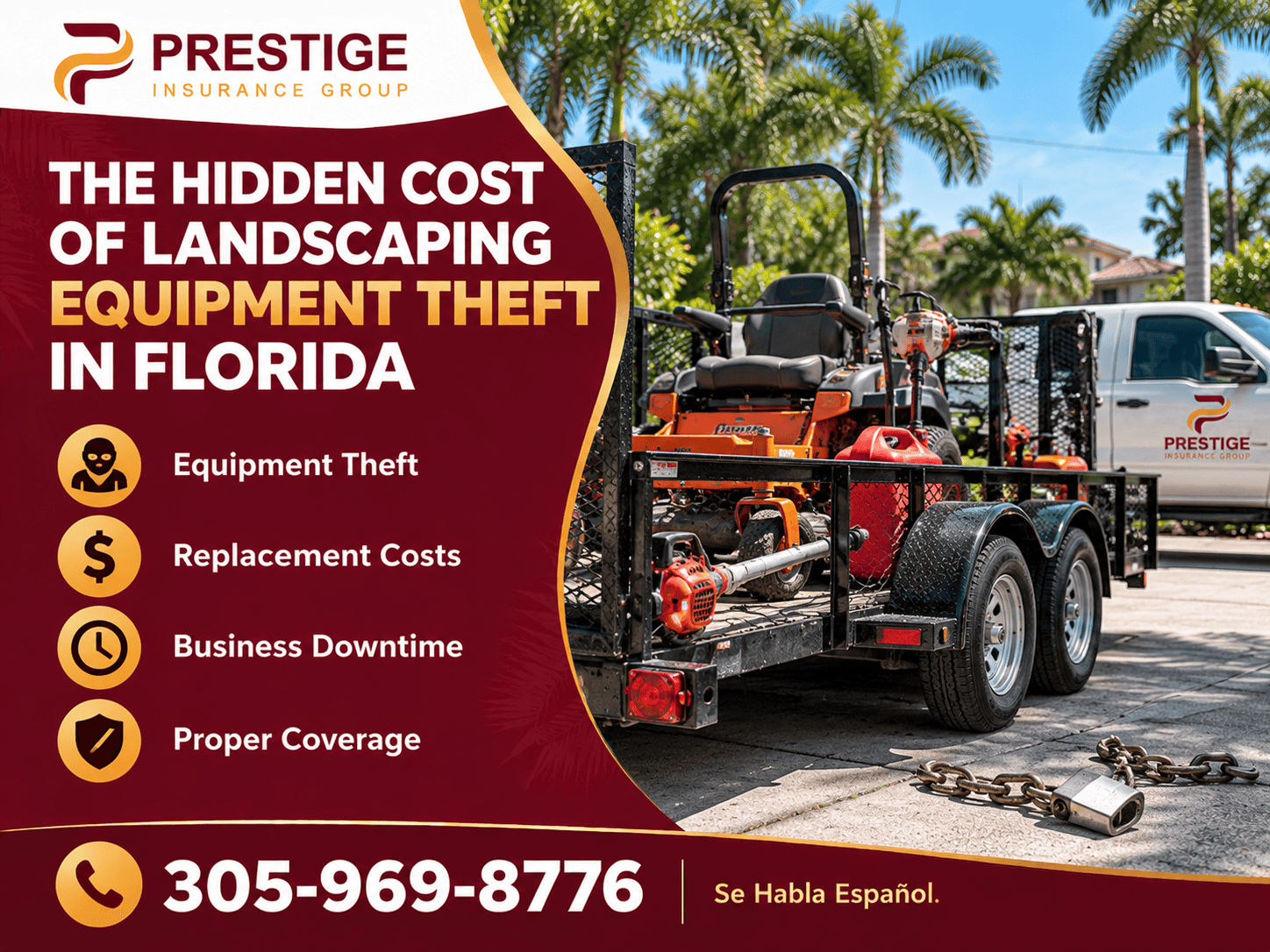
A crew arrives at the yard on a Tuesday morning and the trailer is gone.
The mowers are replaceable. The trimmers and blowers are replaceable. What is not replaceable is Tuesday, and Wednesday, and the two or three weeks it takes to source, finance, and equip a replacement — during which the accounts still expect their properties cut, and the competitor down the road is happy to take them.
That is the part the insurance conversation usually misses. Theft in this trade is treated as a property problem, and the property loss is often the smaller half of it.
Why Landscaping Equipment Is a Target
The economics work for the thief in a way they do not with most trades.
Equipment is portable, unmarked, and immediately sellable. A commercial zero-turn mower has a real resale market with no questions asked. Trailers are easy to hitch and drive away. Equipment sits unattended at job sites during the day and in yards, driveways, and storage lots at night. And the work is visible — anyone can see what a landscaping company owns simply by watching it work.
South Florida in particular has a persistent problem, and the pattern is consistent: loaded trailers taken overnight, equipment taken off open trailers at job sites during the day, and yards hit repeatedly once someone has established what is there.
What It Actually Costs
Four costs, and most companies only insure the first.
The equipment. The replacement cost of what was taken.
The downtime. Accounts that do not get serviced while you source replacements. In a business built on recurring weekly maintenance contracts, a missed cycle is a conversation with the client, and two missed cycles is a lost account.
The rental. If you rent replacement equipment to keep the schedule, that cost runs until the permanent replacement arrives.
The deductible and the renewal. A theft claim affects the loss history, and in a class where carriers already scrutinize theft controls, a claim followed by no change in your storage arrangement is a difficult renewal conversation.
The Coverage Is Inland Marine, Not General Liability
General liability covers damage you cause to others. It does not cover your equipment.
Commercial property covers what sits at a fixed location. Everything that travels — mowers, blowers, trimmers, skid steers, trenchers, aerators, irrigation equipment, hand tools, and trailers — is inland marine.
Three provisions determine whether it responds to a theft.
Where coverage applies. At the job site, in transit, in the trailer overnight, and in the yard. Those are four different situations and not every form covers all four.
How it settles. Replacement cost or actual cash value. This is the one that surprises people. A five-year-old commercial mower is worth very little depreciated and costs the same as always to replace, so an actual cash value settlement on an older fleet does not put the crew back to work.
What sublimits apply. Small equipment — trimmers, blowers, hand tools — frequently carries its own sublimit separate from the scheduled major equipment, and that sublimit is often well below what a crew loads onto a truck each morning.
More at inland marine insurance.
The Conditions Are Where Claims Fail
This is the part worth reading in your own policy.
Theft coverage in this class commonly comes with conditions attached. The trailer must be locked. The trailer must be unhitched from the vehicle. Equipment must be stored in a locked or fenced area. The vehicle must not be left unattended with equipment aboard.
Those conditions are not suggestions. They are what gets examined after a loss, and a claim where the trailer was hitched to a truck parked on a residential street overnight can be denied on the condition rather than the limit.
Read them against how your crews actually operate at the end of a day, not how the policy assumes they do. If the conditions do not match reality, that is a conversation with your agent before a loss rather than after one — sometimes the coverage can be adjusted, and sometimes the operation needs to change.
Newly Acquired Equipment Has a Clock on It
Most inland marine forms provide automatic coverage for equipment purchased mid-term, subject to a limit and a reporting window — often thirty to ninety days.
Buy a mower, forget to report it, and coverage lapses at the end of that window. For a company acquiring equipment regularly, building the reporting habit into the purchase process is worth more than it sounds, because the newest equipment is also the most attractive to steal.
The same applies in reverse. Equipment sold or scrapped but still on the schedule is premium paid on assets you do not own, which an annual pass against what is actually in the yard will find.
What Actually Reduces the Loss
GPS trackers on trailers and major equipment. They have become inexpensive, they recover equipment at a meaningful rate, and carriers increasingly credit them.
Trailer locks — a coupler lock rather than only a hitch pin, since a hitch pin stops nothing.
Wheel locks or boots on trailers stored overnight.
Unhitching, which is both a deterrent and frequently a policy condition.
Secured storage. A fenced, gated, lit yard is a different risk from a driveway, and carriers price it that way.
Lighting and cameras at the yard, with retention long enough to matter — systems overwrite in days and a theft may not be discovered until Monday.
Serial number records and photographs of every piece of equipment, stored somewhere other than the yard. Recovery depends on identification, and so does a clean claim.
Marking equipment visibly, which does not stop a determined thief but reduces the casual resale value.
Varying the routine. Equipment taken from job sites is usually taken by someone who watched the schedule first.
Employee Theft Is a Different Coverage
Tools and small equipment disappearing gradually is a different problem from a trailer taken overnight, and inland marine does not respond to it.
Theft by your own employees requires crime or employee dishonesty coverage, and most landscaping programs carry a modest limit that nobody selected deliberately.
The practical control is inventory. A company that checks equipment in and out, and knows what should be on each truck, finds a problem in weeks rather than at the end of a season.
What to Confirm on Your Policy
-
Does inland marine cover equipment at job sites, in transit, in the trailer overnight, and in the yard?
-
Replacement cost or actual cash value?
-
What sublimit applies to small equipment and hand tools?
-
What theft conditions attach, and does your overnight storage meet them?
-
What is the newly acquired equipment limit and reporting window?
-
Is the schedule current — nothing sold still listed, nothing bought still unreported?
-
Is there crime or employee dishonesty coverage, and at what limit?
-
Is rental reimbursement available to keep the schedule running after a loss?
Review the Equipment Schedule Before You Need It
Prestige Insurance Group works with landscaping and lawn maintenance companies, irrigation contractors, tree services, and grounds maintenance operations across Miami, Hialeah, Doral, Kendall, Fort Lauderdale, West Palm Beach, Stuart, Orlando, Kissimmee, Tampa, and throughout Florida.
If you are not certain what your policy requires of you overnight, that is a five-minute answer and worth having before a Tuesday morning when the trailer is gone.
Miami 305-969-8776 · Orlando 407-993-2331 · Stuart 772-247-3788
Se Habla Español.
Related Reading
En español: Seguro para Empresas de Landscaping en Florida
General information only, not legal advice. Policy forms, conditions, and sublimits vary significantly by carrier; refer to your policy for the terms that apply to your operation.