


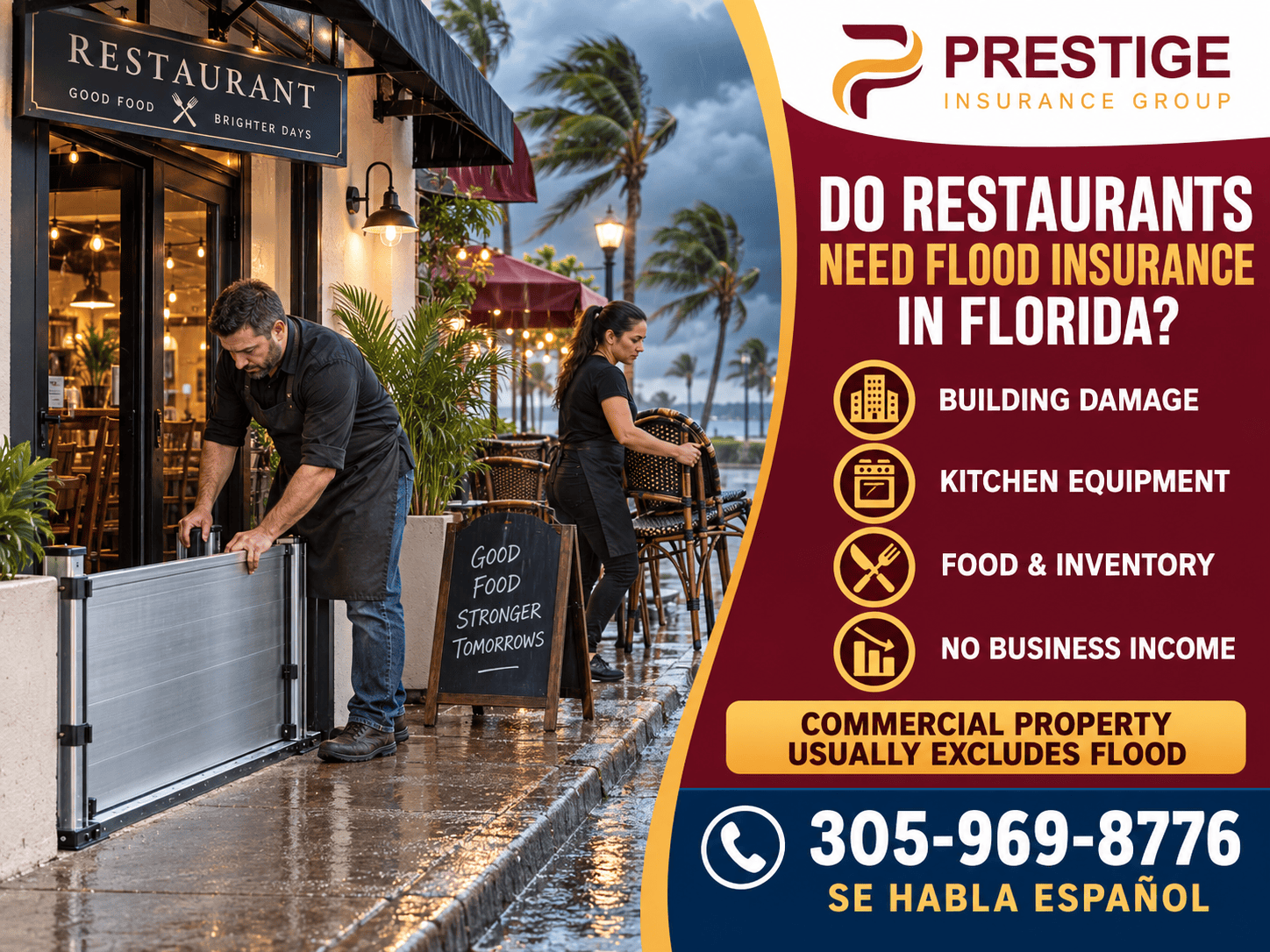
A ground-floor restaurant in Fort Lauderdale takes fourteen inches of water on an August afternoon. There is no hurricane and no surge, just rain falling faster than the drainage can carry it away. Everything that matters to the business sits at floor level: the walk-ins, the line equipment, the electrical panels, the plumbing under the bar, the flooring, the millwork and the build-out the owner paid for. The property policy excludes flood, and even if the owner had carried a flood policy, a standard one would pay nothing toward the four months the restaurant stays closed.
Restaurants carry more flood exposure than almost any other small business, because nearly everything of value sits at or near grade and because a flooded kitchen does not reopen quickly. Whether you need flood insurance is less a question of your flood zone than of what a few inches of water would do to your build-out, your equipment and your ability to open the doors next month.
Flood Is Excluded From Every Property Policy
Many restaurant owners believe their commercial package covers flood, and it does not. Water arriving from outside at ground level, whether from storm surge, rising water, rain that overwhelms the drainage or water backing up through the storm system, is flood, and it requires its own policy. Water that starts inside the building follows different rules. A burst supply line is generally covered by the property policy, while a line weeping behind a wall for weeks generally is not. Those questions are separate from flood, and they get confused after storms because one event often causes both and different adjusters look at each. Our article on what flood insurance does not cover in Florida sets out the other gaps.
A Restaurant’s Most Valuable Property Sits at Floor Level
This is what makes a restaurant’s exposure different from an office or a second-floor retail suite. The build-out alone, including the hood and suppression system, the walk-ins, the gas and plumbing runs, the electrical service, the grease trap, the flooring, the millwork and the finishes, often costs more in a leased restaurant than everything movable put together, and all of it is at or near grade. Add the line equipment, refrigeration, prep stations, dish machine and the bar, the inventory, including a liquor stock that can represent real money, and the point of sale and back office systems, which are replaceable but not overnight. A flood that reaches eighteen inches touches nearly all of it.
If You Lease, Your Flood Policy Is Not About the Building
In a leased space, the landlord insures the structure, and you insure what you brought in and what you built. Under the National Flood Insurance Program, a tenant buys contents coverage, and the technical point worth knowing is that a tenant’s improvements and betterments are covered under the contents portion of the policy rather than the building portion. That means your build-out, often the single most valuable thing you own in the space, shares one limit with your equipment and inventory. The NFIP caps contents coverage for a non-residential business at $500,000, and on a restaurant with a substantial build-out, the improvements alone can take up much of that limit, leaving equipment and inventory short within the same policy.
Read the lease as well. Many commercial leases require the tenant to insure improvements and to carry flood coverage when the property is in a high-risk zone, and our article on insurance for independent retailers in Florida malls and shopping centers covers how lease requirements typically read.
The NFIP Pays Nothing Toward the Closure
This is the gap that decides whether a restaurant reopens. The NFIP covers direct physical damage to the building and contents and nothing else. It does not include business income or extra expense. A flooded restaurant is not closed for a week. Drying, remediation, replacing equipment with long lead times, rebuilding the build-out, permitting and the health department sign-off routinely take months, and after a regional event they take longer, because every contractor and every equipment supplier is working through the same queue. The rent keeps coming due, the loan payments continue and the staff find other jobs.
Private flood has grown substantially in Florida and frequently includes business income and extra expense, along with higher limits than the federal program. For a restaurant, that is usually a more important difference than the premium. Where neither policy reaches the full exposure, excess flood can sit on top. Our comparison of NFIP and private flood insurance explains how the two markets differ, our page on commercial flood insurance covers business placements and our page on business interruption insurance explains how income coverage works on the property side.
Zone X Does Not Mean No Exposure
Much of South Florida’s restaurant inventory sits outside the mapped high-risk zones, and owners often read that as no flood risk. Flat terrain, a high water table, drainage designed for different conditions and development that changes where water goes all produce flooding without a coastal address or a named storm, and a large share of flood claims come from properties outside the high-risk zones. Outside those zones, the premium is generally modest compared to what is at stake for a restaurant with its build-out, equipment and inventory in one ground-floor space.
Coastal Restaurants Face King Tides
A ground-floor restaurant near the water carries an exposure that has nothing to do with storms. Seasonal high tides, usually heaviest in late summer and fall, put water in the streets of coastal communities on clear, calm days. Miami Beach, the Fort Lauderdale beach area, Hollywood, Hallandale Beach, Sunny Isles and the barrier islands all see it, and it has become more frequent rather than less. For a restaurant, that can mean water in the parking lot, at the threshold and in some locations inside, repeatedly and predictably, without any weather event.
Two consequences follow. Tidal flooding is still flood, so the property policy excludes it and only a flood policy responds, even though it can feel like a recurring nuisance rather than an insurable event. And repetition affects placement. A location with a history of tidal intrusion is a known exposure that carriers price and underwrite accordingly, which is an argument for arranging coverage early in the life of the business rather than after the third incident. Waterfront and marina-adjacent restaurants carry more still, with decks, docks, outdoor seating at grade and equipment placed outside, most of which falls outside a flood policy’s building coverage entirely.
Timing and Preparation
A new NFIP policy generally takes thirty days to take effect, with limited exceptions, and private carriers that bind faster commonly stop writing new policies once a storm is being tracked toward the state. An owner deciding in September while watching a forecast has usually missed the window for that season, so flood coverage is arranged in the quiet months.
Preparation does as much as the policy. Raise what you can, including electrical panels, servers, POS equipment and mechanical systems, since walk-in compressors mounted at grade are a common and avoidable loss. Keep inventory off the floor as a standing practice rather than a storm response. Know your flood zone, and if the building or the map has changed, get a current elevation certificate. Keep contractor invoices, permits and photographs of the hood system, the walk-ins and the finish work, because after a flood that file is often the only proof of what was there. And have a plan for the first forty-eight hours, covering who has access, who calls the restoration company and where the documentation lives, because delay is what turns a water loss into a mold loss.
What Restaurant Owners Should Confirm
A few questions cover most of it:
-
Do you carry flood coverage, and is it through the NFIP or a private carrier?
-
If you lease, does your contents limit account for the build-out as well as equipment and inventory?
-
Does your flood coverage include business income and extra expense?
-
What flood zone is the property in, and when did you last check?
-
Does your lease require flood coverage, and does your policy satisfy it?
-
Are your electrical and mechanical systems raised off the floor?
Restaurant Insurance With Prestige Insurance Group
Prestige Insurance Group works with restaurants across Miami, Fort Lauderdale, Hollywood, Coral Gables, Hialeah, Orlando and Tampa, and places flood coverage through both the federal program and the private market alongside the restaurant’s property and liability program. If you carry flood and have never compared the two markets, that comparison is worth having, because the differences show up in the limits and in whether anything covers the months you are closed. Learn more on our restaurant insurance page. Call the office nearest you. Se habla español.
Miami: 305-969-8776 Orlando: 407-993-2331
Frequently Asked Questions
Does my restaurant’s property policy cover flood?
No. Commercial property and business owners policies exclude flood. Rising water from outside the building requires a separate flood policy.
Does flood insurance cover my build-out if I lease the space?
Under the NFIP, a tenant’s improvements are covered under contents coverage, sharing one limit with equipment and inventory. Make sure the contents limit is high enough for all three.
Does flood insurance pay for the time my restaurant is closed?
Not under the NFIP, which does not include business income or extra expense. Many private flood policies do, which is one of the main reasons restaurants compare the two.
Are king tide floods covered?
Tidal flooding is flood, so it is excluded from the property policy and covered only by a flood policy. A history of tidal intrusion can affect how carriers price and place the location.
General information only, not legal advice. Federal flood program limits, coverage structures, waiting periods and terms are set by federal law and regulation and change over time. Private market availability and forms vary by carrier, and flood zone designations change. Refer to your policy and lease for the terms that apply to your business.



