


A church in Broward County receives a letter from an attorney. The allegation involves a volunteer who helped with the youth group six years ago and has not been part of the congregation since.
The board’s first call is to their agent. Their second question, after learning they do have abuse and molestation coverage, is the one that matters: how much, and does it cover volunteers?
The answers to those two questions determine more about the congregation’s future than any other line on the policy.
This Coverage Is Not Automatic
Most general liability policies do not cover abuse and molestation claims. Standard forms commonly exclude them, and coverage comes through a specific endorsement that has to be requested, underwritten, and priced.
A church that has never had this conversation may have no coverage at all, and would not know until a claim.
The first thing to do is find it on the declarations page. Look for language referencing abuse, molestation, or sexual misconduct. If it does not appear, that is the answer.
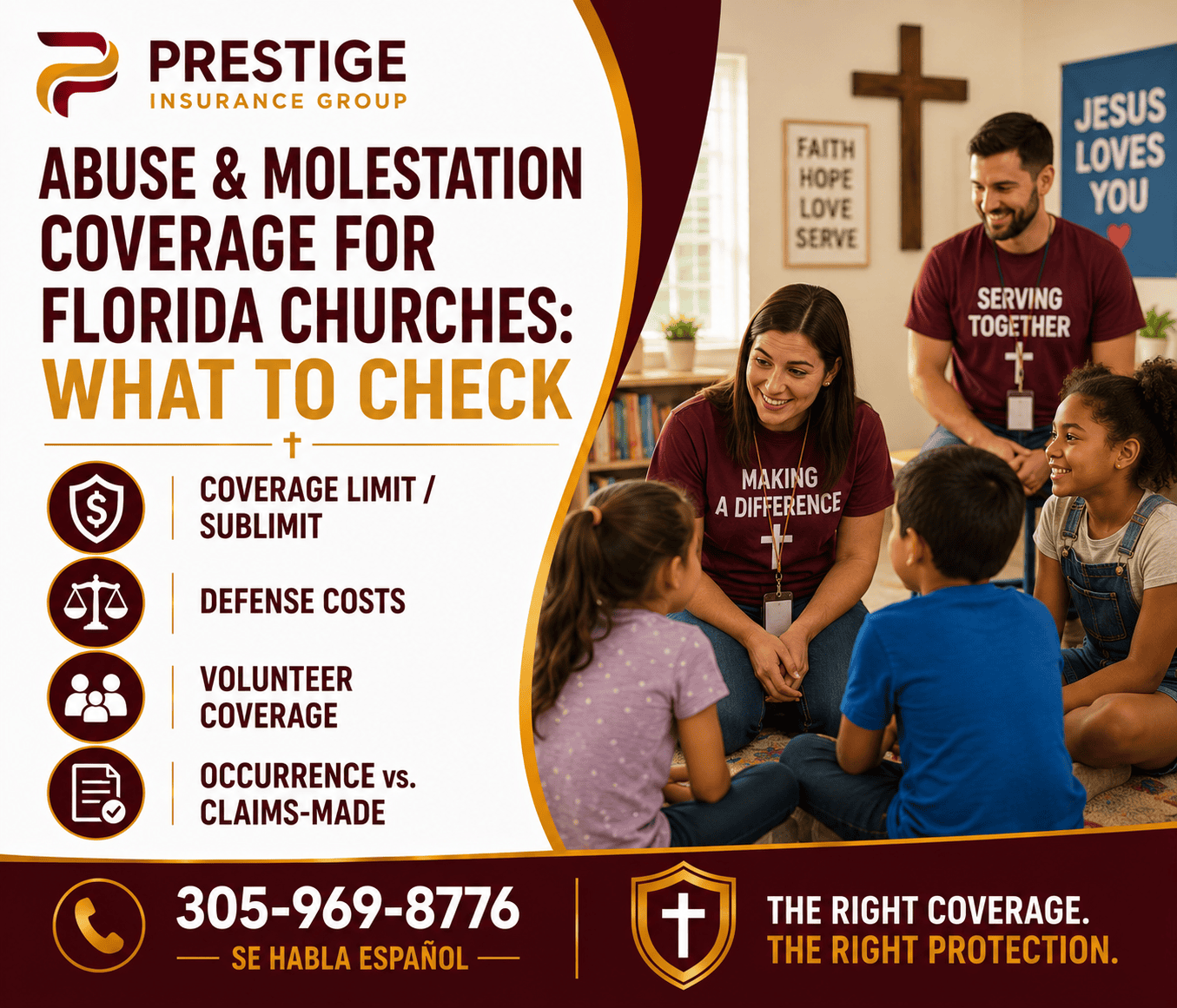
Four Questions That Determine Everything
Is it a sublimit or a full limit?
A church carrying a substantial general liability limit may have an abuse endorsement written at a fraction of that. The sublimit sits inside the larger limit rather than beside it. A congregation that believes it has a million dollars of protection may have a small fraction of that available for the claim most likely to threaten its existence.
Are defense costs inside or outside the limit?
Inside means every dollar spent on attorneys reduces what remains for a settlement. Abuse matters take years and generate substantial legal expense. A modest sublimit with defense inside can be exhausted before the case is anywhere near resolution, at which point the church is funding its own defense.
Does it cover volunteers?
Many church claims involve volunteers rather than paid staff, because volunteers are who runs the programs. Coverage naming only employees leaves the most common exposure uncovered. This is worth confirming in the endorsement language rather than assuming.
Is it occurrence-based or claims-made?
This distinction matters enormously here because abuse allegations frequently surface years after the conduct.
An occurrence policy responds to incidents that happened during the policy period, whenever the claim is made. A claims-made policy responds only to claims reported during the policy period, which means a church that changes carriers or lets coverage lapse may have no protection for prior years.
If the policy is claims-made, ask about retroactive dates and about tail coverage. A congregation that switched carriers without addressing this may have a gap covering exactly the years an old allegation would come from.
What Carriers Require
Insurers writing this coverage impose conditions, and those conditions are not decoration. They frequently determine whether coverage is available at all.
Background screening on anyone with access to minors — employees and volunteers alike. Carriers generally specify the type of check and how often it must be refreshed.
A written child protection policy covering supervision requirements, check-in and check-out procedures, restroom protocols, one-on-one contact rules, and reporting obligations.
The two-adult rule, meaning no adult is alone with a child in an unobservable setting. This is the single most commonly required control.
Training for anyone working with minors, documented and repeated.
Reporting procedures consistent with Florida’s mandatory reporting requirements.
Documentation that all of the above actually happens.
A church that agreed to these terms at binding and has not maintained them has a problem beyond the allegation itself, because the carrier will ask.
Screening Is Not the Same as Protection
Background checks catch people with records. Most people who abuse children do not have one.
The controls that actually reduce risk are structural: visibility, supervision ratios, restrictions on one-on-one contact, open sightlines in classrooms, restroom policies, and a culture where staff and volunteers are expected to speak up about behavior that seems off.
Carriers know this, which is why their requirements focus on supervision procedures rather than screening alone.
Prior Allegations Change the Market
A congregation with a prior abuse claim faces a materially harder market. Some carriers decline outright. Others write with higher retentions, lower sublimits, or additional requirements.
This is worth knowing before a renewal rather than during one, and it is one of the situations where an independent agent with access to multiple markets matters most.
What This Costs Relative to What It Protects
Abuse coverage is generally not the largest line item on a church policy. Raising a sublimit or moving defense costs outside the limit typically costs less than congregations expect.
Weighed against the alternative — a claim that exhausts the available limit and reaches the church’s property, its reserves, and its ability to continue — this is among the highest-value decisions on the program.
Questions to Bring to Your Renewal
-
Do we have abuse and molestation coverage, and at what limit?
-
Is that limit separate from or inside the general liability limit?
-
Are defense costs inside or outside it?
-
Does the coverage extend to volunteers?
-
Is the policy occurrence or claims-made, and if claims-made, what is the retroactive date?
-
What screening and supervision requirements did we agree to, and are we meeting them?
-
What would it cost to increase the limit?
A church that can answer all seven is in better shape than most.
Review Your Coverage
Prestige Insurance Group works with churches, synagogues, ministries, and religious schools throughout Florida, and can review abuse and molestation terms against what your programs actually involve.
Call our Miami office at 305-969-8776, our Orlando office at (407) 993-2331, or our Stuart office at 561-983-4333, or request a quote online.
This article is general information and not legal advice. Policy terms and carrier requirements vary; refer to your specific policy and consult qualified counsel regarding legal obligations, including mandatory reporting requirements under Florida law.