


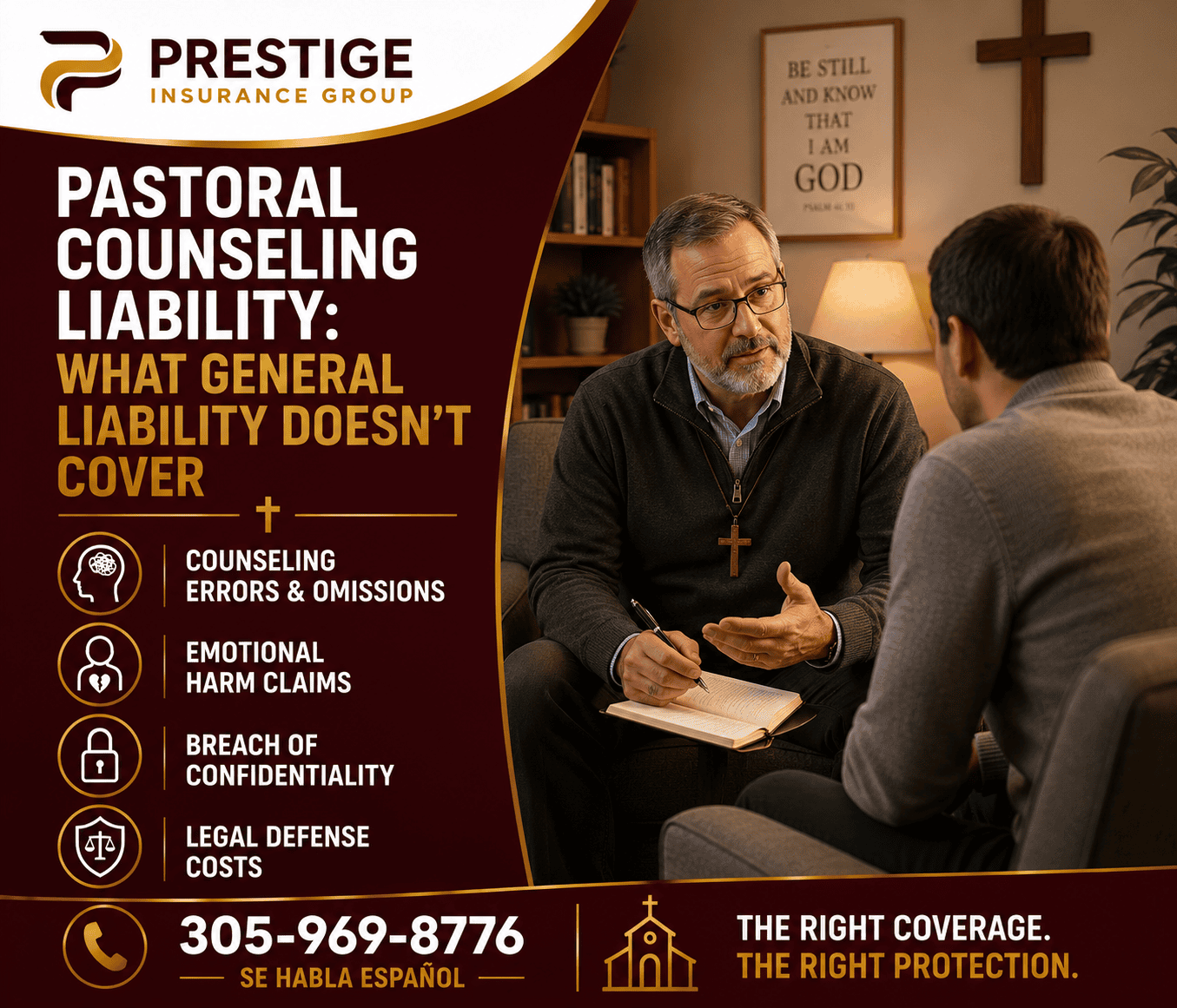
A pastor in Miami meets with a couple in his office on a Thursday afternoon, the way he has met with dozens of couples over fifteen years. The conversation covers their marriage, their finances, and a period of the husband’s life he has not discussed with anyone.
Two years later the marriage ends badly, and the pastor receives a subpoena. Later still, a claim follows alleging that advice he gave contributed to the outcome.
His church has general liability and property coverage. Neither one is designed for this.
Counseling Is Professional Activity
General liability responds to bodily injury and property damage. A counseling claim typically alleges neither. It alleges that a professional relationship existed, that guidance was given, and that harm followed.
That is professional liability territory, and it requires its own coverage — variously called pastoral professional liability, ministers’ professional liability, or counseling liability depending on the carrier.
Some church programs include it. Many do not, and a congregation that has never asked may not have it.
The Range of Activity This Covers
Pastoral counseling is broader than a scheduled appointment in an office.
Premarital and marriage counseling. Grief and bereavement support. Crisis intervention. Addiction and recovery ministry. Youth counseling. Financial guidance. Conversations after a service that turn substantive. Support groups run by lay leaders.
Claims can also arise from statements made in teaching or preaching, from disclosures made in confidence, and from decisions about church discipline that involve pastoral knowledge.
Where Claims Come From
Advice alleged to have caused harm. The most common category — guidance about a marriage, a decision, or a course of action that the person later says damaged them.
Confidentiality. Information shared in a pastoral setting that reaches someone else, whether through disclosure to a spouse, a board, a prayer chain, or a sermon illustration.
Failure to refer. A counselee presenting with symptoms requiring clinical care who was not referred to a licensed professional.
Mandatory reporting failures. Florida law requires reporting of suspected child abuse, and a pastor who learns of it in a counseling setting has obligations. Failing to report creates exposure separate from the underlying situation.
Boundary violations. Allegations that the relationship became inappropriate. This overlaps with sexual misconduct coverage, which is typically handled separately and often excluded from professional liability.
The Line Between Pastoral Care and Clinical Counseling
This distinction determines a great deal, and it is worth the congregation being clear about it.
Pastoral care is spiritual guidance offered by clergy within a religious relationship. It is what most churches do, and it is what pastoral professional liability contemplates.
Clinical counseling is licensed mental health practice, regulated by the state, requiring credentials and carrying its own malpractice standards.
Churches get into trouble at the boundary. A pastor who describes himself as a counselor, offers a structured course of sessions, uses clinical language, or charges a fee has moved toward something a court may evaluate against a clinical standard rather than a pastoral one.
If a church employs or contracts with licensed clinicians, that is a distinct arrangement requiring its own professional coverage. A licensed therapist working out of a church office is not covered by the church’s pastoral liability endorsement.
Clergy Privilege Is Narrower Than Assumed
Florida recognizes a privilege for communications made to a member of the clergy in their professional capacity as a spiritual adviser. Congregations sometimes treat that as blanket protection for anything said to a pastor.
It is narrower than that. The privilege has requirements about the nature and context of the communication, and it does not override mandatory reporting obligations regarding child abuse.
A pastor uncertain about whether a specific disclosure is privileged or reportable should get legal guidance rather than deciding alone in the moment. This is one of the situations where the wrong call carries consequences well beyond an insurance claim.
Practical Controls
Written guidelines defining what pastoral counseling at the church includes and where it stops.
A referral network. Relationships with licensed counselors, and a clear internal standard for when to refer. Situations involving suicidal ideation, abuse, substance dependence, or serious mental illness should trigger referral rather than continued pastoral counseling alone.
Session limits. Some churches cap pastoral counseling at a small number of sessions before referral, which keeps the relationship clearly pastoral.
Mandatory reporting training for all clergy and lay leaders, refreshed periodically.
Confidentiality practices. Clear internal rules about what gets shared, with whom, and under what circumstances — including that prayer requests are not a channel for counseling disclosures.
Physical setting. Offices with windows in the door, appointments during hours when others are present, and awareness of one-on-one dynamics.
Records discipline. Whether to keep counseling notes is a real question with arguments both ways. What matters is that the church has a considered policy rather than inconsistent individual practice.
Lay leaders. Volunteers running support groups should know their role and its limits, and the professional liability coverage should be confirmed to extend to them.
Questions to Ask
-
Does our policy include pastoral professional liability?
-
Does it extend to associate pastors, staff, and lay leaders running groups?
-
How does it interact with the abuse and molestation coverage?
-
Do we employ or host any licensed clinicians, and are they separately covered?
-
Do we have written counseling guidelines and a referral protocol?
-
Has everyone been trained on mandatory reporting?
Review Your Counseling Exposure
Prestige Insurance Group works with churches, synagogues, and ministries across Florida and can review whether your program addresses counseling activity or stops at general liability.
Call our Miami office at 305-969-8776, our Orlando office at (407) 993-2331, or our Stuart office at 561-983-4333, or request a quote online.
This article is general information and not legal advice. Clergy privilege, mandatory reporting obligations, and professional standards depend on Florida statutory provisions and the facts of each situation; consult qualified counsel regarding your organization’s practices.