The owner of a security agency in Hialeah keeps his operation in a small office suite: two desks, a dispatch console, a rack of charged radios, a closet of uniforms, a computer that runs scheduling and payroll, and a monitor wall connected to cameras at several client sites. One Sunday night a burglar pries open the back door and takes the radios, two laptops and a box of new body cameras. On Monday morning the owner calls his agent, certain his insurance will handle it. He carries a general liability policy with high limits, assault and battery coverage, workers’ compensation and a fidelity bond. None of them pays a dollar for the stolen equipment.
That surprise is common among security company owners. Most of the attention in this industry goes to liability, because liability is what clients ask about and what contracts require. The equipment and property the company owns is a separate question, and it needs its own coverage. Our overview of security guard insurance covers the liability side; this article focuses on what the business itself owns.
Why General Liability Does Not Cover Your Own Property
General liability insurance responds to claims that your business caused bodily injury or property damage to someone else. It is built to protect you from what you do to others, such as a guard who damages a client’s gate or a visitor injured in a confrontation. It is not built to protect the things you own. Damage to, theft of or loss of your own radios, cameras, computers or vehicles is simply outside what a liability policy covers.
The same is true of the other policies a guard company usually carries. Workers’ compensation covers employee injuries. A fidelity bond or crime policy covers theft by your employees, often of client property. Assault and battery coverage is a liability coverage. If the company wants protection for its own property, it has to buy it.
What a Security Company Actually Owns
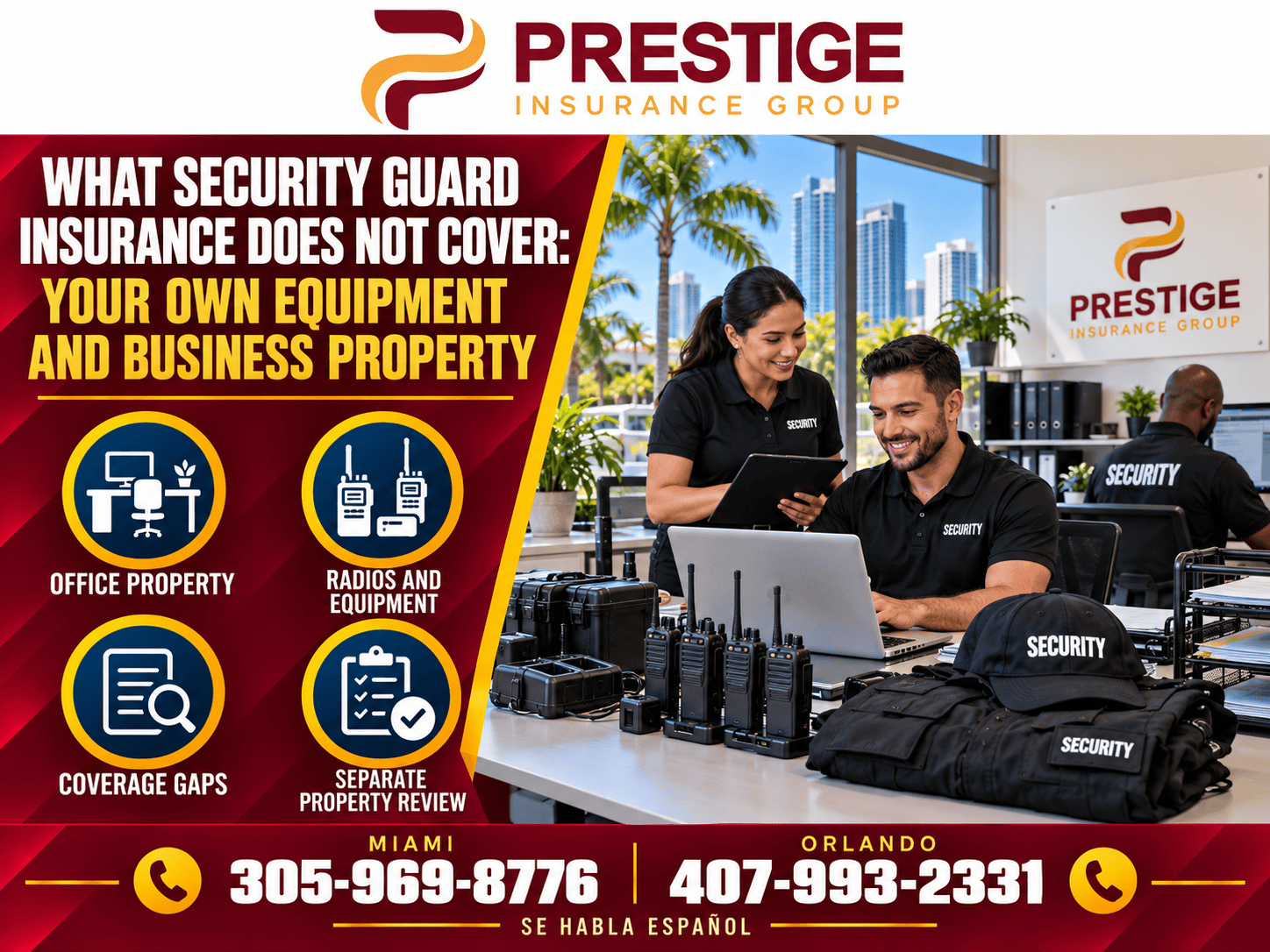
Even a small agency usually owns more than the owner realizes. Typical property includes portable radios and chargers, dispatch and base station equipment, computers, tablets and phones used for scheduling and reporting, cameras and monitoring equipment, body cameras, guard tour and patrol tracking systems, uniforms and inventory of new uniforms, flashlights and other duty gear, office furniture, and any improvements made to a leased office. Some companies also own equipment installed at client sites, such as cameras or access control hardware, or loan equipment to officers who take it home between shifts.
The useful exercise is to list everything the company would have to replace if the office burned down or a vehicle full of gear was stolen, and estimate what replacing it would cost today.
Commercial Property and Inland Marine Do Different Jobs
Two kinds of coverage handle most of this property. A commercial property policy, often written as part of a package or a business owners policy, covers business personal property at the company’s office, such as furniture, computers, the dispatch console and stored inventory. It responds to covered causes of loss like fire, wind and theft at the insured location.
Equipment that moves is a different matter. Radios carried by officers, body cameras, laptops taken to client sites and gear kept in patrol vehicles spend most of their time away from the office. A property policy may provide little or no coverage for property away from the premises. Inland marine coverage, often written as a contractor’s equipment or miscellaneous equipment floater, follows scheduled or blanket equipment wherever it goes. For a company whose equipment is in the field most of the time, inland marine is usually the more important of the two.
Property installed at a client’s site raises its own questions, especially if the contract says who is responsible for it. Reading those contract terms, and listing that equipment specifically if the company bears the risk, avoids arguments after a loss.
Mobile and Multi-Site Operations Need More Attention
A company that runs patrol routes, staffs several sites, or sends supervisors between posts has equipment scattered across many locations at any given time. That pattern increases the chance of theft from vehicles, loss at a client site and damage in transit. It also makes it harder to prove what was where when something goes missing. Keeping an equipment inventory with serial numbers and assignments to specific officers or vehicles helps both with loss prevention and with claims.
Business Income and Data
Physical property is only part of the picture. If a fire or a hurricane shuts down the office, the company may still have to pay officers, rent and other expenses while it relocates dispatch and rebuilds records. Business income and extra expense coverage, which is triggered by a covered physical loss, can help pay for that period. Our article on business income coverage in Florida explains how it works.
Data is another gap. Scheduling systems, client files, incident reports and payroll records live on computers and in cloud accounts. Losing them to a ransomware attack is not a property loss in the ordinary sense, and cyber coverage is the policy designed to respond.
Vehicles Are a Separate Policy
Patrol vehicles and the equipment mounted in them, such as light bars, cameras and radios, raise both auto and property questions. The vehicle itself belongs on a commercial auto policy, and permanently attached equipment may or may not be covered under that policy depending on how it is declared. Loose equipment inside the vehicle usually needs inland marine coverage. If officers use their own cars, the company’s exposure is different again, and hired and non-owned auto liability becomes important, as our article on hired and non-owned auto insurance explains.
Worth Confirming With Your Agent
-
Whether you carry property coverage for your office contents and at what value
-
Whether radios, body cameras and laptops used in the field are covered away from your office
-
Whether equipment installed at client sites is your responsibility under your contracts
-
How equipment in patrol vehicles is covered, on the auto policy or an inland marine floater
-
Whether you have business income and extra expense coverage for the office
-
Whether you carry cyber coverage for scheduling, client and payroll data
-
Whether your equipment inventory is current and includes serial numbers
This article is general information and is not legal advice.
Talk to Prestige Insurance Group
Prestige Insurance Group works with security guard companies throughout Florida, and we look at the whole program, not only the liability that clients ask about. If you are not sure how your radios, cameras, office and vehicles are covered, we can review what you have, identify the gaps and place property, inland marine and the rest of your coverage through the right markets.
Call the office nearest you. Se habla español.
Orlando: 407-993-2331
Miami: 305-969-8776
Stuart: 772-247-3788
Prestige Insurance Group, License L057894