A Coconut Grove couple leave Dinner Key on a Friday morning for a long weekend in Bimini. On Saturday afternoon a squall pushes their boat onto a coral head outside the harbor, and the repair estimate comes back at forty thousand dollars. When they call their carrier from the dock, they learn that their navigation territory stops at U.S. waters, and that the policy they had paid for every year never left Florida with them.
Boat insurance covers sudden and accidental losses. Almost every exclusion in the policy follows from that single principle: if a loss developed slowly, was avoidable or arose from how the vessel was used rather than from an accident, the policy probably does not respond. Here is what that means in practice, and where Florida owners most often discover the gap at the worst moment.
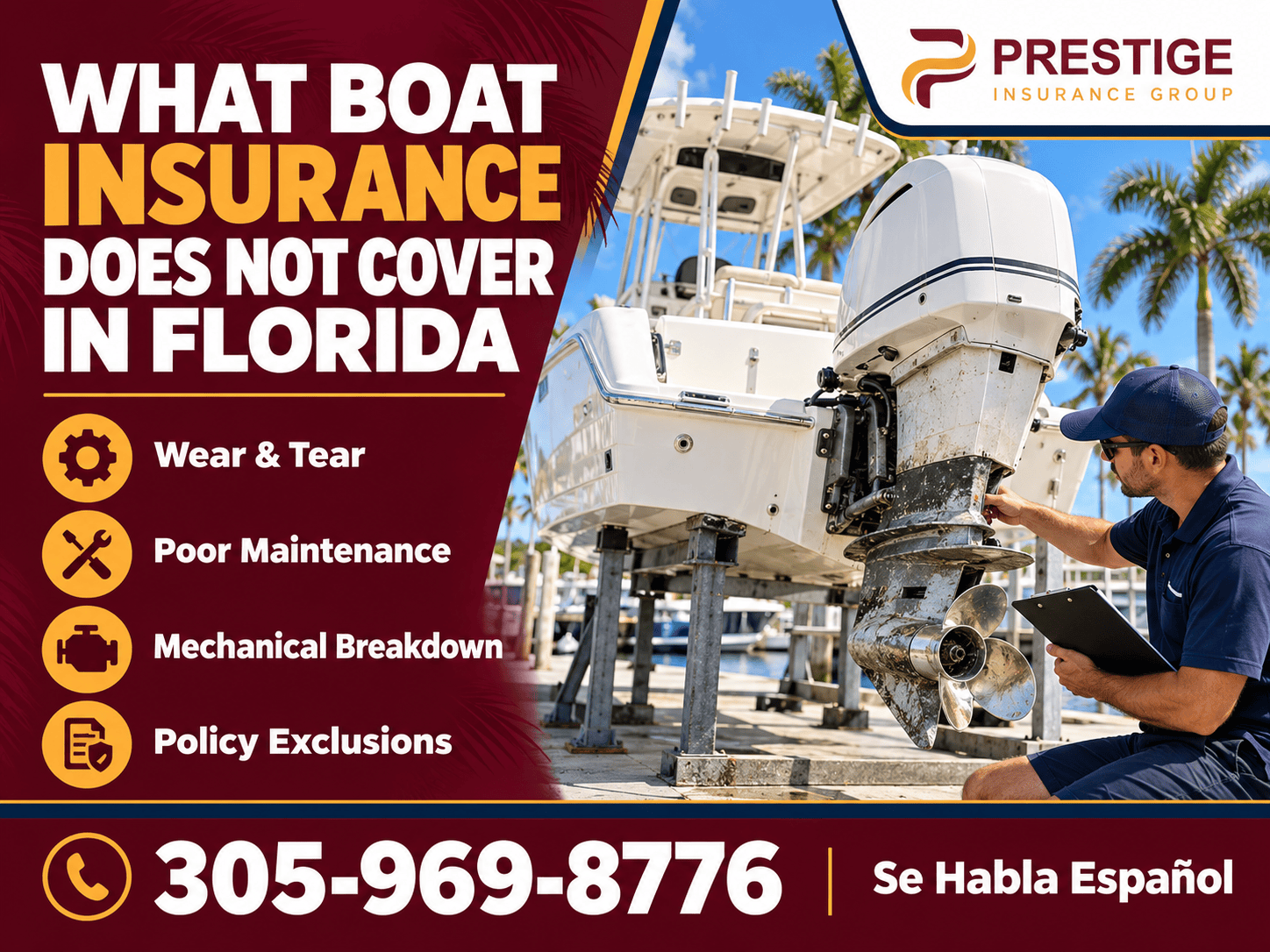
Wear, Corrosion and Anything That Happened Slowly
The largest category of denied claims is not really an exclusion at all. It is the boundary of what insurance is for. Fading, rust, corrosion, deteriorated seals, aging upholstery, worn flooring, old wiring, cracked hoses, rot, mold, mildew, delamination and blistering are all consequences of time rather than of an event. So is marine growth, since barnacles and other organisms fouling the hull and underwater components are treated as maintenance, not damage.
Florida accelerates all of it. Sun, heat, humidity, saltwater and year-round use age a vessel faster than almost anywhere else, which makes maintenance more important here, not less, and it does not convert deterioration into a covered loss. The related trap is a slow leak. Water intruding through a worn seal over months causes real damage, and because the cause was gradual and detectable, the resulting damage is generally excluded too.
Carriers also decline claims where the loss traces to neglect, such as an unmaintained bilge pump, ignored warning signs, unrepaired leaks or a failure to secure the vessel before a storm. Records of routine maintenance are worth keeping for exactly this reason.
Mechanical Breakdown, and the Important Exception
Engine and transmission failure, electrical and fuel system problems, overheating, pump failure and steering failure are not covered under a standard policy when they result from age, use or internal failure. Some carriers offer a mechanical breakdown endorsement, but most owners do not have one. The exception matters: if a covered peril such as a collision, a sinking or a fire causes the mechanical damage, that damage is generally covered even though ordinary breakdown is not.
Many marine policies also include a latent defect provision, sometimes called an Inchmaree clause, which covers damage resulting from a hidden defect in materials or construction, and in some forms from crew negligence. It does not pay to replace the defective part, but it does pay for what the defect damaged. Whether your policy carries one is a reasonable question for your agent.
Commercial Use, Including an Occasional Charter
This is the exclusion most likely to produce a total denial rather than a partial one. A recreational policy assumes recreational use, so charters, fishing guide services, paid tours, rentals, listing the vessel on a rental platform, paid captain arrangements the carrier has not approved, transporting customers and diving operations all fall outside it.
Owners underestimate how little activity triggers this. “I only took a paid group out once” is enough for a carrier to deny a claim arising from that trip. Florida also requires liability coverage for boat rental and livery operators, which makes commercial use a legal question as well as a coverage one; our article on renting out your boat in Florida explains what the law requires. If money changes hands in connection with the boat, the arrangement needs to be disclosed before the trip rather than explained afterward.
Operating Outside the Navigation Territory
Every policy defines where coverage applies, and the definitions vary considerably between carriers. For South Florida owners this is the most avoidable serious gap on the list. A run to Bimini, Nassau, the Abacos or the Exumas is an ordinary weekend from Miami, Key Biscayne or the Upper Keys, and if your navigation territory stops at U.S. waters, you are operating with no coverage the moment you cross it.
Some policies extend to the Bahamas by endorsement, and some restrict coverage seasonally by limiting navigation during the hurricane months. Confirm both before any trip outside Florida waters. Our article on navigation limits covers this in more detail.
Hurricane Conditions That Can Void a Claim
Storm damage is generally covered. What catches owners is the set of conditions attached to it. Named storm deductibles are usually separate from the standard deductible and frequently calculated as a percentage of insured value rather than a flat amount. Many policies also impose haul-out or storm plan requirements, and if the policy requires the vessel to be pulled or relocated when a named storm approaches and that is not done, the claim can be affected regardless of how the damage occurred.
Policies may also specify approved storage, require compliance with the marina’s storm plan or restrict coverage based on where the vessel sits during the season. And carriers suspend binding once a storm enters the forecast cone, so coverage cannot be added or increased when a storm is already coming. Storm-related decisions belong in May, not August.
Storm Surge, Rising Water and Your Own Dock
There are two separate points of confusion here. How a boat policy treats storm surge, rising water and marina flooding depends on the form, and it does not automatically mirror how homeowners or flood policies work, so it is worth asking about directly rather than assuming.
Separately, your boat policy covers damage your vessel causes to someone else’s dock through its liability coverage, but it does not cover your own dock, lift, seawall, pier or floating dock. Those fall to homeowners insurance or flood insurance, and they often sit in a gap between the two, because waterfront structures are commonly limited or excluded on both forms.
Sublimits on Gear, Electronics and Personal Effects
Theft is covered, but the policy treats items differently depending on what was taken. Permanently attached equipment generally falls under hull coverage. Unattached items such as rods, reels, tackle, portable electronics, dive gear, coolers, phones, cameras and water sports equipment fall under personal effects or unattached equipment coverage, which typically carries a much lower limit and sometimes its own deductible.
Conditions can also apply, since theft from an unlocked vessel, theft while trailered or theft of items stored off the boat may be treated differently. Owners with substantial fishing electronics or dive equipment should ask whether those items need to be scheduled rather than assuming the general limit reaches them.
Trailers and Transport
If you trailer the boat, the trailer must be listed on the policy, because it is not automatically included. Your auto policy generally provides liability while towing but typically does not cover physical damage to either the boat or the trailer. Coverage while the vessel is being transported can also be limited, so loading and unloading, boat ramp incidents, trailer failure and transport by a professional hauler are all worth confirming. This matters for anyone running between Miami-Dade and the Keys regularly. See our auto insurance page for how the towing side works.
Who Is Allowed to Operate
Policies may restrict coverage by operator age, experience or named-operator requirements, and high-performance vessels frequently carry tighter restrictions. Florida separately requires anyone born on or after January 1, 1988 to hold a Boating Safety Education ID Card to operate a vessel of ten horsepower or more, so handing the wheel to a guest without one creates a legal problem alongside a potential coverage one. If friends, family or hired captains operate your boat, discuss it with your agent rather than assuming it is fine.
Intentional Acts, Illegal Activity and Impairment
Insurance covers accidents. It does not cover intentional damage, fraud, criminal acts or use of the vessel for illegal purposes. Boating under the influence sits in this category and carries consequences beyond the claim. Florida treats it seriously, and an alcohol-related incident involving injuries can produce criminal exposure alongside a liability claim that the policy may handle differently.
Racing and High-Performance Use
Organized racing, speed trials and competitive events are excluded unless specifically approved. High-performance vessels also face restricted underwriting in general, and some carriers will not write them at all. If the boat is fast, disclose it on the application, because a carrier that learns about it at claim time has grounds to contest.
Umbrella Coverage Does Not Automatically Include the Boat
Owners who carry personal umbrella insurance often assume it extends over the vessel by default. Umbrella policies commonly impose eligibility rules based on boat length, horsepower, personal watercraft, high-performance vessels and operator age, and they respond only if the underlying boat liability limit meets the carrier’s requirement. A vessel that is not scheduled, or underlying limits that fall short, can leave a hole in coverage the owner believed was seamless. Our article on common boating injuries in Florida shows why that limit matters.
How to Check Your Own Policy
Most of this can be resolved in one conversation. These are the questions worth asking:
-
Is the hull written on an agreed value or actual cash value basis?
-
What does the named storm deductible produce in dollars at the current insured value?
-
Are there haul-out or storm plan requirements, and what exactly do they require?
-
Where does the navigation territory end?
-
Is the trailer listed?
-
What are the limits on unattached equipment and personal effects?
-
Is salvage and wreck removal a separate limit or paid from the hull amount?
-
Is the vessel scheduled on your umbrella, and do the underlying limits meet its requirement?
Review Before a Claim, Not During One
Prestige Insurance Group helps Florida boat owners compare marine coverage across carriers and identify exactly where a specific policy stops. For the other side of the policy, see what boat insurance covers in Florida and how much boat insurance costs in Florida, or visit our boat insurance page. Call the office nearest you. Se habla español.
Miami: 305-969-8776 Orlando: 407-993-2331
Frequently Asked Questions
Does boat insurance cover mechanical breakdown?
Not ordinarily. Some carriers offer an endorsement, and damage caused by a covered peril such as a collision or fire is treated differently from breakdown itself.
Does boat insurance cover a paid charter?
No. Recreational policies exclude commercial use, and even a single paid trip can result in a denied claim.
Is my dock covered by my boat policy?
No. Your own dock, lift and seawall fall to homeowners or flood coverage, and they are frequently limited on both.
Does my umbrella cover the boat?
Only if the vessel qualifies under the umbrella’s rules and your underlying boat liability limit meets its requirement.
General information only, not legal advice. Florida boating and livery requirements, policy forms, exclusions and carrier appetite vary and change over time. Refer to your policy for the terms that apply to your vessel.