


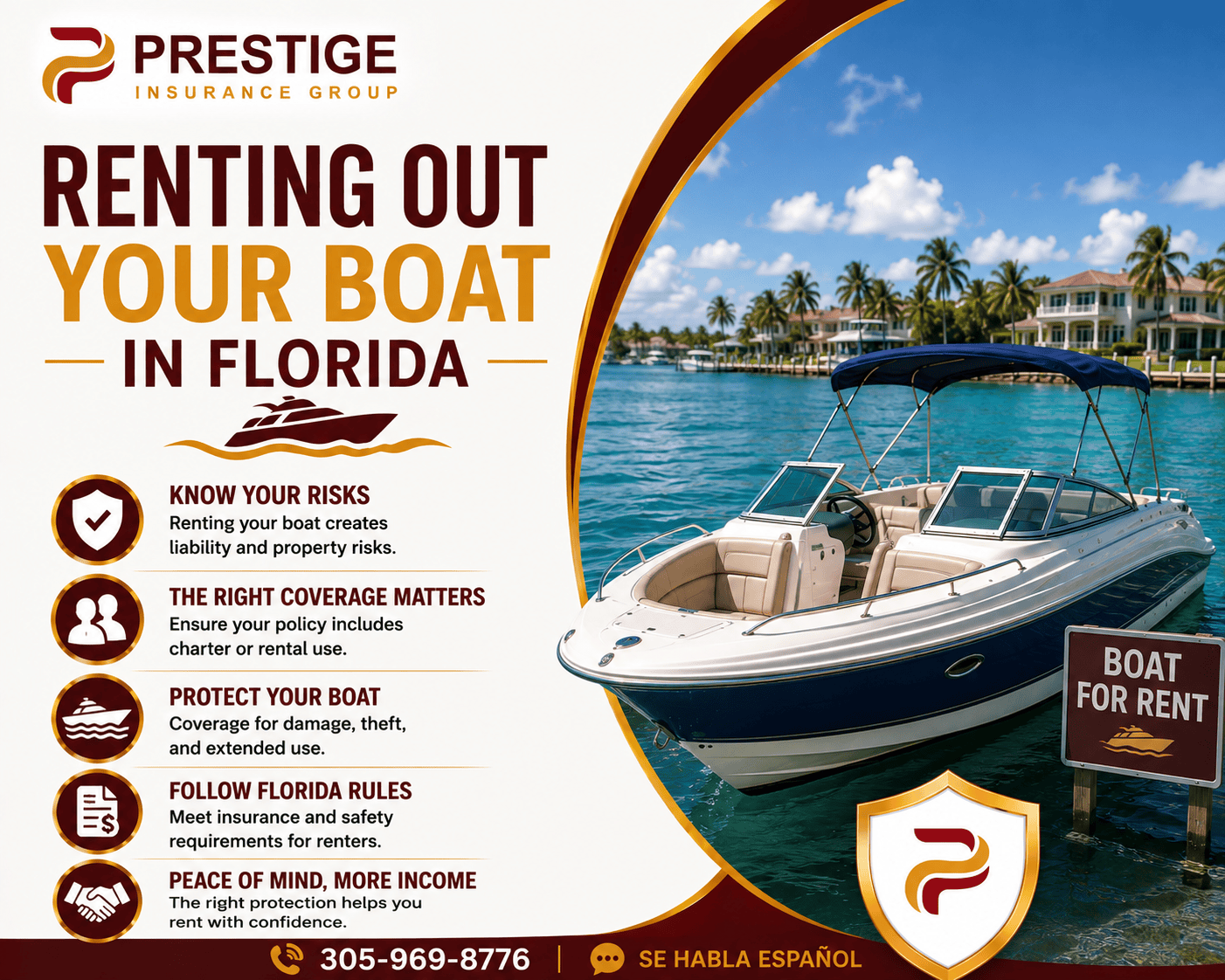
Renting Out Your Boat in Florida: What SB 606 Actually Requires
If you list your boat on Boatsetter, GetMyBoat, or a similar platform — even once — Florida law treats you as a livery. Not a boat owner who occasionally rents. A livery, with permit, insurance, and documentation obligations attached.
Most owners who list a boat do not know this. The platform makes it feel like posting a spare room, and the legal category it places you in is considerably heavier than that.
What the Boating Safety Act Changed
Senate Bill 606, the Boating Safety Act of 2022, took effect January 1, 2023 and rewrote the rules for anyone renting out a vessel in Florida.
Liability insurance is mandatory. A livery must carry coverage of at least five hundred thousand dollars per person and one million dollars per event, insuring against accident, loss, injury, property damage, or other casualty arising from operation of the vessel. Recreational boat insurance is not required in Florida; livery insurance is.
The policy must cover the renter, not just you. This is where most standard commercial policies fall short — many insure the business but not the person operating the boat.
A livery permit is required through the Florida Fish and Wildlife Conservation Commission.
Pre-rental instruction is required, delivered by someone holding a boating safety license. The renter and the instructor both sign an attestation form covering each component of the instruction, and the livery must retain that form and produce it to law enforcement on request.
Renters must be offered the opportunity to buy renter’s insurance. If they decline, you need a signed acknowledgement of refusal on file using the statutory language.
The requirement reaches motorboats, personal watercraft, sailboats, houseboats, and paddlecraft used as livery vessels. Human-powered-only rental operations are exempt.
Your Recreational Policy Does Not Cover This
This is the part that produces denied claims.
A recreational boat policy insures personal, non-commercial use. Renting the vessel is commercial activity, and the exclusion is not partial — a claim arising from a rental under a recreational policy can be denied outright, whether it is damage to your boat, injury to the renter, or a third-party liability claim from the renter’s operation.
The frequency does not matter. One weekend rental to a stranger from an app is commercial use. So is a paid arrangement with someone you know.
And the exposure is not limited to the rental period in a way owners find intuitive. An undisclosed pattern of rental activity can create problems on the underwriting side generally, since the carrier priced and issued the policy on a description of use that was not accurate.
What Platform Insurance Does and Does Not Cover
The major platforms partner with specialty insurers to provide policies designed for this exact situation, and they generally do meet Florida’s livery requirements. That is real coverage and it solves the compliance problem for the trip.
What owners misread is the scope.
It covers the booking period. Coverage attaches during the trip booked through the platform. A rental arranged directly with someone who found you through the app, or a trip that runs past the booked window, may fall outside it.
It does not replace your own hull coverage. Platform programs typically require you to hold an underlying policy for the vessel outside rental periods. Your boat still needs coverage while it sits at the dock between bookings, and that is your policy, not theirs.
Deductibles apply, often substantial, and responsibility for them varies by program.
Renter eligibility is screened by the platform, with criteria around age, driving and boating history, and background. Those screens protect the program, not you specifically, and they are not a substitute for your own judgment about who takes the boat out.
The practical structure most owners end up with is a recreational or commercial hull policy underneath and a platform rental policy layered for trips. Both need to exist, and your own carrier needs to know about the rental activity.
Boat Clubs Work Differently
Club membership is not the same as owning and renting.
In most club models the club owns the fleet and carries the coverage, and members are covered as operators under the club’s program. The questions worth asking before joining are what your liability exposure is as an operator, what damage deductible applies to you, and whether your personal umbrella extends over club use.
Where owners get into trouble is placing their own boat into a club’s fleet for use by members. That is a commercial arrangement involving your vessel, and it needs to be structured deliberately rather than assumed into the club’s policy.
Fractional Ownership and LLC-Titled Boats
Two ownership structures that complicate coverage.
Fractional or co-ownership. Multiple owners on one vessel raises questions about who is a named insured, whether all co-owners are permitted operators, and how liability is allocated when one owner’s guest is injured. Get every owner named on the policy rather than relying on a permissive-use provision.
LLC ownership. Boats are frequently titled to an LLC for liability or tax reasons. That works, but the policy must be written with the LLC as named insured and the individual operators as additional insureds or permitted operators. A policy naming an individual on a boat titled to an entity creates an insurable interest problem exactly when you least want one.
Neither structure is a way to convert commercial use into personal use. An LLC that rents the boat is still a livery.
Chartering With a Captain
A different arrangement with different rules.
A bareboat charter — the renter takes the vessel without crew — is a livery transaction under the framework above. A crewed charter, where you or a hired captain operates, moves into commercial passenger-carrying territory, which brings Coast Guard licensing and inspection requirements depending on vessel size and passenger count.
Neither is covered by a recreational policy, and the crewed version raises additional questions around the captain as a paid operator.
If You Want to Rent Your Boat
The order matters.
Tell your current agent before you list. Some carriers will decline to continue the policy once rental activity begins; better to know that in advance than at renewal or at claim time.
Obtain the FWC livery permit. It is a legal requirement, not a platform formality.
Confirm your insurance meets the statutory limits and covers the renter, not just you. Platform programs generally do; an ordinary commercial policy may not.
Understand what remains your responsibility between bookings — hull coverage, storage, maintenance, and the vessel’s condition when it goes out.
Build the documentation habit. Pre-rental instruction, signed attestation forms retained for the required period, and signed insurance refusals if a renter declines coverage. These are records law enforcement can ask for.
And decide whether the economics work after all of it. Rental income looks better before the permit, the compliant insurance, the increased wear, and the deductible exposure are counted.
Talk It Through Before You List
Prestige Insurance Group helps Florida boat owners understand what rental activity does to their coverage, what SB 606 requires, and how to structure a policy that keeps the vessel protected between bookings.
Miami: 305-969-8776 Orlando: 407-993-2331 Stuart: 561-983-4333
Se Habla Español.
Frequently Asked Questions
Does renting my boat once make me a livery? Under Florida law, renting out a vessel places you in the livery category, with permit and insurance obligations that follow.
What insurance does Florida require for boat rentals? At least five hundred thousand dollars per person and one million dollars per event, covering both the livery and the renter.
Does my recreational policy cover a rental? No. Commercial use is excluded, and a claim arising from a rental can be denied in full.
Is the platform’s insurance enough? For the trip, generally yes on compliance. It does not replace hull coverage for the vessel between bookings, and deductibles apply.
What if I title the boat to an LLC? That does not change the analysis. An LLC renting a boat is still a livery, and the policy needs to name the entity correctly.
What about joining a boat club instead? Club members are typically covered under the club’s program. Placing your own boat into a club fleet is a separate commercial arrangement.
Related Articles
Boat Insurance in Florida · Do I Need Boat Insurance in Florida · What Boat Insurance Does Not Cover in Florida · Common Boating Injuries in Florida · Short-Term Rental Insurance in Florida · Personal Umbrella Insurance