


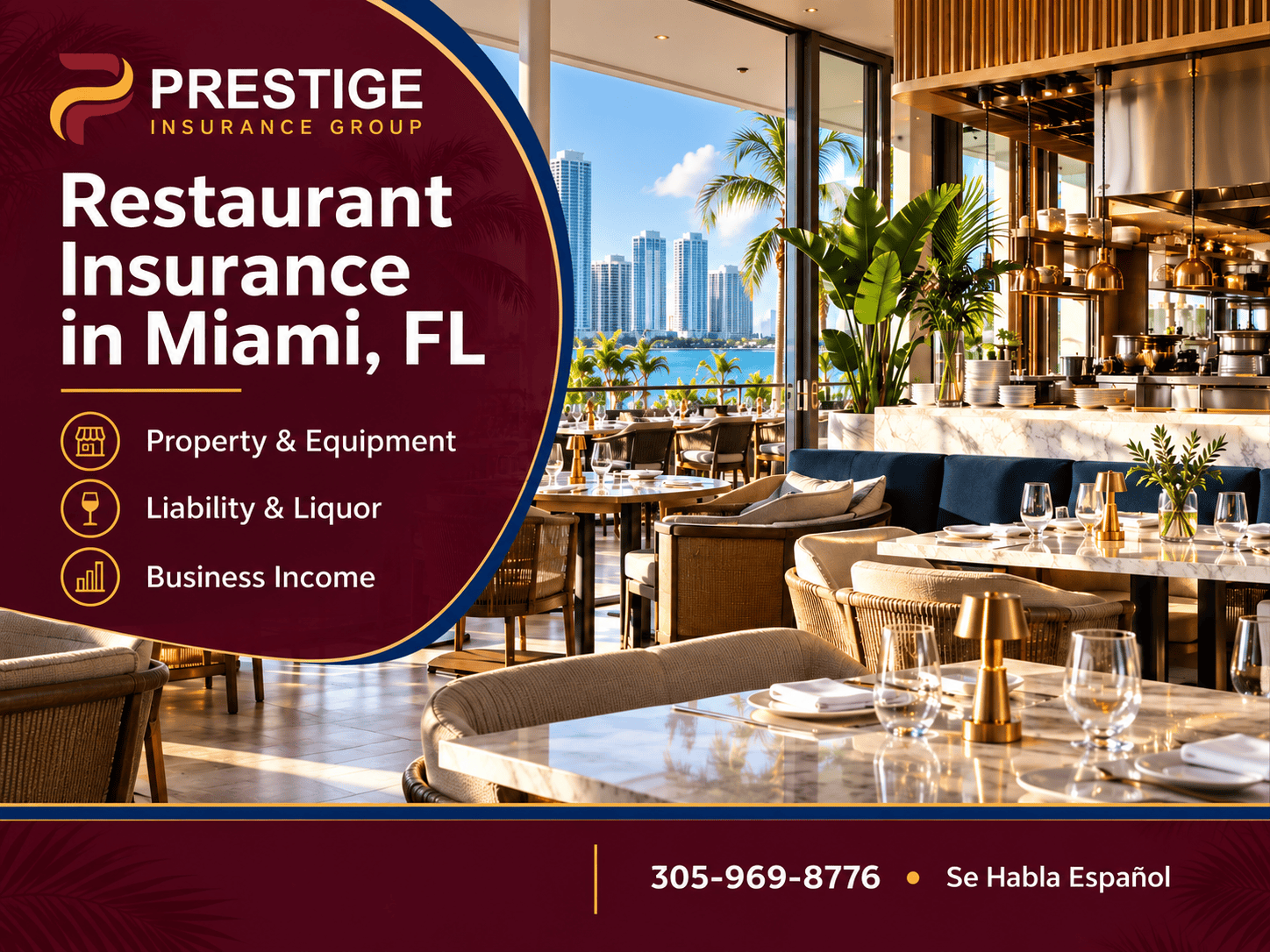
Miami is one of the most dynamic restaurant markets in the country, serving residents, international visitors, business travelers, convention crowds, and cruise passengers, often all in the same week. But treating “Miami restaurants” as one category misses something that matters for insurance. Brickell, Wynwood, Miami Beach, Doral, and Kendall have developed very different dining environments, and the neighborhood a restaurant operates in shapes how its insurance program should be built.
For an overview of restaurant coverage across the state, see Restaurant Insurance in Florida.
What a Miami Restaurant Insurance Program Includes
Every Miami restaurant starts from the same foundation. General liability covers customer injuries and damage to other people’s property, from a slip near the host stand to a guest who chips a tooth on something that should not have been in the food. Property coverage protects the kitchen equipment, furniture, inventory, and the build-out the restaurant paid for, along with business income to replace lost earnings and keep paying expenses while the restaurant is closed after a covered loss. Liquor liability is a separate coverage, and it is essential for any restaurant that sells beer, wine, or spirits, because general liability excludes most claims arising from serving alcohol. Workers’ compensation is required in Florida once a restaurant has four or more employees, and in Florida every restaurant employee, from the line cook to the server to the bartender, falls under the same class code.
Beyond that foundation, most Miami restaurants also need hired and non-owned auto for employees who drive for catering or errands, employment practices liability for the harassment, discrimination, and wage claims that busy kitchens generate, and an umbrella above the liability coverages when a landlord or the size of the operation calls for higher limits. Equipment breakdown and food spoilage are worth adding in a city where a power outage during a storm can take the walk-in cooler and everything in it with it.
The coverage questions do not change from one neighborhood to the next. What changes is which of them deserves the most attention.
Miami Is Not One Restaurant Market
A restaurant in Brickell often depends on office workers, business lunches, residents of nearby condominium towers, and evening diners. Commercial space is expensive, and owners tend to invest heavily in tenant improvements, kitchen equipment, and interior design to compete. For these restaurants, property values, the build-out, and the lease usually carry the most weight.
A Wynwood restaurant sees a different pattern, concentrated in evenings, weekends, and major events. Alcohol, entertainment, outdoor seating, and foot traffic play a larger role than they do at a Brickell lunch spot, which puts liquor liability and crowd-related exposures at the center of the program.
Miami Beach adds tourism, coastal weather, flood exposure, alcohol service, and late hours. Some establishments operate as restaurants at dinner and turn into something closer to a nightclub as the evening goes on, and underwriters price that transition carefully.
Restaurants in Doral benefit from a large corporate and international business community and a strong Latin American customer base. Catering, private events, and corporate accounts can be major revenue sources there, which brings off-premises operations, delivery vehicles, and event liability into the conversation.
In Kendall, many restaurants operate in shopping centers and serve local families and repeat customers. The profile is closer to a suburban market, and the shopping center lease and its insurance requirements often drive the program.
No Miami neighborhood is inherently riskier than another. Location shapes how a restaurant operates, and the operation is what drives the risk.
The Lease Can Matter as Much as the Menu
For many Miami restaurant owners, one of the most consequential decisions happens before the first meal is served: signing the lease.
Restaurant build-outs in Miami are expensive. Even when the building belongs to someone else, a tenant may spend heavily on commercial kitchen equipment, refrigeration, exhaust hoods, fire suppression, plumbing, electrical work, bars, flooring, lighting, and custom finishes. Once those improvements are installed, the lease decides who owns them, who maintains them, and who pays to replace them after a fire or hurricane. If the lease makes the tenant responsible, the build-out needs to be insured at its full replacement cost on the tenant’s property policy.
Miami leases also tend to spell out insurance requirements in detail, including minimum liability limits, property coverage, workers’ compensation, additional insured status for the landlord, and waivers of subrogation. Those requirements should be reviewed before the lease is signed, not when the landlord asks for a certificate a few days before opening.
An Existing Restaurant Space Is Not Necessarily Turnkey
Taking over a former restaurant can save significant construction costs, since the hood, kitchen layout, and plumbing may already be in place. But in a market where restaurant spaces turn over quickly, a second-generation space can also come with older plumbing, electrical systems, refrigeration, grease traps, HVAC equipment, roof issues, and deferred maintenance that become the new tenant’s problem, depending on the lease. Underwriters will ask about the age and condition of these systems, and updates made before opening help with both the property placement and the premium.
Accessibility deserves the same attention. A space that has operated as a restaurant for years does not automatically meet current accessibility requirements for the new operation. Our ADA Compliance for Florida Restaurants guide covers this in detail.
Hurricane, Wind, and Flood in Miami-Dade
Miami-Dade sits in Florida’s High-Velocity Hurricane Zone, and restaurant property here is priced with that in mind. Most Miami restaurant property is placed with surplus lines carriers rather than standard admitted companies, and the named storm deductible is usually a percentage of the insured values rather than a flat dollar amount. Owners should know what that deductible is in dollars before hurricane season, not after a storm.
Flood is excluded from commercial property policies and has to be written separately. Restaurants in Brickell, Miami Beach, and the neighborhoods along the bay carry real flood exposure, and kitchen equipment often sits close to the floor, where even a few inches of water can do expensive damage. Business income tied to a flood closure is a separate question as well. Our guide, Do Restaurants Need Flood Insurance in Florida?, covers how wind and flood respond differently to the same storm.
Alcohol and Nightlife Overlap More Here Than Almost Anywhere
Miami’s dining and nightlife industries blur together more than in most Florida cities. A restaurant may open as a traditional dining room and gradually add DJs, dancing, bottle service, and later closing hours. That shift changes the restaurant’s underwriting profile, and it often moves the account from a standard restaurant market into the surplus lines market, where liquor liability and assault and battery coverage are written with more care. Restaurants with entertainment should expect underwriters to ask about security staff, ID checks, closing times, and promoters. Our Liquor Liability Insurance in Florida guide covers these questions, including assault and battery coverage once entertainment and late hours are part of the business.
The Carriers Behind Miami Restaurant Programs
We place Miami restaurants with standard carriers such as Philadelphia, Liberty Mutual, Starr, and Arch, and with surplus lines carriers including Harleysville, Sierra Specialty, and Trisura Specialty for restaurants with late hours, entertainment, or property that the standard market will not take. For delivery vehicles and employment practices liability, we also work with carriers such as Progressive. Having both markets available matters in Miami, where many restaurants need a standard-market liability program paired with a surplus lines property placement.
For a detailed look at what drives premiums in this market, see What Affects Restaurant Insurance Costs in Miami and South Florida?
Restaurant Insurance for Miami Businesses
Prestige Insurance Group works with restaurants, cafés, bars, caterers, and hospitality businesses throughout Miami and South Florida, from neighborhood counter-service spots to full-service fine dining. A good restaurant insurance review starts with the operation itself, including its location, sales, staff, alcohol service, entertainment, build-out, and lease, and builds the program around those exposures.
For a restaurant insurance review, call our Miami office at 305-969-8776. Se habla español.
Related Reading
Restaurant Insurance in Florida Restaurant Insurance in Florida: Coverage, Cost & Requirements What Affects Restaurant Insurance Costs in Miami and South Florida? Liquor Liability Insurance in Florida Do Restaurants Need Flood Insurance in Florida? ADA Compliance for Florida Restaurants What Restaurant Insurance Does Not Cover in Florida



