

How Much Does HOA Insurance Cost in Florida?
There’s no meaningful statewide average that answers this question, because “HOA insurance” can describe dramatically different properties and programs. A gated single-family community with several hundred homes might have the association insuring nothing more than a clubhouse, pool, and entrance gate. A condominium association with a similar number of residents might be responsible for insuring an entire multi-story building — elevators, mechanical systems, garages, and all. Those two communities can look similarly sized on paper and carry almost nothing in common from an insurance standpoint.
Unit Count Is a Bad Proxy for Insurance Cost
The single biggest mistake boards make when estimating cost is anchoring on the number of residences. It genuinely doesn’t tell the story. Two communities with several hundred units each can have completely different amounts of association-owned property actually being insured — a traditional HOA might carry a relatively small property schedule (clubhouse, gatehouse, recreational structures) while a condo association of the same size is insuring an entire building’s replacement cost. See our HOA vs. Condo Association comparison for the full breakdown of why that structural difference matters so much — it’s the real starting point for any cost conversation, not the unit count.
Replacement Cost, Not Market Value, Drives the Property Premium
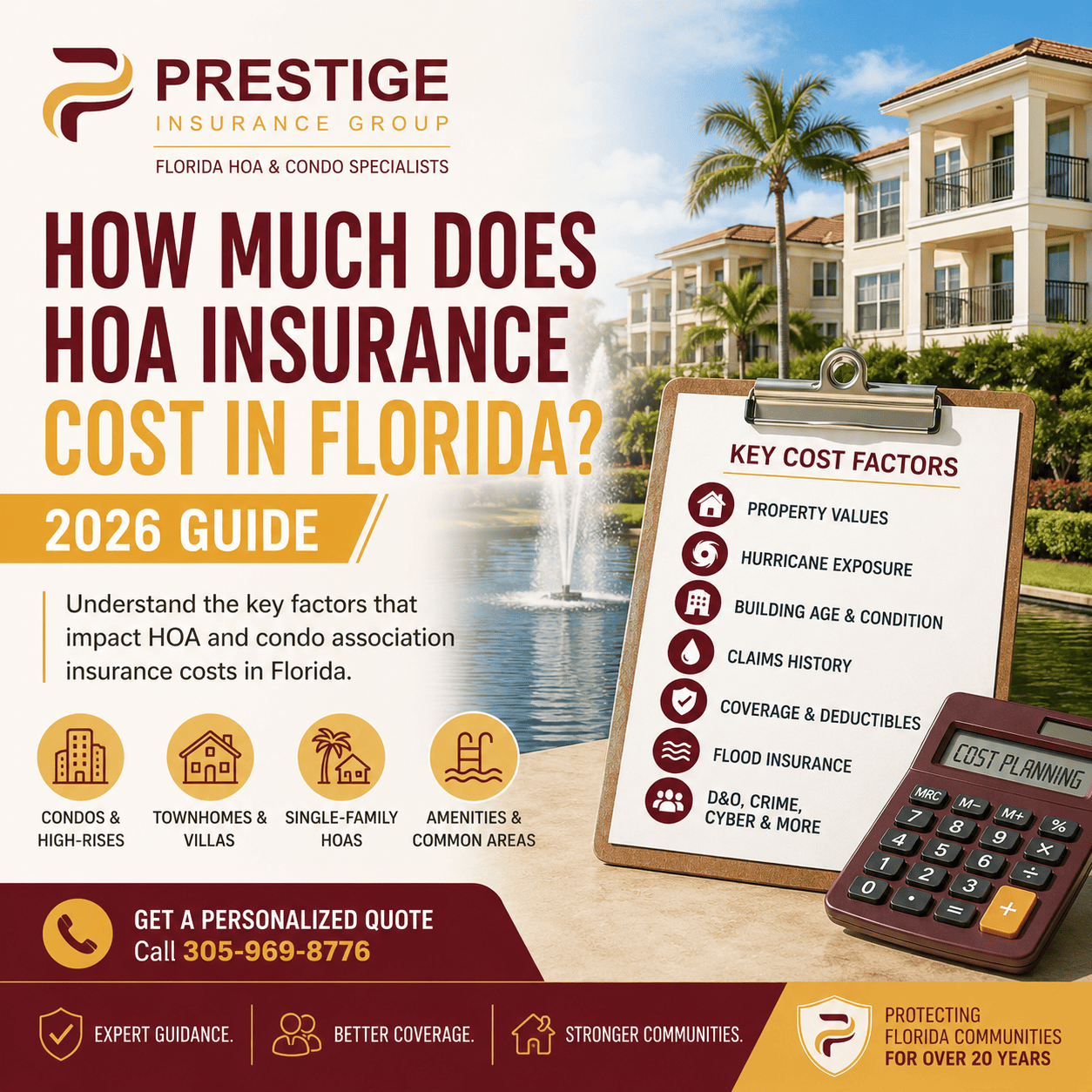
For associations with real building responsibility, property values are the single largest cost driver — and market value and replacement cost are genuinely different numbers. A waterfront condo can carry enormous real estate value almost entirely from its land and location, while the actual cost to reconstruct the building itself is a separate calculation driven by construction type, height, and current building costs. Florida condominium law reinforces this directly: adequate property insurance must be based on replacement cost determined by an independent appraisal at least every 36 months — not the building’s sale price. Construction costs also drift upward even when the physical building hasn’t changed at all — labor, materials, and code requirements all shift over time, which is exactly why an insured value that was accurate five years ago can quietly become inadequate today.
Construction, Age, and Documented Maintenance All Matter More Than the Year Built
Two buildings constructed the same decade can present completely different underwriting profiles. One may have replaced its roof, modernized electrical systems, and completed plumbing improvements; another may have deferred all of it. Age alone tells an insurer very little — condition and documentation tell the real story. An association that’s invested in its property should make sure that investment is actually visible to underwriters: permits, contractor invoices, and inspection reports turn “we believe it was updated” into a documented fact a carrier can actually price favorably. Construction type matters too — a reinforced-concrete high-rise and a wood-frame clubhouse present genuinely different property risk even at similar values, and fire protection, sprinklers, and building height all factor into how underwriters actually see the property.
Geography Is More Nuanced Than “Coastal Is Expensive, Inland Is Cheap”
Florida’s regional variation is real but not a simple coastal-vs-inland split. Miami-Dade combines some of the state’s highest property values with serious hurricane exposure. The Florida Keys face extreme coastal wind risk plus logistical challenges that can affect reconstruction cost after a major storm. Southwest Florida communities carry their own storm-surge history. Central Florida properties, despite sitting further from the coast, still face real tropical-system wind and rainfall exposure — inland location reduces certain risks without eliminating hurricane exposure altogether. The honest takeaway: a property’s actual location, construction, and elevation matter far more than which broad region of the state it sits in.
Claims History Tells a Story Only With Context
Insurers review prior losses, but raw claim counts miss the real picture. A single major hurricane claim reflects a regional catastrophe; several unrelated water losses from the same aging plumbing system reflect a systemic problem that’s likely to recur. What the association did after a loss matters as much as the loss itself — if repeated plumbing failures led to an actual plumbing replacement project, that context belongs in the underwriting submission alongside the loss history, not buried behind it. Our HOA claims guide covers using claims as genuine risk-management information rather than just a renewal-time formality.
Amenities, Employees, and Security Change the Program, Not Just the Premium Line
Pools, clubhouses, fitness centers, and recreational facilities add real property and liability value that a unit-count estimate completely misses — two similarly sized HOAs can carry very different insurance programs simply because one owns extensive amenities and the other doesn’t. The same applies to employment structure: an association employing maintenance or administrative staff directly carries workers’ compensation exposure a fully outsourced community doesn’t have to consider. And a community using a security vendor should know that spending more on guards or cameras doesn’t automatically translate into a lower premium — security is a genuine risk-management investment evaluated on its own operational merits, separate from what it does or doesn’t do to the insurance quote. Our security company insurance guide covers what actually matters when a security vendor is part of the picture.
Deductibles Move Risk, Not Cost — Understand the Actual Dollars
A lower premium achieved through a higher deductible hasn’t reduced the association’s total risk; it’s shifted more of it back onto the community. Neither a low deductible nor a high one is automatically the right choice — it depends entirely on the association’s financial capacity to actually absorb the retained amount after a real loss. Percentage deductibles specifically deserve translation into real dollars before a board evaluates them; “5%” means something very different on a $3 million property than a $30 million one. Our deductibles guide walks through that conversion in detail.
Flood, D&O, Crime, and Cyber Make “Total Premium” Comparisons Nearly Meaningless
This is worth being blunt about: comparing your association’s total insurance cost against a neighboring community’s is close to useless without knowing what’s actually included. One association may carry substantial flood coverage; another may carry none at all — and looking only at the bottom-line premium makes the second community look artificially cheaper for reasons that have nothing to do with better pricing. The same applies to D&O, crime/fidelity, and cyber coverage, which address governance, financial dishonesty, and digital fraud respectively — genuinely different risks from property and wind, priced on entirely different factors (board exposure, funds under management, digital footprint) rather than square footage or construction type. “What’s their premium” is the wrong question. “What are they actually buying for that premium” is the right one.
Why Did Our Premium Go Up?
There’s rarely one universal answer. Property replacement values may have genuinely increased. The building is a year older and may now draw more underwriting attention on a specific system. Claims may have developed since the last renewal. Broader reinsurance and catastrophe-market conditions can shift independent of anything the association did. A meaningful premium increase deserves a specific explanation from your insurance professional — not a generic “the market went up” — and it’s worth checking whether the increase reflects genuinely higher insured property value (meaning you’re now insuring more, not just paying more for the same thing) before assuming the carrier simply raised rates.
Can We Actually Lower the Cost?
Sometimes — but reducing premium and reducing total financial risk aren’t the same move. Accepting a larger deductible lowers the premium number without eliminating the underlying risk; it just relocates it back onto the association’s own balance sheet. The more durable path to a better outcome is improving the actual property: completing needed repairs, correcting whatever’s driving repeated claims, and giving underwriters better documentation to work with. None of that guarantees a lower number, since Florida pricing is shaped by plenty of factors outside any one association’s control — but it genuinely reduces physical risk and tends to expand which carriers are willing to compete for the account, which is worth more over time than chasing the cheapest renewal every year.
The Cheapest Quote Deserves Questions, Not Automatic Acceptance
A significantly lower proposal can be good news — some carriers genuinely have a stronger appetite for a given property and price it more competitively. But the board’s job is to find out why it’s lower before assuming it’s simply the better deal: compare insured property values, deductibles, whether flood is included, and whether D&O, crime, cyber, and umbrella coverage match what the more expensive proposal includes. Sometimes the gap is real competitive pricing. Sometimes it’s a program that’s quietly transferring less risk to the insurer and more onto the association. Both possibilities are common enough that the difference is always worth understanding before choosing on price alone.
The Bottom Line
There’s no single number that answers “what should our HOA insurance cost” without first understanding what the association actually owns, how it’s built, where it sits, what’s happened to it physically over time, and which policies are actually part of the comparison. The right question was never “what does a similar-sized HOA pay” — it’s “what does this community’s actual property and risk profile justify,” evaluated on its own terms rather than against a generic average or a neighbor’s premium.
Prestige Insurance Group works with Florida homeowners associations and condominium associations to build insurance programs — and cost comparisons — around each community’s actual property and risk profile. Call 305-969-8776 or request a quote online to have your association’s program reviewed, or contact our Miami office directly.