

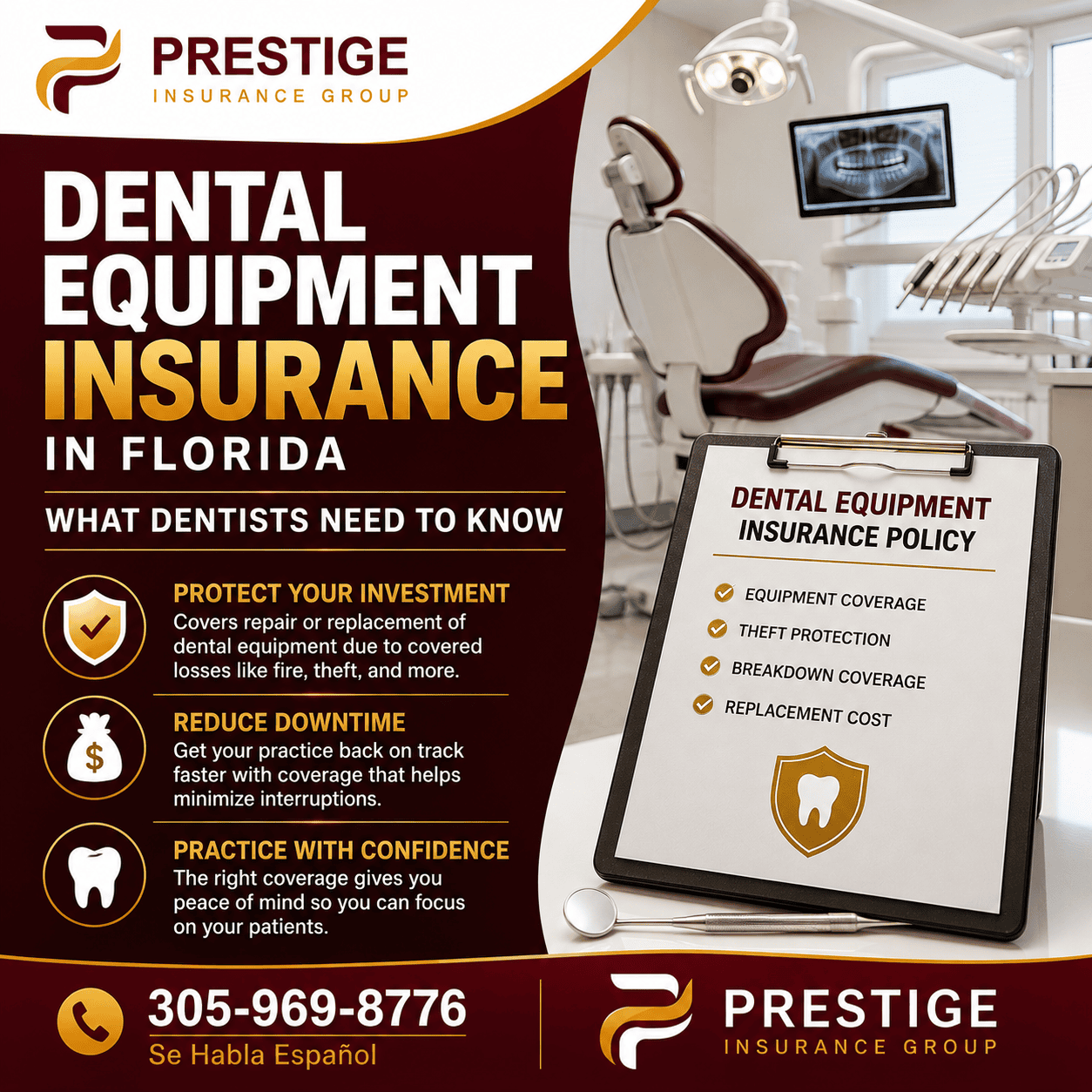
Dental Equipment Insurance in Florida: What Dentists Need to Know
Dental offices in Florida rely on specialized, expensive equipment to operate every single day — dental chairs, imaging systems, sterilization units, and precision tools represent some of the most valuable assets any practice owns. Protecting that equipment properly requires understanding a distinction most dentists never learn until they’re filing a claim: standard property insurance and equipment breakdown coverage protect against genuinely different things.
For a full overview of coverage for dental practices, see our Dental Office Insurance in Florida guide.
Standard Property Insurance Has a Real Gap Most Dentists Don’t Know About
This is the single most important thing to understand about protecting dental equipment. Standard commercial property insurance covers damage from fire, storms, theft, and vandalism — external events happening to the equipment. What it typically doesn’t cover is internal mechanical or electrical breakdown — a motor burning out, a circuit board failing, a compressor seizing from normal wear or a sudden electrical fault. If a power surge damages a set of dental chairs, that’s frequently not a covered property loss at all, since the damage didn’t come from fire, theft, or a storm — it came from an internal electrical failure. Dentists who assume their property policy automatically covers every way equipment can fail are exactly the ones who discover this gap during a claim, not before one.
Equipment Breakdown Coverage Fills This Specific Gap
Equipment breakdown coverage exists specifically to address what standard property insurance leaves out — sudden, accidental mechanical or electrical failure of equipment on your premises, including dental vacuum systems, cabinet-mounted X-ray machines, imaging systems, patient chairs, sterilization units, and compressors. This coverage typically pays for repair or replacement of the failed equipment, commonly subject to a modest deductible around $1,000, and can also reimburse lost income if the breakdown actually shuts down operations — often after the first several hours of normal business time affected, rather than covering every minute of downtime from the first moment. This coverage is usually available as an endorsement added to an existing property policy, for a relatively small additional premium given the real protection it provides.
Understand the Difference Between Replacement Cost and Actual Cash Value
This distinction genuinely affects how much you’ll actually receive after a covered loss, and it’s worth understanding before a claim, not during one. Actual cash value (ACV) pays the equipment’s fair market value at the time of loss — original cost minus depreciation — which can be considerably lower than what it would actually cost to replace older equipment today. Replacement cost value (RCV) pays what it would actually cost to replace the damaged item with new equipment of similar kind and quality, without any deduction for depreciation. Most policies only offer replacement cost coverage on equipment less than five years old; equipment older than that is frequently valued on an actual cash value basis by default. If your practice’s imaging systems or chairs are aging, confirming exactly which valuation method applies — and whether upgrading to replacement cost coverage makes sense — is worth a direct conversation with your agent.
Equipment Floaters Cover a Different Situation Entirely
This is a separate coverage type worth understanding if your practice uses portable equipment — intraoral scanners, portable imaging devices, or equipment moved between multiple office locations. An equipment floater, sometimes called inland marine coverage, protects portable equipment against fire, theft, water damage, and vandalism while it’s away from your primary location — in transit, at a temporary site, or at a second office. Standard commercial property insurance generally only covers equipment while it stays at your primary location; once it leaves the premises, that coverage typically doesn’t follow it. A floater “floats” with the equipment wherever it goes. Importantly, floaters typically exclude the same mechanical and electrical breakdown risks that equipment breakdown coverage addresses — the two coverage types are complementary, not interchangeable.
Common Mistakes That Create Real Coverage Gaps
Several mistakes show up repeatedly when equipment coverage gets reviewed after a loss. Underinsuring equipment value relative to what it would actually cost to replace is common, particularly as practices add expensive imaging or CAD/CAM systems without updating coverage limits accordingly. Assuming all breakdowns are automatically covered under a standard property policy, without confirming equipment breakdown coverage is actually in place, is another. Choosing coverage based purely on premium price, without reviewing what’s actually excluded, and neglecting basic maintenance requirements that some policies condition coverage on, round out the list. Each of these is genuinely avoidable with a direct policy review rather than assuming existing coverage automatically handles every scenario.
What Affects the Cost of Dental Equipment Coverage
Several factors shape what equipment coverage actually costs: the total insured value of your equipment, the specific types of equipment involved (imaging and CAD/CAM systems carry different risk profiles than basic hand tools), the age and condition of that equipment, your claims history, and your location within Florida. South Florida practices commonly face somewhat higher costs than other parts of the state, reflecting higher property values and greater storm exposure. See our How Much Does Dental Office Insurance Cost in Florida? guide for the broader cost picture across a dental practice’s full insurance program.
The Bottom Line
Protecting dental equipment properly means understanding that standard property insurance, equipment breakdown coverage, and equipment floaters each address genuinely different scenarios — external damage, internal mechanical failure, and portable equipment away from your primary location, respectively. Confirming your practice actually has all three pieces in place, with valuation methods that reflect your equipment’s real age and value, is what closes the gaps most dentists don’t discover until they’re already filing a claim.
Dental Equipment Insurance for Florida Practices
Prestige Insurance Group helps Florida dental practices build equipment coverage that actually reflects their real technology investment, not a generic property policy assumption. For a Florida dental equipment insurance review, contact Prestige Insurance Group:
Miami: 305-969-8776 Orlando: 407-993-2331 Stuart: 561-983-4333
Se Habla Español.