


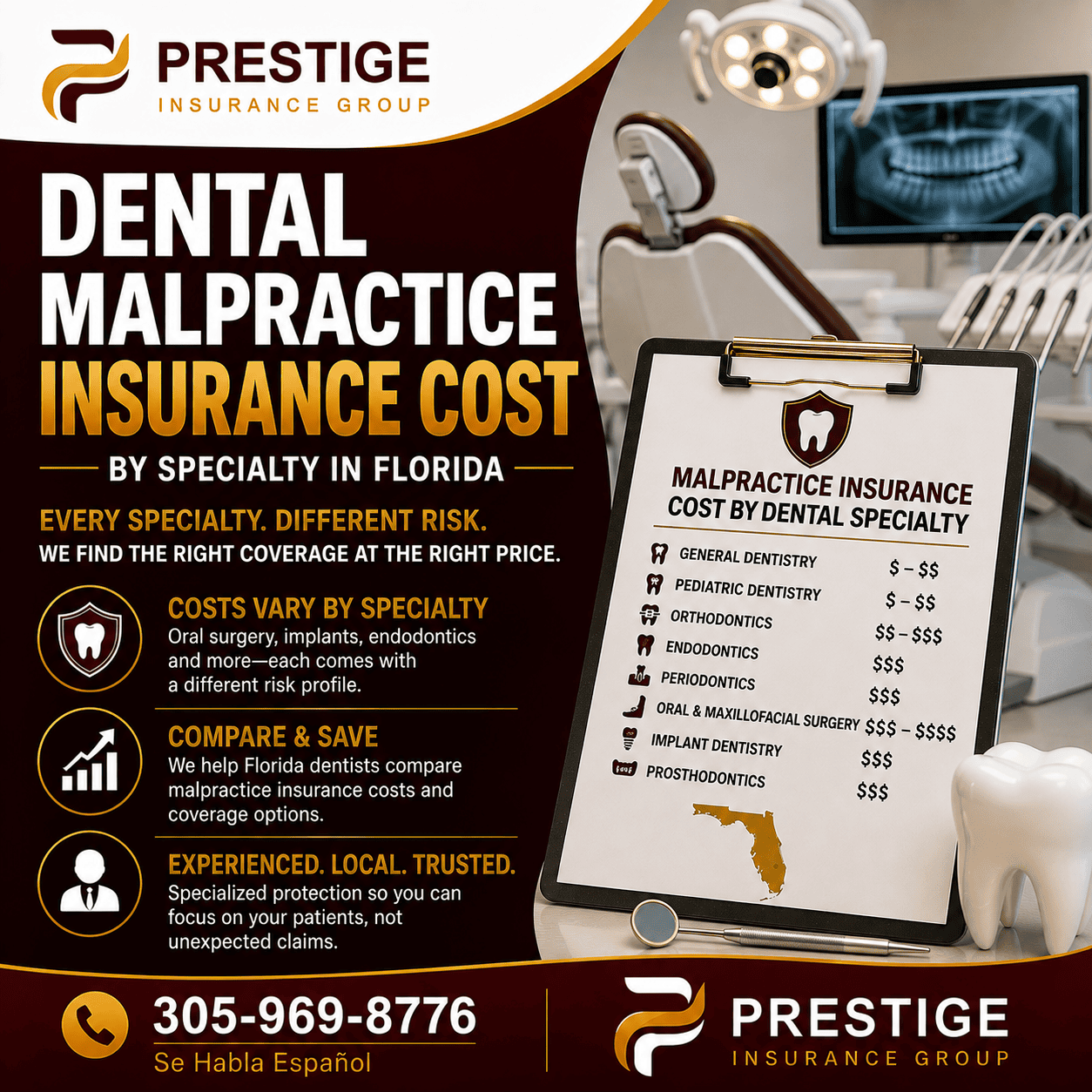
Dental Malpractice Insurance Cost by Specialty in Florida
The honest answer to what dental malpractice insurance actually costs depends almost entirely on one question: what specialty are you in, and do you sedate patients? Understanding the real range by specialty — not a single national average — is what lets a dentist budget accurately rather than being surprised at renewal.
For the broader mechanics behind these numbers, see our Medical Malpractice Insurance in Florida guide.
The Real Range by Specialty
General dentists commonly pay $1,200 to $4,000 annually for malpractice coverage, with most falling in the $2,000 to $3,500 range at standard risk. New graduates in their first year or two often pay considerably less — as low as $350 to $1,500 — reflecting both limited procedure complexity early in a career and introductory pricing many carriers offer.
Specialists face meaningfully higher premiums across the board. Orthodontists commonly pay $2,500 to $5,000 annually. Endodontists run $3,000 to $8,000. Periodontists run $4,000 to $9,000. Cosmetic-focused dentists — those offering veneers, smile makeovers, and injectables alongside restorative work — commonly pay $3,000 to $8,000, with pricing climbing further for practices actively offering Botox or dermal fillers. Oral surgeons sit at the top of the range, typically $10,000 to $25,000 annually, with some sources citing figures as high as $30,000 to $50,000 for oral and maxillofacial surgeons performing the most complex procedures.
Florida Is a Genuinely Higher-Cost State
This isn’t a generic caveat — it’s a specific, documented fact worth knowing directly. Florida is named alongside New York and Pennsylvania as one of the country’s higher-risk dental malpractice environments, meaning Florida dentists across every specialty should reasonably expect pricing toward the higher end of these national ranges, not the middle or low end. This is consistent with Florida’s broader position in national physician malpractice data as well, where the state consistently ranks among the highest for average claim payouts.
Sedation Status Divides the Market More Than Specialty Does
This is the single most important pricing factor worth understanding, and it cuts across specialty lines entirely. Two dentists with identical qualifications and the same specialty designation can sit in genuinely different pricing tiers depending on whether they sedate — IV or moderate sedation carries meaningfully higher risk, and therefore meaningfully higher premiums, than nitrous oxide or oral sedation, which in turn costs more than a practice offering no sedation at all. A general dentist offering IV sedation for extractions can see pricing closer to a non-sedating specialist than to a typical general dentist, purely because of that one variable.
Implant Volume Adds a Specific, Quantifiable Premium
Practices with meaningful implant volume commonly see premiums run 15% to 25% above the baseline for their specialty, reflecting the documented failure rates and malpractice litigation share tied specifically to implant procedures — a topic covered in more depth in our Dental Implants, Patient Expectations, and Risk Management guide. This isn’t a flat surcharge applied uniformly; it scales with how central implant work actually is to a given practice’s case mix.
Career Stage Genuinely Affects Pricing, Independent of Specialty
New dentists typically enjoy meaningfully lower premiums during their first few years — commonly $350 to $1,500 — reflecting both limited procedural complexity and introductory pricing many carriers extend to build a book of newer, lower-risk business. By mid-career, general dentists commonly settle into the $2,000 to $3,000 range as their scope of practice and patient volume both increase. This career-stage discount isn’t permanent, and pricing typically rises as a dentist’s caseload and procedure complexity genuinely grow, not simply with the passage of time alone.
Real Ways to Manage Cost Without Cutting Coverage
Several genuinely legitimate strategies exist for managing premium cost without underinsuring. Joining a state dental association or a group practice can unlock pooled insurance programs with real savings, and many of these memberships include access to peer review panels that can help resolve patient complaints before they escalate into formal claims. Bundling malpractice coverage strategically with a Business Owner’s Policy or cyber liability coverage can reduce overall premium cost by roughly 5% to 25%, though this requires careful review to confirm you’re not becoming over-insured on property while under-insured on liability in the process. Standard limits of $1,000,000 per claim and $3,000,000 aggregate remain the most common structure most dentists actually carry.
What This Means for Budgeting Accurately
The honest takeaway is that “how much does dental malpractice insurance cost” genuinely depends on specialty, sedation practices, implant volume, career stage, and Florida’s own higher-risk standing nationally — not a single number that applies uniformly. A newly licensed general dentist in a non-sedating practice and an established oral surgeon performing IV sedation for complex extractions aren’t just paying different premiums, they’re operating in genuinely different risk categories that happen to share the same coverage name.
Dental Malpractice Insurance for Florida Practices
Prestige Insurance Group helps Florida dentists understand exactly what’s driving their malpractice premium and where genuine opportunities to manage that cost actually exist.
Learn more about Dental Office Insurance in Florida.
For a Florida dental malpractice insurance quote, contact Prestige Insurance Group:
Miami: 305-969-8776 Orlando: 407-993-2331 Stuart: 561-983-4333
Se Habla Español.