


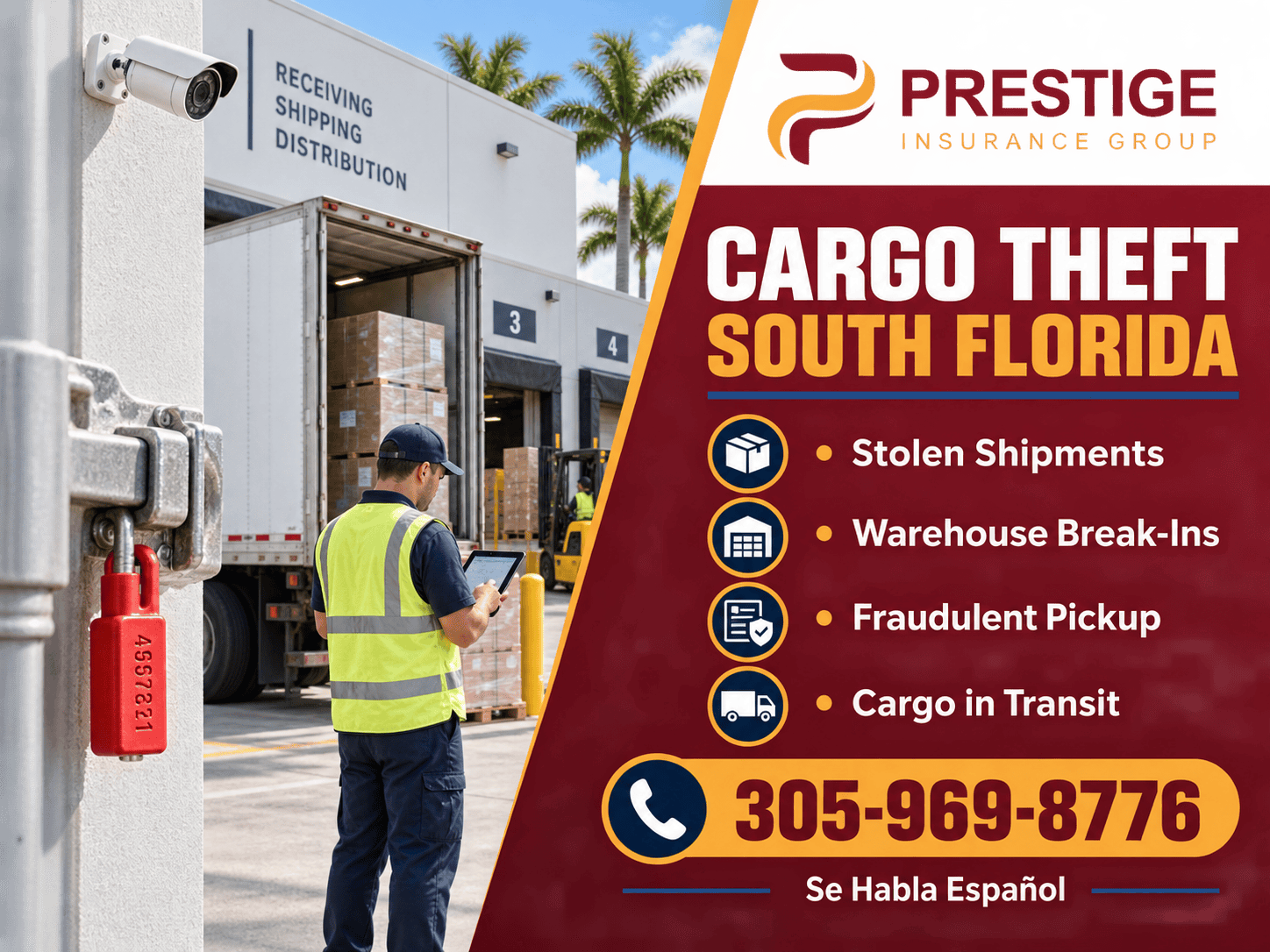
A distributor in Medley releases a full truckload of consumer electronics on a Thursday afternoon. The driver has the right paperwork, the right load number, and a tractor with a carrier name matching the one on the booking.
The load never arrives. The carrier whose name was on the tractor has never heard of it.
Nothing was broken into. Nobody forced anything. The goods were handed over voluntarily to someone who was not who he said he was, and that distinction decides whether the cargo policy responds.
Three Kinds of Cargo Theft, and Only One Is What People Picture
Straight theft is the version everyone has in mind. A trailer taken from a yard, a truck taken at a stop, a container lifted from a lot overnight. Physical, obvious, and reported as a theft.
Pilferage is quieter. Partial loads, cases missing from a sealed shipment, product disappearing between the dock and the destination. It is often an inside problem and it frequently goes undetected long enough that pinpointing where it happened becomes impossible.
Strategic theft is the growth area and the one that costs the most. It relies on deception rather than force: a fictitious pickup using stolen carrier credentials, a legitimate carrier’s identity used to book a load, double brokering where a load is re-brokered to someone who was never vetted. The goods are handed over willingly and the deception is only discovered when the shipment does not arrive.
Voluntary Parting Is the Exclusion That Matters
This is the coverage point worth the whole article.
Cargo policies are written to respond to theft. Many of them exclude, or heavily restrict, loss arising from voluntary parting — property released to someone who obtained it through fraud or deception.
A trailer stolen from a fenced yard is theft. A load handed to a driver with convincing paperwork is voluntary parting, and on a standard form that can be the difference between a paid claim and a denied one.
Coverage for fictitious pickup and identity theft of a carrier is available, but it usually requires specific wording rather than being assumed present. Any distributor or broker releasing freight to carriers should know in plain terms whether their policy addresses it.
Whose Policy Even Applies
Cargo losses get confusing because the goods move through several parties’ hands, and each has different coverage.
Your own inventory in your own warehouse is commercial property. Theft is typically covered, subject to the policy’s terms and whatever security conditions it contains.
Your goods in transit are an inland marine or cargo question, and whether you or the carrier insures them depends on the arrangement and the terms of sale.
A motor carrier hauling for you carries motor truck cargo coverage. That protects the carrier’s liability, not your interest, and the two are not the same amount.
Your goods in a third-party warehouse raise a warehouse legal liability question. That coverage pays only where the warehouseman is legally liable — negligent — rather than paying because the goods went missing. A clean theft from a properly secured 3PL facility with no negligence can produce very little.
Shippers interest coverage is the version that insures your goods rather than someone else’s liability for them, and for a distributor moving valuable freight it is often the more direct answer.
The Carrier’s Liability Is Smaller Than the Goods
Distributors routinely assume that if a carrier loses the load, the carrier pays for the load. That is frequently not true.
Interstate motor carrier liability operates under a federal framework, and carriers commonly limit their exposure through released value provisions in the bill of lading and their contract terms. The result can be a recovery measured per pound rather than at the value of the freight.
For a pallet of electronics or pharmaceuticals, the difference between the released value and the invoice value is enormous. A distributor relying on the carrier’s liability as its cargo insurance has a plan that works on paper towels and fails on anything worth stealing.
Read the limitation language in your carrier agreements, and insure your own interest where the numbers do not work.
South Florida Is a Concentration Problem
Freight moving through PortMiami and Port Everglades, the warehouse density through Medley, Doral, Hialeah, and around the airport, and the volume of high-value imported goods put an unusual amount of attractive freight in a small area.
That concentration produces organized activity rather than opportunistic theft. Operations that surveil yards, identify high-value loads, and use credentials and paperwork well enough to pass a busy shipping office are working at a different level from someone cutting a fence.
Two consequences. Underwriters know the territory and price it. And operational controls matter more here than they would somewhere freight is spread thin.
What Actually Reduces the Loss
Vet the carrier, every time. Verify the MC number and the authority status directly rather than from the paperwork presented. Confirm the insurance certificate with the issuing agent on any load worth the call. Check that the company’s contact information matches its filed records rather than what appears in the booking email.
Confirm identity at the dock. The driver’s name and the tractor should match what the carrier confirmed, and a phone call to a number you already had, not one from the load confirmation, resolves most fictitious pickups before they happen.
Control what you publish. Load boards showing commodity detail, value, and pickup windows are a targeting tool. Generic descriptions and less advance detail reduce the information available to whoever is shopping for a load to take.
Address double brokering in the contract. Prohibit re-brokering without written consent, and make it a term with consequences rather than a preference.
Secure the yard. Fencing, gates, lighting, camera coverage with real retention, and a rule about where loaded trailers sit overnight. Many cargo policies contain conditions about attended vehicles and secured locations, and those conditions become coverage arguments after a loss.
Seals and tracking. Numbered seals recorded at loading, and tracking on high-value loads, both deter and document.
Targeted Commodities Are Underwritten Differently
Electronics, pharmaceuticals, liquor, tobacco, copper and metals, designer goods, and high-value food products draw both thieves and carrier scrutiny.
Many cargo forms exclude or sublimit specific commodity categories. A distributor that has changed what it moves, or added a line, should confirm the policy still covers it rather than discovering the exclusion at the claim.
What Distributors Should Confirm
-
Does your cargo policy respond to fictitious pickup and theft by deception, or exclude voluntary parting?
-
Are you relying on carrier liability, and have you read the released value limitation in your agreements?
-
Do you carry shippers interest coverage on loads where carrier liability would not make you whole?
-
If goods sit in a third-party warehouse, is the coverage warehouse legal liability or something that pays without proving negligence?
-
Are the commodities you actually move covered, or excluded or sublimited?
-
Does your policy contain attended vehicle or secured location conditions, and are you meeting them?
-
Do your carrier agreements prohibit re-brokering without consent?
-
Do you verify carrier authority and insurance independently, on every load?
-
How long does your camera system retain footage?
Warehouse, Distribution, and Logistics Insurance in Florida
Prestige Insurance Group writes warehouses, distributors, wholesalers, and logistics operations across Miami, Medley, Doral, Hialeah, Fort Lauderdale, Orlando, and Tampa.
If you move freight worth stealing, send us your cargo policy and one of your carrier agreements. Whether voluntary parting is covered, and whether the carrier’s liability limitation leaves you short, are both answerable from those two documents.
Distributors that sell products under their own brand can be treated as the manufacturer in a lawsuit. Our page on manufacturer insurance explains how that changes the coverage.
For a complete overview, see our page on wholesaler and distributor insurance in Florida.
Call the office nearest you.
Miami: 305-969-8776 Orlando: 407-993-2331
General information only, not legal advice. Cargo, inland marine, and warehouse legal liability forms vary substantially between carriers, and the treatment of voluntary parting, fictitious pickup, commodity categories, and security conditions depends on the specific policy. Carrier liability limitations depend on the bill of lading and contract terms and should be reviewed with counsel.



