

For a manufacturer, the production line isn’t just where products get made — it’s where nearly all the revenue comes from. When that line stops, the loss compounds by the hour, not the day.
The real numbers behind manufacturing downtime are genuinely striking. Unplanned downtime costs manufacturers anywhere from $22,000 to over $300,000 per hour depending on operation size, with a widely-cited cross-industry average around $260,000 per hour for larger facilities. Smaller job shops and mid-size operations typically face a more modest — though still significant — range, with some smaller manufacturers losing roughly $5,000 per hour of downtime. The average manufacturing plant experiences approximately 800 hours of unplanned downtime per year, and 82% of manufacturers report experiencing at least one unplanned downtime event within the past three years.
At Prestige Insurance Group, we help Florida manufacturers evaluate business interruption insurance solutions designed around the real financial impact of a production shutdown. Learn more about our Manufacturer Insurance solutions.
What Is Business Interruption Insurance?
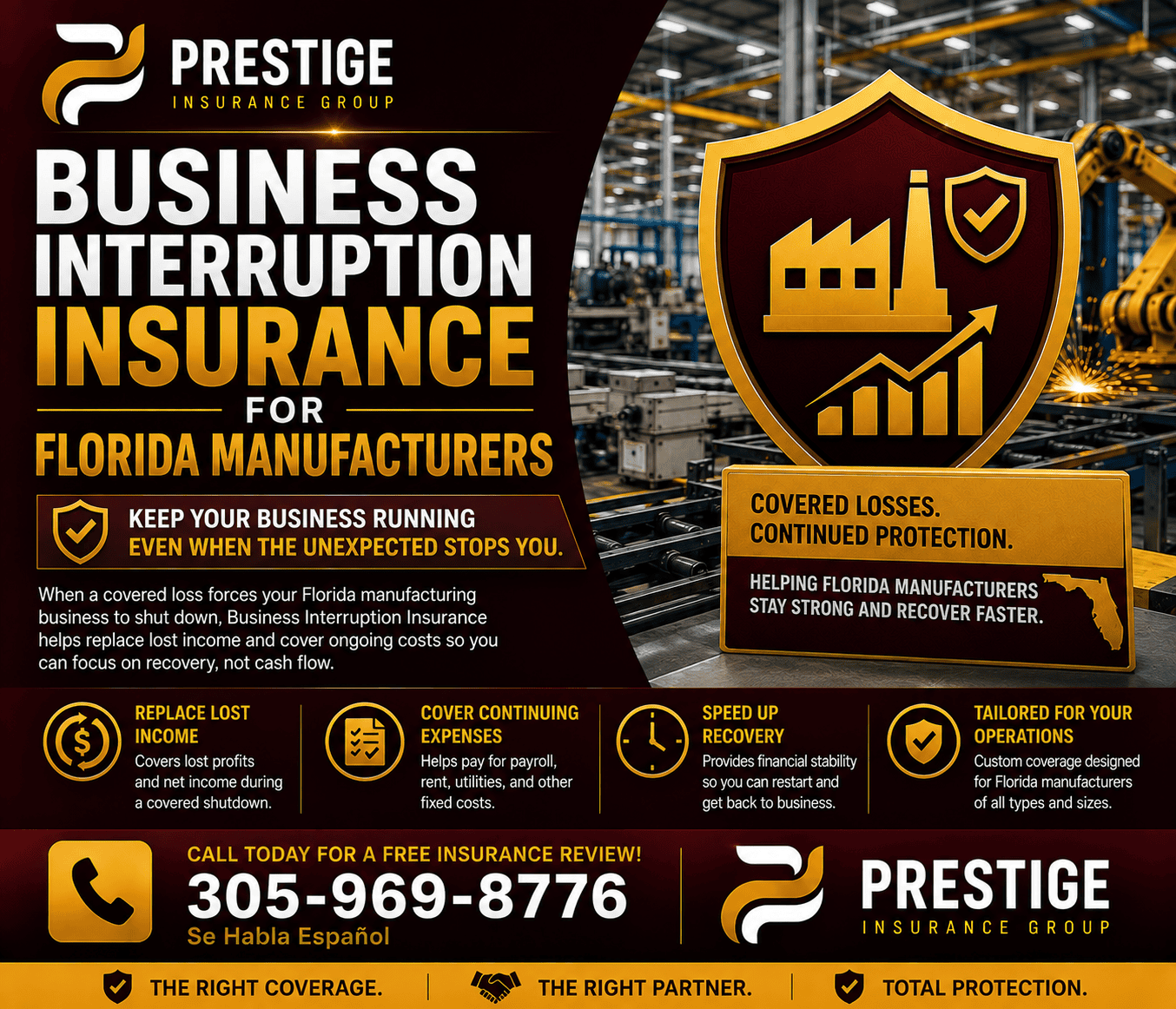
Business interruption insurance generally helps replace lost income when a covered property loss forces a manufacturer to suspend or reduce operations. Coverage may help address lost revenue, ongoing operating expenses like rent and utilities, payroll obligations, and in some cases, temporary relocation expenses — the goal is helping the business survive financially while production is restored.
Why Manufacturers Face Especially High Interruption Risk
Unlike many service businesses that can often continue operating in some capacity after a property loss, manufacturers frequently cannot generate revenue at all once production physically stops. A retail business with fire damage might still process online orders; a manufacturer whose production line is offline typically has no equivalent fallback. This is exactly why business interruption represents such a large share of total loss in manufacturing-related claims — in the context of product recalls specifically, business interruption alone accounts for roughly 49% of total recall cost, a larger share than the physical retrieval and disposal expenses combined.
Common Causes of Manufacturing Interruption
Equipment failure remains one of the leading causes of unplanned downtime, whether from aging machinery, deferred maintenance, or sudden mechanical breakdown. Equipment-related interruptions are routine for many manufacturers, with a significant share of facilities reporting at least monthly disruptions.
Fire damage can destroy or damage production equipment directly, and even facilities that avoid total destruction often face extended downtime while equipment is repaired, replaced, or recalibrated.
Hurricane and severe weather events can affect power supply, facility structure, and equipment simultaneously — genuinely significant given Florida’s exposure to storms during a substantial part of the year.
Water damage from roof leaks, plumbing failures, or storm-related flooding can affect electrical systems, automated equipment, and raw material inventory all at once.
Utility interruptions, including extended power outages, can halt automated production lines even when the facility itself sustains no direct physical damage — worth understanding, since coverage for utility-only interruptions varies significantly by policy.
The Hidden Costs Beyond Lost Production
When manufacturers calculate downtime costs, they typically count lost production output and direct repair expenses first — the visible costs. The hidden costs often exceed the visible ones by two to three times. Emergency parts ordered on short notice commonly cost 30% to 40% more than the same parts purchased through normal channels, and expedited shipping adds another layer of cost. Idle labor continues to draw payroll even when the line isn’t running. Missed shipment deadlines can trigger contractual penalties with customers. And the reputational cost of repeated late deliveries can affect customer relationships well beyond the immediate financial hit of the interruption itself.
What Business Interruption Coverage Typically Requires
Coverage generally requires a covered property loss — fire, windstorm, certain water damage events, or other covered causes of loss — to trigger the policy. This is an important distinction: a supply chain disruption, vendor failure, or labor shortage that stops production without any direct physical damage to the manufacturer’s own facility typically does NOT trigger standard business interruption coverage, even though the financial impact on the business can be just as severe.
Contingent Business Interruption for Manufacturers
Many manufacturers depend heavily on a small number of key suppliers for raw materials or components. Contingent business interruption coverage may help address lost income when a covered loss occurs at a supplier’s or customer’s location rather than the manufacturer’s own facility — genuinely important for manufacturers whose production depends on a single critical vendor, since a fire or storm at that supplier’s facility can shut down the manufacturer’s own line just as effectively as a loss at their own building.
Extra Expense Coverage Can Reduce Total Downtime
Many business interruption policies include extra expense coverage, which may help pay for measures that allow a manufacturer to resume operations faster — temporary equipment rentals, expedited repairs, or temporary production space. The goal is minimizing the total downtime period rather than simply waiting out a standard repair timeline, since every day of reduced downtime directly reduces the total interruption loss.
How Manufacturers Can Reduce Downtime Risk
Preventive and predictive maintenance programs address one of the leading causes of unplanned downtime directly, since equipment failure driven by deferred maintenance is a genuinely preventable category rather than a random event. Spare parts discipline — maintaining critical replacement components on-site rather than ordering them only after a failure — can meaningfully reduce both downtime duration and the emergency-premium costs described above. Backup power planning matters directly for facilities running automated equipment, given how quickly a utility interruption can halt production. Supplier diversification reduces the risk that a single vendor’s disruption becomes the manufacturer’s own production stoppage. And accurate, current downtime cost tracking — knowing your specific facility’s real per-hour cost rather than relying on industry averages — is itself a genuinely valuable exercise, since manufacturers who can’t quantify their own downtime cost struggle to prioritize the right prevention investments.
Business Interruption and Florida’s Hurricane Exposure
Florida manufacturers face genuine, recurring hurricane risk that businesses in many other states never encounter. A storm that damages a facility’s roof, floods a production floor, or knocks out power for an extended period can create business interruption losses that continue well after the physical repairs are complete — supply chains, transportation routes, and customer relationships often take longer to recover than the building itself.
Insurance Coverages Often Paired with Business Interruption
Commercial Property Insurance provides the underlying coverage that triggers business interruption protection. Learn more about Commercial Property Insurance.
Equipment Breakdown Coverage addresses mechanical and electrical failures that standard property insurance typically excludes — directly relevant given equipment failure’s role as a leading downtime cause.
Commercial Flood Insurance matters given Florida’s flood exposure, since standard property policies generally exclude flood damage. Learn more about Commercial Flood Insurance.
Commercial Umbrella Insurance provides additional liability protection above underlying policies. Learn more about Commercial Umbrella Insurance.
Frequently Asked Questions
Does business interruption insurance cover any production stoppage? No. Coverage generally requires a covered property loss to trigger the policy — supply chain or labor disruptions without physical damage typically aren’t covered under standard terms.
What’s contingent business interruption coverage? It addresses lost income when a covered loss occurs at a key supplier’s or customer’s facility rather than the manufacturer’s own location.
How is business interruption loss calculated? Coverage is typically based on the income the business would have earned had the loss not occurred, based on financial records, plus certain continuing operating expenses.
Does business interruption coverage include payroll? Often yes, helping address continuing payroll obligations during a covered interruption period.
Why is downtime more expensive than manufacturers expect? Because visible costs like lost production and repairs are typically only half the real impact — emergency parts premiums, idle labor, and missed shipment penalties often double the total.
Protecting Florida Manufacturers From Production Interruption
A production shutdown can affect a manufacturer’s finances long after the physical damage is repaired — and the real per-hour cost of downtime, whether $5,000 or $260,000, makes clear this is one of the most consequential risks a manufacturing business faces.
Prestige Insurance Group helps Florida manufacturers evaluate business interruption insurance solutions designed around the real financial impact of a production stoppage.
Contact Prestige Insurance Group today to discuss business interruption insurance for your manufacturing business:
Manufacturers that also import or distribute products should read our page on wholesaler and distributor insurance, and those running their own storage or fulfillment space our page on warehousing and logistics insurance.
Miami: 305-969-8776 Orlando: 407-993-2331
Se Habla Español.