


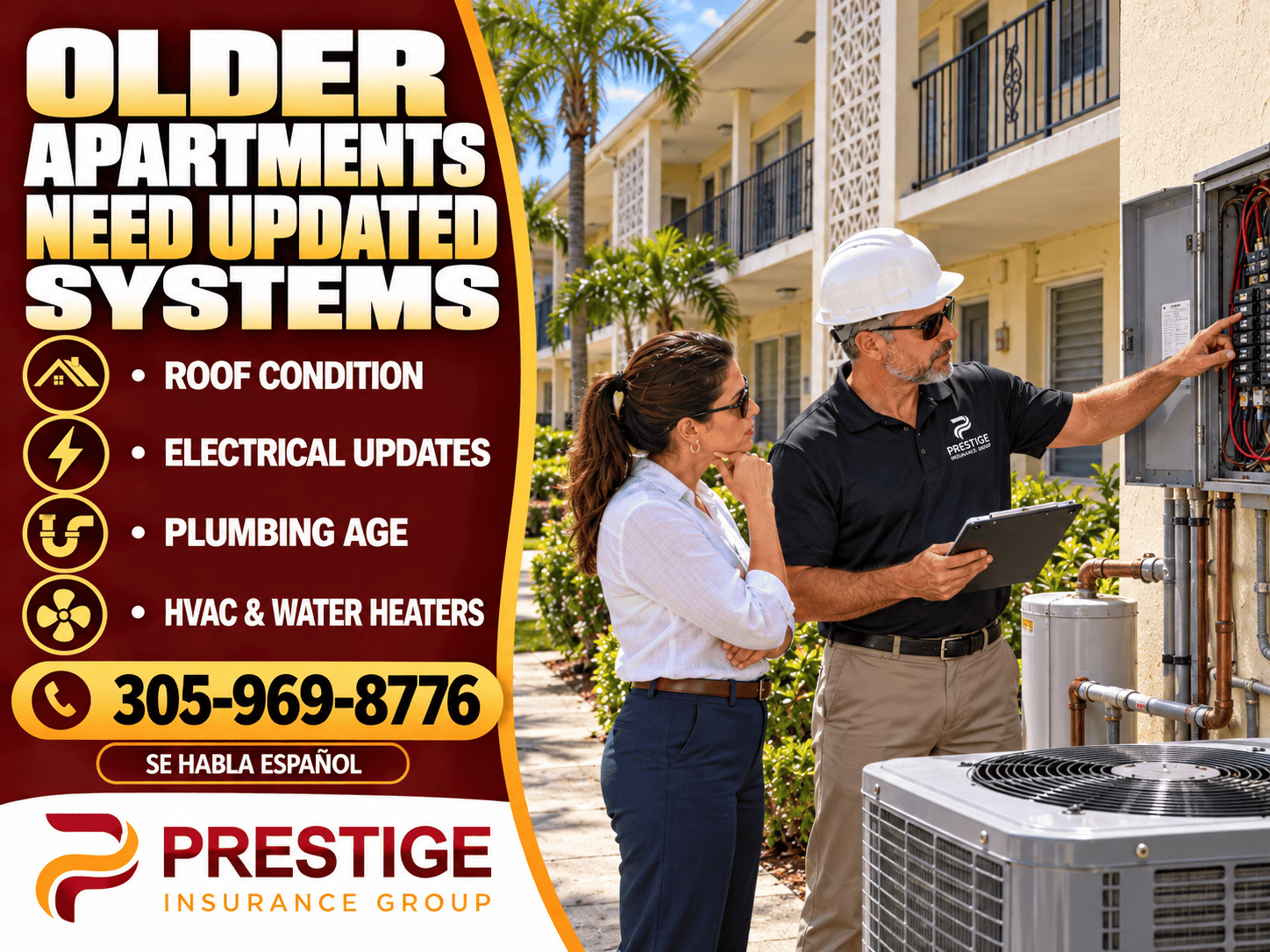
Older apartment buildings aren’t automatically hard to insure — but they do require a genuinely different underwriting conversation than newer construction, and owners who understand what carriers are actually looking for tend to get meaningfully better results than owners who simply submit an application and hope for the best.
For the coverage foundation this article builds on, see our What Does Apartment Building Insurance Cover in Florida? and What Apartment Building Insurance Does NOT Cover in Florida guides.
Age Alone Isn’t the Real Underwriting Question
There’s no single age threshold that makes a Florida apartment building difficult to insure. What actually matters to a carrier is the documented condition of the building’s major systems — roof, electrical, plumbing, HVAC — and whether they’re original to construction or have been meaningfully updated since. A 1980s building with a five-year-old roof and updated electrical can underwrite far better than a 2005 building that’s never had a system touched. The year built sets expectations; documentation of actual condition is what determines the real answer.
Roof Condition Drives More of the Conversation Than Anything Else
Roof age, material, and documented repair history carry disproportionate weight in Florida apartment underwriting, precisely because roof failures are so directly tied to both wind and water damage. Carriers frequently want to know not just how old a roof is, but whether it’s been fully replaced under permit or simply patched and coated repeatedly — a documented, permitted replacement reads completely differently than an undocumented series of repairs, even if both roofs look similar from the ground.
Some policies state that requirement as a warranty, meaning the roof age shown on the policy must reflect the year of full replacement to code rather than the year of the last repair. An inaccurate answer there can support a denial or a cancellation after a claim, which makes getting it right at application more than a formality.
Flat and low-slope roofs, common on many older Florida apartment buildings, deserve particular attention because they’re more prone to ponding water and membrane deterioration than pitched roofs, and that vulnerability shows up in how carriers price and structure coverage. It’s also worth confirming how the policy settles a roof claim — replacement cost or actual cash value, and whether any cosmetic damage exclusion applies — since on an older roof that provision decides most of what a wind claim is worth.
Electrical Systems Can Limit Which Carriers Will Even Quote the Property
Outdated electrical panels — older Federal Pacific and Zinsco panel types in particular — are widely recognized in the insurance industry as carrying elevated fire risk due to documented failure-to-trip issues, and their presence can limit carrier availability entirely rather than simply affecting price. Aluminum branch wiring raises similar questions. If an older building still has one of these systems, replacement documentation — permits, invoices, and photos — genuinely matters to the underwriting outcome, not just as a formality but because it changes which markets will even consider the property.
Plumbing Age Deserves the Same Documentation Discipline
Cast iron and galvanized plumbing, common in older Florida construction, is a real underwriting concern given how much Florida apartment claims activity traces back to water damage — and in multifamily buildings specifically, a single plumbing failure can spread through multiple units before anyone notices.
An owner who can document when plumbing was updated, and with what materials, presents a meaningfully different risk profile than one relying on a vague statement that the plumbing has been updated. Underwriters generally want to know three things: whether the building was fully repiped or only partially, what material was installed, and whether the drain lines were replaced along with the supply lines. Cast iron drains fail slowly and repeatedly, and a building that replaced supply lines while leaving original drains in place has answered only half the question.
Ordinance or Law Exposure Is Larger on Older Buildings, Not Smaller
This is one of the more consequential coverage gaps specifically tied to building age. A structure that fully complied with code decades ago may not simply be rebuilt as it was after a major covered loss — current code can apply during reconstruction, sometimes touching structural, electrical, fire-protection, or accessibility requirements the original building never needed.
The coverage comes in three parts: the value of the undamaged portion that must be demolished, the cost of demolition and debris removal, and the increased cost of construction. Many policies carry the first and little of the other two, and the gap tends to be largest precisely on the properties where it’s most often underinsured — older buildings where ownership assumed the existing limit was adequate because it always had been.
Equipment Breakdown Matters More as Mechanical Systems Age
Older HVAC systems, boilers, pumps, and elevators are more likely to experience a sudden mechanical or electrical failure than newer equipment, and standard commercial property insurance doesn’t cover that kind of internal breakdown — it’s a distinct coverage designed specifically for that gap. For an older apartment building with meaningful mechanical infrastructure, equipment breakdown coverage deserves the same deliberate review as the property and liability lines, not an assumption that it’s automatically included.
Balconies, Stairs, and Walkways Age Too
On the liability side, elevated areas are where age produces severity. Balconies, exterior corridors, stairs, and railings deteriorate gradually, and in a coastal environment salt and moisture accelerate corrosion in railings and concrete spalling in structural elements.
A fall from an elevated area is a categorically different claim than a ground-level trip, and these conditions develop slowly enough that they are visible long before they fail. Documented inspection of railings, stair treads, and walkway surfaces, with prompt repair of what the inspection finds, protects both the residents and the eventual defense.
Real Estate Investors Should Investigate Insurance Before Closing, Not After
An older apartment building can look financially attractive on paper and become considerably less so once a realistic insurance premium — or a carrier’s outright reluctance to write it — enters the picture. Roof condition, electrical and plumbing systems, prior loss history, and flood zone should all be investigated during due diligence, while there’s still time to factor the findings into the purchase price or negotiate repairs as a condition of closing. Discovering a serious coverage or pricing problem after the deal has already closed leaves the investor with far fewer options than discovering it beforehand.
Documentation Is the Single Most Effective Thing an Owner Can Control
Every category above points to the same underlying lesson: carriers aren’t necessarily looking for a perfect building — they’re evaluating whether the owner is actively managing and documenting the property’s condition. Roof permits and inspection reports, electrical and plumbing update records, HVAC service history, and photographs of completed work can all meaningfully change underwriting outcomes on an older property. An identical building with strong documentation and one with none can receive very different treatment from the same carrier, which makes documentation one of the few underwriting factors genuinely within an owner’s control.
The Bottom Line
Older Florida apartment buildings aren’t a red flag by default — many of the state’s best-performing multifamily investments are decades old and simply well maintained and well documented. The difference between a good outcome and a costly surprise almost always comes down to whether the roof, electrical, plumbing, and ordinance or law exposure were investigated and documented proactively, or discovered for the first time during a claim.
Prestige Insurance Group helps Florida apartment building owners and real estate investors evaluate insurance considerations on older properties, ideally before a purchase closes or a policy renews with outdated assumptions. To review insurance for an older Florida apartment building, contact Prestige Insurance Group:
Miami 305-969-8776 · Orlando 407-993-2331
Se Habla Español.
Related Reading
This article is for general informational purposes only and is not legal advice. Policy forms, warranties, endorsements, and carrier guidelines vary; refer to your policy and application for the terms that apply to your property. Prestige Insurance Group, Florida agency license L057894.



