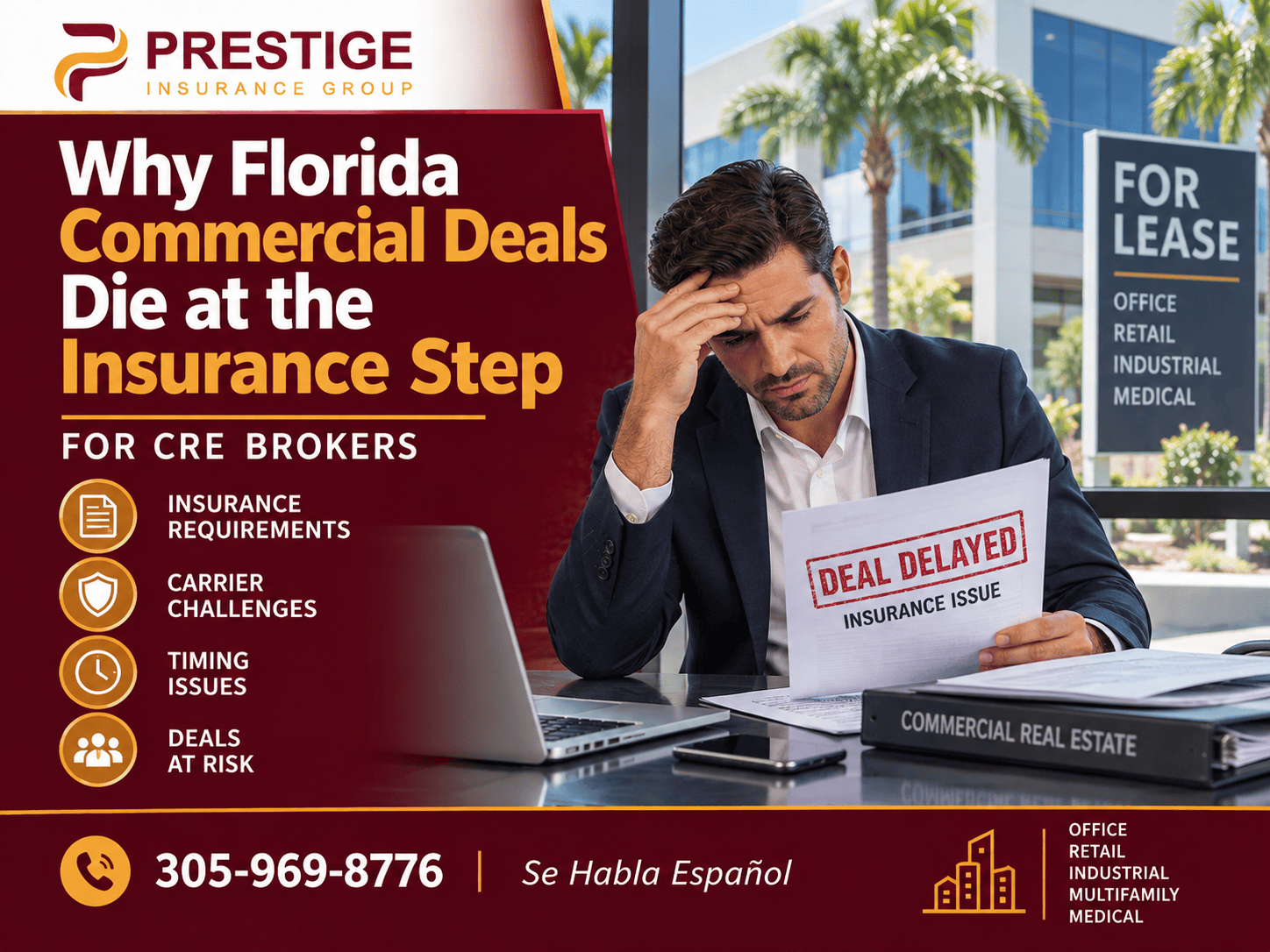
A commercial broker in Westshore has a forty-thousand-square-foot flex building under contract with a buyer from North Carolina. Financing is approved, the environmental report is clean and the estoppels are coming back. Three weeks before closing, the buyer’s lender asks for the insurance binder, and the buyer’s agent back home sends over a quote that is far above what the pro forma assumed. Two carriers declined outright because of the roof. The buyer asks for a price reduction, the seller refuses, and a deal that looked finished starts to unravel over a line item nobody discussed at the letter of intent.
This happens in Florida more often than brokers in other markets would expect, and it almost always happens late, when there is the least room to fix it. Most of what causes it can be seen much earlier. A broker who knows what underwriters will look at can raise those questions at listing or early in due diligence, when they are a pricing conversation instead of a crisis.
Why Insurance Has Become a Deal Issue in Florida
For most of the country, property insurance on a commercial building is a cost that gets confirmed near closing and rarely changes the outcome. Florida is different. Wind exposure, building age, roof condition and loss history drive both the price and whether coverage is available at all. A building that would be routine to insure elsewhere can have a short list of willing markets here, and those markets price by scarcity as much as by risk.
That changes the role insurance plays in a transaction. It affects the buyer’s net operating income, the lender’s approval, the reserves the buyer needs and sometimes whether the building can be financed in its current condition. Treating it as a closing formality is what turns it into a closing problem.
Roof Age Decides Whether the Building Can Be Insured
The roof is the single most important item, and it is often treated as a maintenance question rather than a transaction one. Carriers apply roof age limits that vary by roof type and by market. A building past a carrier’s limit does not get a higher quote; it gets a decline. Each decline narrows the remaining options until what is left is expensive and restrictive.
Brokers can help by asking for the roof’s age with documentation, such as permits and invoices, rather than relying on the seller’s recollection. Underwriters treat a roof of unknown age as the oldest plausible age. A roof approaching a carrier’s limit is better raised as a price conversation at offer than discovered after contract. Two policy provisions also matter: whether the roof will be settled at actual cash value rather than replacement cost, and whether a cosmetic damage exclusion applies. On an older roof, those terms can reduce a wind claim to a fraction of the repair cost, and the buyer should know that before closing.
The Insurance Number in the Pro Forma Is Often From Another Market
Buyers from outside Florida frequently model insurance using what they pay in their home markets. That number tends to be wrong in a predictable direction, and the correction usually arrives after the buyer is committed to the deal.
The fix is simple: get an indication on the specific address early. An agent who writes Florida commercial property can usually provide a realistic range quickly once they have the building’s age, construction, roof information, occupancy and loss history. A realistic number at offer is worth much more to the deal than an unrealistic one discovered three weeks before closing.
The Hurricane Deductible Is a Percentage
Florida commercial property policies typically carry a named storm or hurricane deductible expressed as a percentage of the insured value rather than a flat dollar amount. Buyers who are new to the state often read the premium on a proposal and miss what that percentage means in dollars. On a building insured for several million dollars, even a modest percentage can mean a six-figure amount the owner must absorb after a storm.
That affects the transaction in two ways. The buyer needs to be capitalized for it, and lenders often set a maximum deductible in the loan documents. A buyer who chooses a higher percentage to lower the premium may be in conflict with their own loan requirements. Raising it during due diligence avoids an argument with the lender at closing.
Flood Is Separate, and the Map Is Not the Whole Story
Flood is excluded from standard commercial property policies and has to be written separately, either through the National Flood Insurance Program or a private flood market. The flood zone determines whether the lender requires flood coverage, but it does not tell the whole story about the risk. Buildings outside high-risk zones still flood, and pricing increasingly depends on the property’s own characteristics, such as elevation and distance to water.
An elevation certificate is worth requesting early. It affects pricing, it affects which private markets will consider the building, and it can take time to produce when everyone is trying to close.
Loss History Follows the Building
A property with recent claims is priced with that history in view, and the buyer inherits it even though the buyer did not cause it. Carriers typically ask for several years of loss runs, and a recent water or wind loss can limit options or raise the price. Asking the seller for loss runs early, along with documentation of repairs made after any claim, lets the buyer’s agent present the building accurately instead of leaving underwriters to assume the worst.
Condition, Occupancy and Contract Requirements
Underwriters also look at electrical, plumbing and fire protection systems, especially in older buildings, and at who occupies the space. A tenant mix that includes restaurants, auto repair or other higher-hazard uses can change the price or the markets available. Leases matter too. Tenants and lenders may require the owner to carry specific limits, name them as additional insureds or waive subrogation, and those requirements need to fit the policy the buyer can actually obtain. Our article on buying an older commercial building in Florida covers the condition questions in more detail, and replacement cost vs. market value explains why the insured value rarely matches the purchase price.
When to Bring in an Insurance Agent
The best time to involve an agent is at the letter of intent or the start of due diligence, not when the lender asks for the binder. An early indication gives the buyer a realistic number, identifies any condition that could cause declines and leaves time to solve problems through price, credits or repairs. For brokers, it protects the deal and the relationship with both sides.
Worth Confirming With Your Agent
-
The roof’s age, type and documentation, and whether carriers will write it at replacement cost
-
A realistic premium indication on the specific address before the buyer finalizes the pro forma
-
The hurricane deductible in dollars and the maximum deductible the lender will allow
-
Whether flood coverage is required, and whether an elevation certificate exists
-
Five years of loss runs and documentation of any repairs
-
Lease and lender insurance requirements, and whether the available policy can meet them
This article is general information and is not legal advice.
Talk to Prestige Insurance Group
Prestige Insurance Group works with commercial buyers, owners and brokers across Florida, and we can provide early indications on specific properties through standard and specialty markets. If you have a building under contract or about to list, bring us in early and we will tell you what underwriters are likely to see.
Call the office nearest you. Se habla español.
Orlando: 407-993-2331
Miami: 305-969-8776
Stuart: 772-247-3788
Prestige Insurance Group, License L057894