


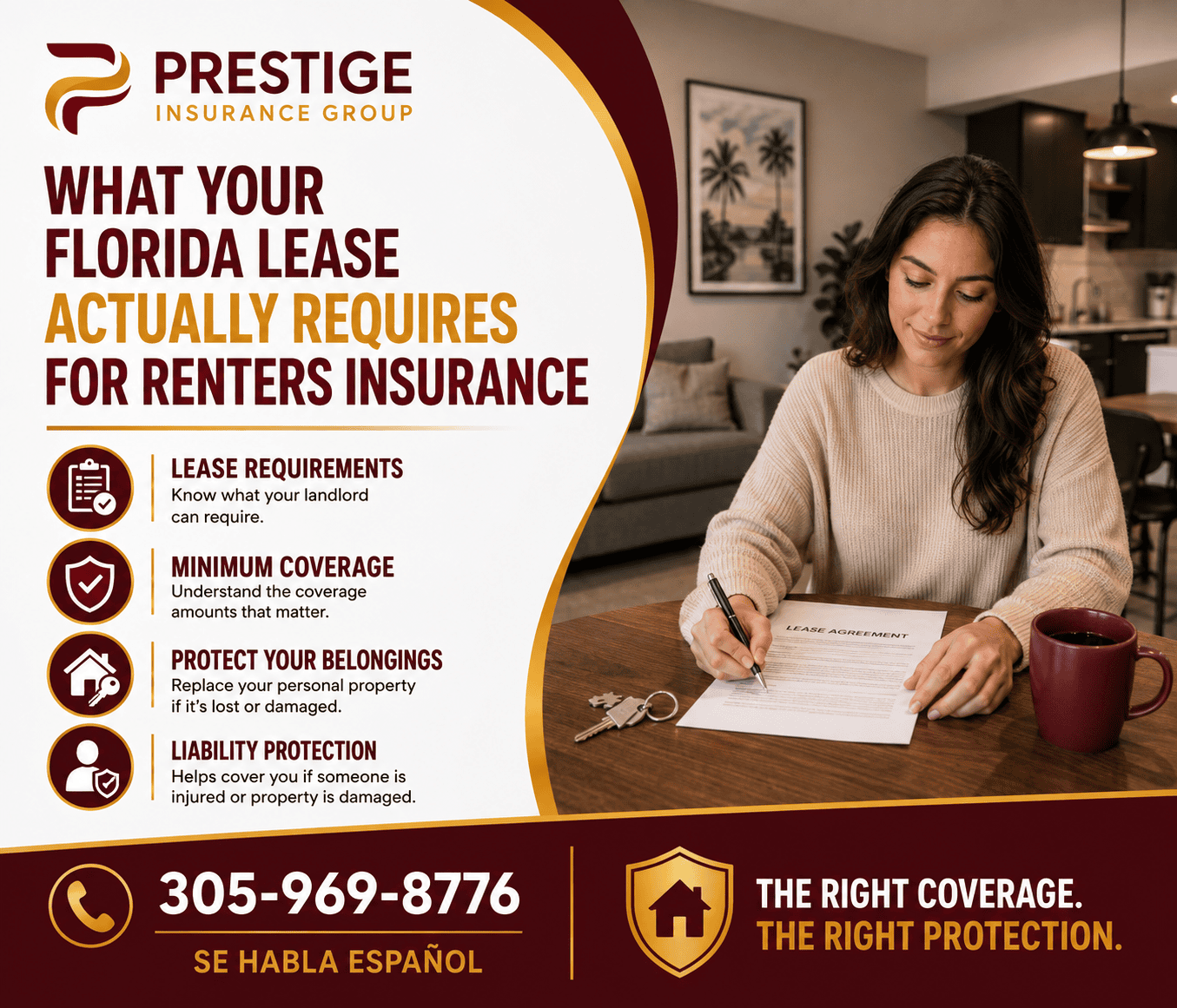
A tenant signing a lease on a Brickell apartment gets to page nine and finds a paragraph requiring renters insurance: a minimum of $100,000 in personal liability, the landlord named as an additional interested party, and proof of coverage delivered before the keys are handed over. She has three days.
She buys the cheapest policy she can find online, emails the certificate, and gets her keys. The requirement is satisfied. Whether she is actually protected is a different question, and nobody at the leasing office is going to ask it.
What landlords require, and why
Lease insurance clauses exist to protect the landlord, not the tenant. Understanding that explains everything about how they are written.
The requirements almost always center on liability coverage — typically $100,000, sometimes $300,000. If a tenant starts a fire, floods a unit, or causes injury on the property, the landlord wants a policy standing behind that tenant rather than an uncollectable judgment.
Most leases also require the landlord be named as an additional interested party or interested party. This is a notification mechanism, not coverage. It means the insurer will tell the landlord if the policy lapses, is cancelled, or is not renewed. The landlord gets no coverage from it and cannot file a claim under it.
Some leases specify a certificate of insurance delivered before move-in, and many require ongoing proof at each renewal.
What leases almost never specify is a personal property minimum, because the landlord has no interest in whether your belongings are insured. That decision is left entirely to you, presented as a dropdown at checkout, and defaulted low.
Additional interested party is not additional insured
These terms get used interchangeably and they are not the same thing.
Additional interested party means notification only. The landlord is told about changes to the policy status. This is what residential leases almost always mean, and adding it costs nothing.
Additional insured extends actual coverage to the named party, giving them rights under your policy. This is standard in commercial leases and unusual in residential ones. If a lease demands it, ask the carrier whether they will do it on a renters form — many will not.
If your lease uses the second term but the leasing office means the first, it is worth clarifying before you buy something you do not need.
Some landlords offer their own program
Increasingly, large apartment communities offer a policy at lease signing, sometimes billed with your rent, sometimes presented as the default option.
Read what it actually is. Some of these are genuine renters policies. Others are tenant liability insurance — they cover damage you cause to the landlord’s property and nothing else. No personal property coverage, no loss of use, no liability for injuries to guests.
That product satisfies the landlord completely. It leaves you with nothing if the building burns down. If the enrollment form talks only about damage to the premises and never mentions your belongings, it is not renters insurance.
You are generally free to buy your own policy instead, and it is usually both broader and cheaper.
What the requirement doesn’t tell you
The lease sets a liability floor and stops. Everything that determines whether the policy helps you is left blank:
Personal property limit. The minimum offered at checkout is frequently $6,000, which does not refurnish an apartment. Nothing in the lease pushes you higher.
Replacement cost versus actual cash value. A policy that settles on a depreciated basis meets the same lease requirement and pays substantially less.
Loss of use. Usually a percentage of the property limit, so a minimum policy carries a minimum displacement budget — often $1,200 to $2,400, which in South Florida covers days rather than the weeks a real repair takes.
Deductibles, including the separate hurricane deductible on Florida policies.
Flood. Excluded entirely, and no lease requires you to fix that.
The liability limit is the one number the lease gets right, because it is the number the landlord cares about.
Practical points at signing
Get the certificate early. Most carriers can issue proof of coverage the same day, but leave yourself margin — a delayed certificate can delay your keys.
Match the effective date to your lease start, not to the day you bought the policy. Coverage that begins after you move in leaves a gap.
Confirm the landlord’s exact legal name and address for the interested party field. Leasing offices reject certificates over name mismatches, and it is faster to get it right the first time.
Keep the certificate. You will be asked again at renewal.
Read the clause for anything unusual. Some leases require higher liability limits, specific carrier ratings, or waiver of subrogation. These are worth flagging to whoever writes the policy rather than discovering them after the fact.
Buy the policy for yourself, not for the lease
The requirement is a floor set by someone whose interests are not yours. Meeting it takes about five minutes and costs very little. Being actually covered takes a slightly longer conversation and usually costs a few dollars more per month.
Prestige Insurance Group can issue a certificate that satisfies your lease and, in the same conversation, make sure the limits behind it reflect what you actually own. Call us at 305-969-8776 or request a quote online.
This article is general information and not legal advice. Lease terms vary; review your specific lease for the requirements that apply to you.