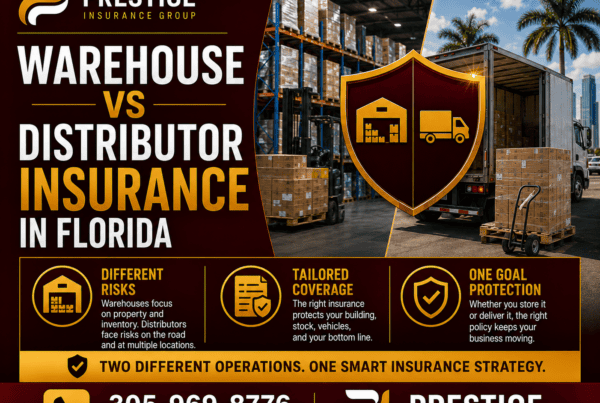



For many wholesalers and distributors, the warehouse is the heart of the business. Inventory arrives, products are stored, orders are fulfilled, trucks are loaded, and shipments leave for customers throughout Florida and beyond.
A warehouse interruption can impact every aspect of a distributor’s operation. Fire, theft, water damage, hurricanes, equipment breakdowns, and liability claims can all result in significant financial losses. Warehouse insurance helps wholesalers and distributors address many of these risks while supporting business continuity when unexpected events occur.
At Prestige Insurance Group, we help Florida distributors evaluate insurance solutions designed to protect warehouses, inventory, equipment, employees, and daily operations.
Why Warehouse Insurance Matters
Many distribution companies have hundreds of thousands or even millions of dollars invested in inventory, equipment, racking systems, forklifts, technology systems, buildings, and loading docks. A single loss can create operational disruptions that extend far beyond property damage — without proper coverage, a warehouse incident may affect customer relationships, revenue, contracts, supply chain operations, and business growth simultaneously. Warehouse insurance helps businesses prepare for these compounding exposures.
Common Warehouse Risks for Florida Distributors
Florida warehouses face a variety of operational risks.
Fire losses remain one of the most severe claims affecting distributors, with potential causes including electrical failures, forklift battery charging stations, equipment malfunctions, human error, and combustible inventory. A major warehouse fire may result in inventory destruction, building damage, smoke contamination, and business interruption all at once. Businesses often pair warehouse protection with Commercial Property Insurance.
Water damage can occur from roof leaks, plumbing failures, sprinkler discharges, and storm damage. Even relatively small water events can damage packaging, electronics, building materials, food products, and stored inventory simultaneously.
Theft and crime remain real concerns given how frequently warehouses contain valuable inventory attractive to thieves, involving inventory theft, employee theft, cargo theft, equipment theft, and organized crime activity. This is a genuinely well-documented risk in Florida specifically — in February 2026, the Florida Attorney General’s office charged members of an organized cargo theft ring responsible for at least 32 incidents across six Florida counties, resulting in nearly $7.8 million in losses, and Florida consistently ranks among the top five most cargo-theft-impacted states nationally.
Hurricane damage is a risk Florida businesses must prepare for every year, with storms capable of damaging warehouse roofs, exterior walls, inventory, equipment, and loading areas. Hurricanes may also interrupt transportation routes and supply chains well beyond the direct property damage itself.
Flooding is often one of the most misunderstood warehouse risks, since standard commercial property insurance typically does not cover flood damage. Flood losses can affect buildings, inventory, equipment, and machinery — many warehouse owners evaluate Commercial Flood Insurance to address this exposure directly.
What Warehouse Insurance Typically Covers
Coverage varies by policy and carrier, but many warehouse insurance programs include protection for buildings (warehouse structures, offices, storage facilities, and attached improvements), inventory (raw materials, finished products, stock, and packaging materials — often one of the largest exposures a distributor carries), equipment (forklifts, conveyor systems, pallet jacks, warehouse technology, and security systems), and business personal property (computers, furniture, office equipment, and operational tools).
Warehouse Legal Liability
Warehouse operators may also face liability claims. Customer injuries can occur through slips and falls, loading dock incidents, falling objects, and trip hazards. Property damage claims can arise when a business is accused of damaging customer property while handling or storing goods. Third-party liability extends to vendors, truck drivers, contractors, and customers moving through warehouse operations regularly. Liability protection is commonly addressed through General Liability Insurance.
Loading docks create some of the most common warehouse liability exposures, with potential claims including truck collisions, falling cargo, employee injuries, customer injuries, and equipment accidents. Because loading docks combine vehicle traffic, pedestrians, and inventory movement all in the same space, they often become a genuine focal point for loss prevention efforts.
Forklift Accident Exposures
Forklifts are essential to warehouse operations, but they also contribute to many warehouse claims, including employee injuries, inventory damage, rack collapse, property damage, and vehicle impacts. Employee-related incidents may involve Workers’ Compensation Insurance for covered workplace injuries.
Business Interruption Risks
Property damage is often only part of the financial impact. A warehouse shutdown can result in lost revenue, delayed deliveries, contract penalties, and customer losses that continue well after the physical damage is repaired. Business interruption coverage may help address income losses resulting from certain covered property claims.
Real Warehouse Claim Examples
A warehouse fire can start when an electrical malfunction ignites overnight, destroying inventory, damaging the building, and halting operations for several weeks — leaving the business facing both property losses and lost revenue simultaneously. A roof leak loss occurs when heavy rain enters through a damaged roof section, damaging inventory stored beneath the affected area until thousands of dollars in products become unsellable. A forklift incident can happen when an operator accidentally strikes storage racks, causing inventory to fall and damage customer products awaiting shipment, leaving the distributor facing both property damage and operational delays. A slip-and-fall claim can occur when a delivery driver slips near a loading dock during rainy weather, leading to a liability claim against the warehouse operator.
Risk Management Tips for Florida Warehouses
Strong risk management can reduce both claim frequency and claim severity. Regular roof inspections may help identify leaks, damage, and drainage issues before they become larger problems. Fire prevention measures — fire suppression systems, electrical inspections, housekeeping procedures, and storage guidelines — reduce one of the most severe risk categories directly. Security improvements including surveillance cameras, alarm systems, access controls, and lighting improvements can meaningfully reduce theft exposure. Accurate inventory controls help reduce losses, improve accountability, and support claims documentation when something does go wrong. Employee training programs can improve safety involving forklifts, loading docks, material handling, and emergency procedures across the whole team.
Additional Insurance Policies Many Distributors Consider
Warehouse insurance often works alongside other coverages, including product liability insurance to protect against product-related claims, Commercial Auto Insurance for delivery operations and company vehicles, Commercial Umbrella Insurance for additional liability protection above underlying policies, and Workers’ Compensation Insurance to help protect employees and employers after workplace injuries.
Comprehensive Wholesaler and Distributor Insurance programs often combine multiple coverages to address these operational risks together rather than as separate, disconnected policies.
Frequently Asked Questions
Does warehouse insurance cover inventory? Many policies provide inventory protection, although coverage details vary by carrier and policy structure.
Is flood damage covered automatically? Typically no. Separate flood insurance may be needed to close this gap.
Does warehouse insurance cover theft? Many policies provide protection for certain theft-related losses, subject to policy terms and conditions.
Are forklifts covered? Coverage depends on policy structure and the nature of the loss.
Can warehouse insurance include business interruption coverage? Often yes, depending on policy design and carrier options.
Protecting Florida Warehouses and Distribution Operations
Warehouses are critical to the success of wholesalers and distributors throughout Florida. From inventory and equipment to loading docks and employee safety, warehouse operations face numerous risks that can affect profitability and business continuity. A properly structured insurance program can help address property losses, liability exposures, employee injuries, and operational disruptions before they become major financial events.
Prestige Insurance Group helps Florida wholesalers and distributors evaluate warehouse insurance solutions designed to protect inventory, buildings, equipment, employees, and ongoing operations.
Contact Prestige Insurance Group today to discuss warehouse insurance options for your distribution business:
Distributors that sell products under their own brand can be treated as the manufacturer in a lawsuit. Our page on manufacturer insurance explains how that changes the coverage.
Miami: 305-969-8776 Orlando: 407-993-2331
Se Habla Español.