


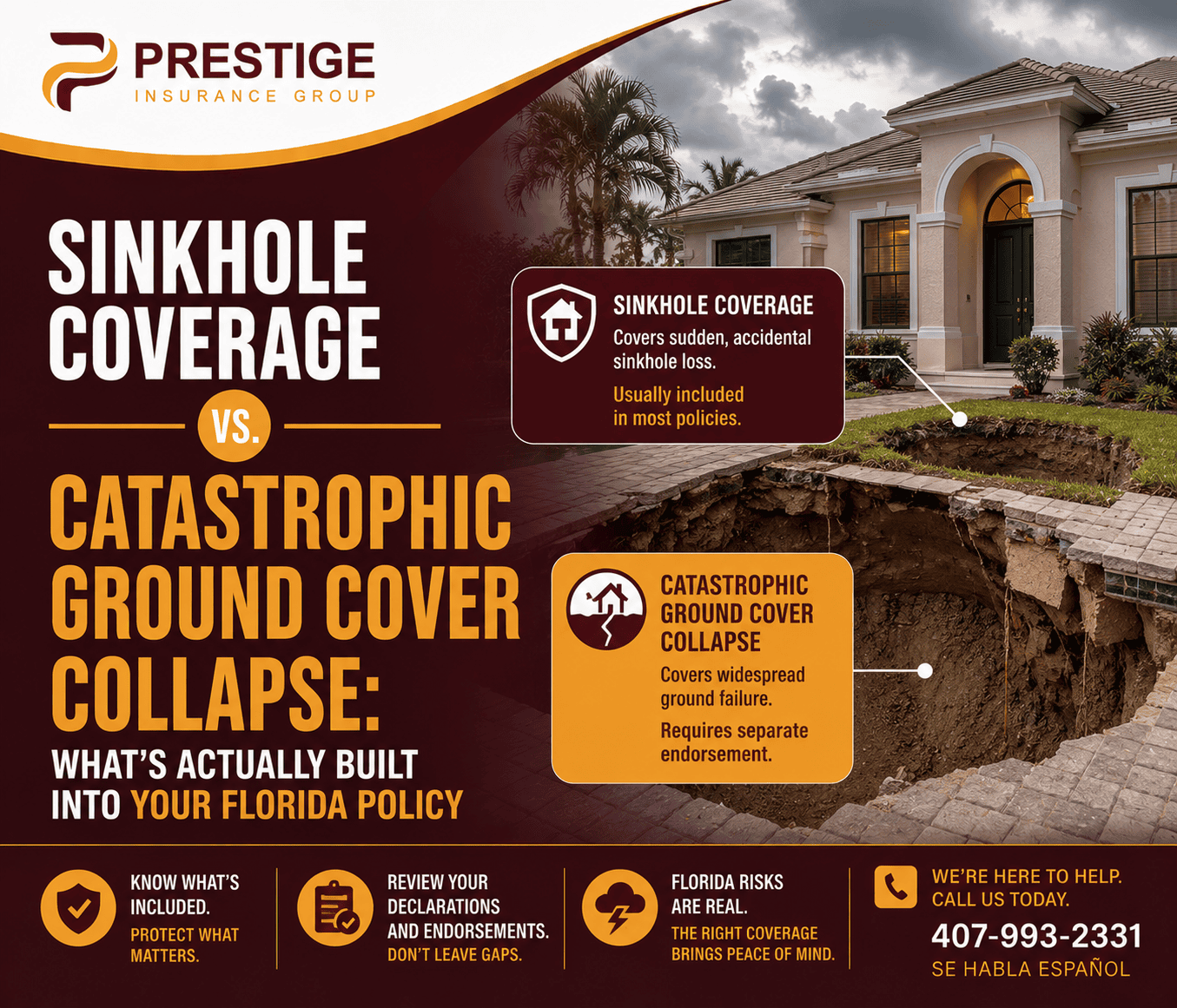
Sinkhole Coverage vs. Catastrophic Ground Cover Collapse: What’s Actually Built Into Your Florida Policy
Most Florida homeowners believe they’re covered for sinkhole damage simply because they own a homeowners policy. Technically, they’re right — and that’s exactly where the confusion begins. Florida law does require every property insurer to include a form of sinkhole-related coverage in every policy. What the law doesn’t require is coverage for the kind of sinkhole damage that actually happens to most Florida homes.
At Prestige Insurance Group, we help homeowners understand exactly what their policy covers before a real sinkhole event tests the difference. Learn more about our Florida Homeowners Insurance solutions.
Two Genuinely Different Coverages, One Common Name
Florida Statute 627.706 draws a hard, specific line between two distinct coverages that both relate to sinkhole activity, but function very differently.
Catastrophic Ground Cover Collapse (CGCC) is mandatory. Every insurer authorized to write property insurance in Florida must include it in every policy. You don’t pay extra for it, and you cannot opt out of it.
Sinkhole loss coverage is optional. The law requires insurers to make it available for an additional premium, but it is not automatically included — you have to actively request it and pay for it separately, and the insurer may require a property inspection before issuing it.
Here’s the part that catches most homeowners off guard: these two coverages are not the same thing wearing different names. CGCC is a narrow, severe-event coverage. Sinkhole loss coverage is the broader protection that addresses what most people actually picture when they think “sinkhole damage.”
Why CGCC Almost Never Actually Pays Out
The statute defines catastrophic ground cover collapse extremely narrowly — and this is genuinely the most important thing for Florida homeowners to understand. For a loss to qualify, all four of the following conditions must be present at the same time:
-
Abrupt collapse of the ground cover — the ground must suddenly give way, not settle gradually over months or years.
-
A depression in the ground cover that is clearly visible to the naked eye.
-
Structural damage to the covered building, including the foundation.
-
The structure being condemned and ordered vacated by the government agency legally authorized to issue such an order.
All four conditions must occur together. If even one is missing, the loss doesn’t qualify — regardless of how much genuine damage your home has sustained. And the statute is explicit on this exact point: damage consisting merely of the settling or cracking of a foundation, structure, or building does not constitute a catastrophic ground cover collapse. This directly excludes the far more common, gradual pattern of real Florida sinkhole activity — the slow-developing cracks in walls, uneven floors, and foundation settlement that homeowners in genuinely sinkhole-prone areas actually experience.
What This Means in Practice
Picture the most common real-world scenario: cracks slowly appear in your walls over several months, doors and windows begin sticking, and a foundation inspection eventually confirms sinkhole activity beneath your home. Under the mandatory CGCC coverage alone, this loss almost certainly is not covered — there was no abrupt collapse, no sudden visible depression, and no government condemnation order. Your home wasn’t destroyed overnight; it deteriorated gradually, which is exactly the scenario the statute excludes from mandatory coverage.
Without the optional sinkhole loss endorsement added to your policy, a homeowner in this situation could be facing significant, genuine structural damage with no coverage at all — despite technically having “sinkhole coverage” on their policy the entire time.
The Warning Your Insurer Is Required to Give You
Because this distinction is so commonly misunderstood, Florida law requires insurers offering policies that exclude sinkhole loss coverage to disclose this fact in bold type of at least 14 points, using specific statutory language: “YOUR POLICY PROVIDES COVERAGE FOR A CATASTROPHIC GROUND COVER COLLAPSE THAT RESULTS IN THE PROPERTY BEING CONDEMNED AND UNINHABITABLE. OTHERWISE, YOUR POLICY DOES NOT PROVIDE COVERAGE FOR SINKHOLE LOSSES.” If you’ve seen this exact language on your policy documents, it’s not boilerplate — it’s the law’s way of making sure you understand precisely what you don’t have.
How Optional Sinkhole Coverage Works
If you add sinkhole loss coverage to your policy, it covers structural damage to the building — including the foundation — caused by sinkhole activity, without requiring the four-part catastrophic test described above. Contents coverage under a sinkhole loss claim applies only when there’s also structural damage to the covered building itself. Policies offering this coverage may include a dedicated sinkhole deductible of 1%, 2%, 5%, or 10% of your dwelling coverage limit, with corresponding premium discounts available at each deductible level — giving homeowners some genuine flexibility in balancing premium cost against out-of-pocket exposure, similar to how a hurricane deductible works.
Why This History Matters
Florida originally required full, comprehensive sinkhole coverage in every property policy starting in 1981. That changed in 2007, when legislation introduced the current, narrower CGCC-mandatory structure and shifted broader sinkhole coverage to an optional, additional-cost endorsement instead. Understanding this history helps explain why so many homeowners assume they’re fully covered — for decades, they effectively were, and the coverage structure changed underneath many policies without most homeowners noticing the shift.
If You Believe You Have a Genuine Sinkhole Claim
Florida law provides a formal path for resolving disagreements between homeowners and insurers over sinkhole-related claims. Under Section 627.7074, either party has the right to request a neutral evaluation of the claim — a real, structured process worth understanding if you and your insurer disagree about whether your damage qualifies for coverage under either policy provision.
Who Should Genuinely Consider Adding Sinkhole Coverage
While sinkhole risk varies significantly across Florida, homeowners in areas with documented geological activity — particularly the west-central Gulf Coast counties around Tampa Bay, which account for a disproportionate share of the state’s sinkhole claims — should take this decision seriously rather than assuming their built-in coverage is sufficient. Even homeowners in lower-risk areas, including much of Central Florida, may want to evaluate the optional coverage given how narrowly the mandatory protection is actually defined.
Frequently Asked Questions
Does every Florida homeowners policy cover sinkhole damage? Every policy includes mandatory Catastrophic Ground Cover Collapse coverage, but this only applies to a narrow, severe scenario — most real sinkhole damage requires the separate, optional sinkhole loss endorsement.
What’s the difference between “abrupt” and “gradual” sinkhole damage under the law? CGCC requires sudden, visible collapse; damage that develops gradually through settling or cracking over time does not qualify, even if a sinkhole is ultimately the cause.
Do I have to pay extra for real sinkhole protection? Yes — insurers must offer sinkhole loss coverage, but only for an additional premium, and it’s not automatically included in a standard policy.
How do I know which coverage I currently have? Check your declarations page and policy disclosures directly — if your policy excludes sinkhole loss coverage, your insurer is legally required to disclose this in bold type using specific statutory language.
What happens if my insurer denies a sinkhole claim? Florida law provides a neutral evaluation process under Section 627.7074 if you and your insurer disagree about whether a loss qualifies for coverage.
Understanding What You’re Actually Protected Against
The gap between “having sinkhole coverage” and “being covered for the sinkhole damage that actually happens” is one of the most consequential, and most misunderstood, distinctions in Florida homeowners insurance. Understanding exactly which coverage your policy includes — and whether the optional endorsement makes sense for your property — is worth confirming before, not after, damage occurs.
Prestige Insurance Group helps Florida homeowners understand exactly what their policy covers and evaluate whether additional sinkhole protection makes sense for their property.
Contact Prestige Insurance Group today:
Miami: 305-969-8776 Orlando: 407-993-2331 Stuart: 561-983-4333
Se Habla Español.