


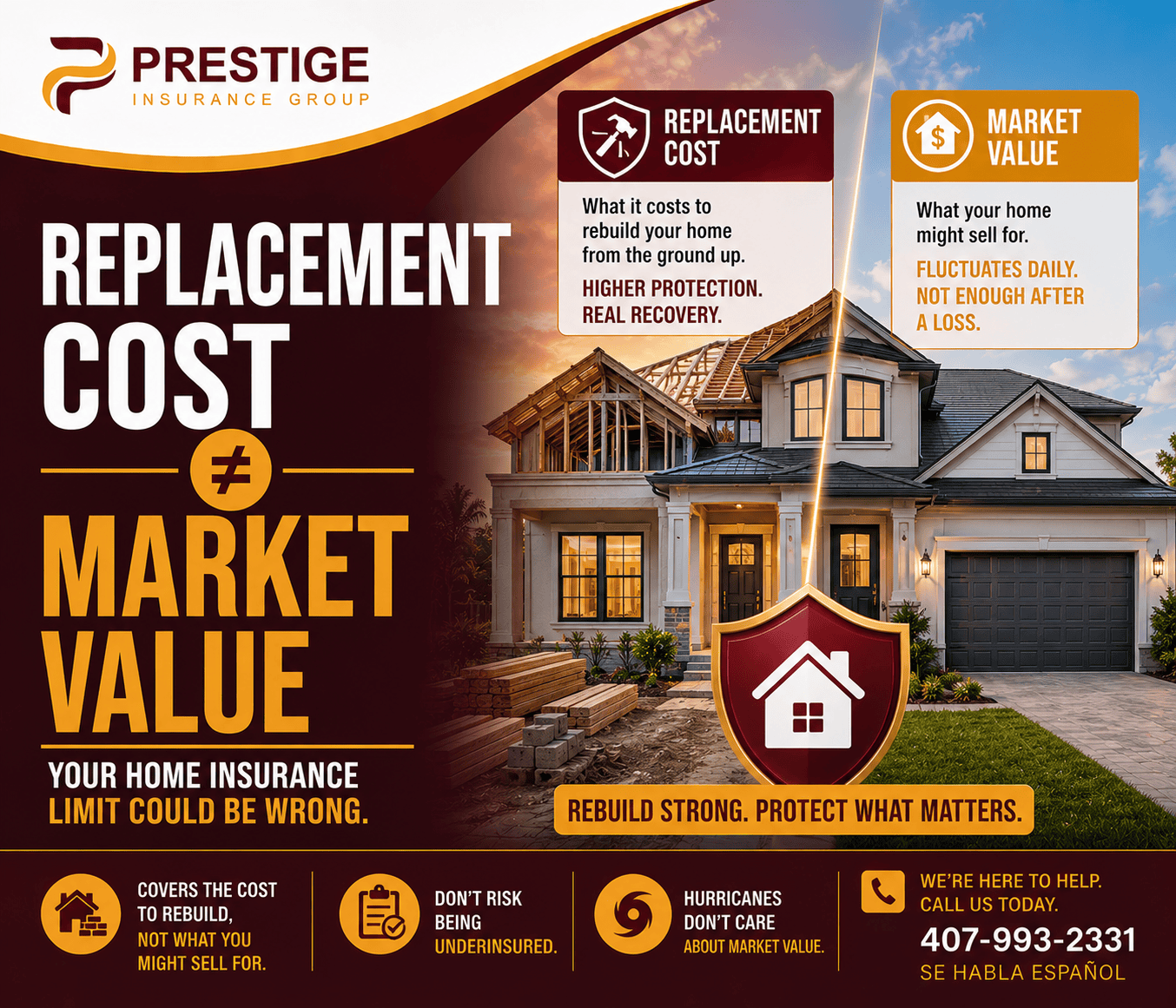
Replacement Cost vs. Market Value: Why Your Home Insurance Limit Should Never Match Your Zestimate
Ask most Florida homeowners how much dwelling coverage they carry, and many will answer with what they paid for the house, or what a real estate website says it’s currently worth. Neither number should actually determine your insurance limit — and understanding why is one of the most consequential things a Florida homeowner can learn before, not after, a major claim.
At Prestige Insurance Group, we help Florida homeowners calculate real replacement cost and avoid the underinsurance gap that catches so many by surprise. Learn more about our Florida Homeowners Insurance solutions.
Two Genuinely Different Numbers
Market value reflects what a buyer would pay for your home today, factoring in land value, neighborhood demand, school districts, and comparable recent sales. It includes the lot your home sits on.
Replacement cost reflects what it would actually cost to rebuild your home’s physical structure from the ground up, using current labor rates, current material costs, and current building codes — and it excludes the land entirely, since land doesn’t burn down or blow away in a storm.
These two numbers frequently diverge significantly in Florida, sometimes in either direction. A home in a rapidly appreciating waterfront neighborhood may have a market value well above its actual rebuild cost, since much of that value reflects the land and location rather than the structure itself. An older home in a less fashionable but structurally solid neighborhood may cost considerably more to rebuild than its market value suggests, once current building codes and specialized construction requirements are factored in.
What Rebuilding Actually Costs in Florida Right Now
Real, current numbers matter here, and they’ve moved substantially. Florida construction costs averaged $103 per square foot in 2015; by 2024, that figure had risen to $162 per square foot — a genuine, dramatic increase driven by material costs, labor demand, and supply constraints. As of 2026, rebuild costs vary considerably by region: inland North Central Florida communities run roughly $150 to $250 per square foot, while South Florida’s High-Velocity Hurricane Zone counties — Miami-Dade, Broward, and Palm Beach — command $350 to $800 or more per square foot, reflecting the region’s stricter wind-resistance building codes and elevated construction demand.
This means a 2,500-square-foot home in South Florida could genuinely require $875,000 to $2 million or more in dwelling coverage just to rebuild the structure itself — a figure many homeowners with older policies are nowhere close to carrying.
The Real Formula for Checking If You’re Underinsured
This is genuinely one of the most valuable, actionable things a Florida homeowner can calculate directly: divide your Coverage A dwelling limit by your home’s true reconstruction cost (your square footage multiplied by the current Florida rebuild cost per square foot for your specific construction type and region). If the result comes out below 0.80, you likely fail your policy’s coinsurance requirement and are underinsured.
This isn’t just an abstract shortfall. Many Florida policies include a coinsurance clause that penalizes claims proportionally when a home is insured below this threshold — meaning even a partial loss can result in a reduced claim payment, not just a total loss leaving you short. An independent agent can run a professional replacement-cost estimate to check this calculation directly, rather than relying on guesswork or an outdated figure from when you first purchased the policy.
Replacement Cost Value vs. Actual Cash Value
This is a closely related, equally important distinction worth understanding alongside replacement cost itself. Replacement Cost Value (RCV) coverage pays to replace damaged property with new materials, without deducting for age or wear. Actual Cash Value (ACV) coverage pays replacement cost minus depreciation — meaning an older roof or aging system is reimbursed at a fraction of what it would actually cost to replace today. RCV policies typically cost modestly more in premium, but pay meaningfully more at claim time, particularly for older roofs and major systems where depreciation can be substantial.
Why Roof Claims Specifically Often Come Up Short
Since Florida’s 2022 reforms, carriers can apply a separate roof deductible of up to 2% of your dwelling limit, distinct from your standard or hurricane deductible. Combined with an outdated replacement cost estimate or an ACV policy on an older roof, many homeowners discover their roof claim payout falls well short of actual replacement cost — a genuinely common, avoidable surprise that proper coverage review can help prevent.
Why This Gap Widens Over Time
Replacement cost isn’t a number you calculate once and forget. Construction costs continue rising, building codes continue evolving, and your own home changes through renovations, additions, and upgrades. A policy that accurately reflected your home’s rebuild cost five years ago may be significantly outdated today, especially given how much Florida construction costs have moved just since 2015. Reviewing your replacement cost estimate at every renewal — and especially after any major renovation — helps close this gap before a claim exposes it.
What to Do If You Discover a Gap
If your coverage calculation reveals you’re below the 0.80 threshold, the fix is straightforward, even if the premium adjustment isn’t always welcome: increasing your Coverage A limit to genuinely reflect current reconstruction cost. This may increase your premium, but the alternative — discovering a coinsurance penalty or a significant shortfall while your home is actively uninhabitable after a real loss — is a far more expensive outcome than the incremental premium increase required to close the gap proactively.
Frequently Asked Questions
Should my dwelling coverage match my home’s market value? No — dwelling coverage should reflect replacement cost, which excludes land value and reflects current construction costs, not what a buyer would pay for your home today.
How much does it actually cost to rebuild a home in Florida right now? It varies significantly by region, from roughly $150-$250 per square foot inland to $350-$800 or more per square foot in South Florida’s stricter-code coastal counties.
What is the 80% coinsurance rule? If your dwelling coverage limit divided by your true reconstruction cost falls below 0.80, you likely fail your policy’s coinsurance requirement and may face a reduced claim payment even on a partial loss.
What’s the difference between RCV and ACV coverage? RCV pays to replace damaged property with new materials without age deduction; ACV pays replacement cost minus depreciation, often resulting in significantly lower payouts on older roofs and systems.
How often should I review my replacement cost estimate? At every policy renewal, and especially after any major renovation, addition, or upgrade to your home.
Making Sure Your Coverage Reflects Reality
The gap between what your home is worth and what it would actually cost to rebuild is one of the most consequential, and most commonly overlooked, numbers in Florida homeowners insurance. Understanding it — and checking your own coverage against the real math — is worth doing before a storm tests the accuracy of your policy.
Prestige Insurance Group helps Florida homeowners calculate accurate replacement cost and avoid the coinsurance gap that catches so many homeowners by surprise.
Contact Prestige Insurance Group today:
Miami: 305-969-8776 Orlando: 407-993-2331 Stuart: 561-983-4333
Se Habla Español.