


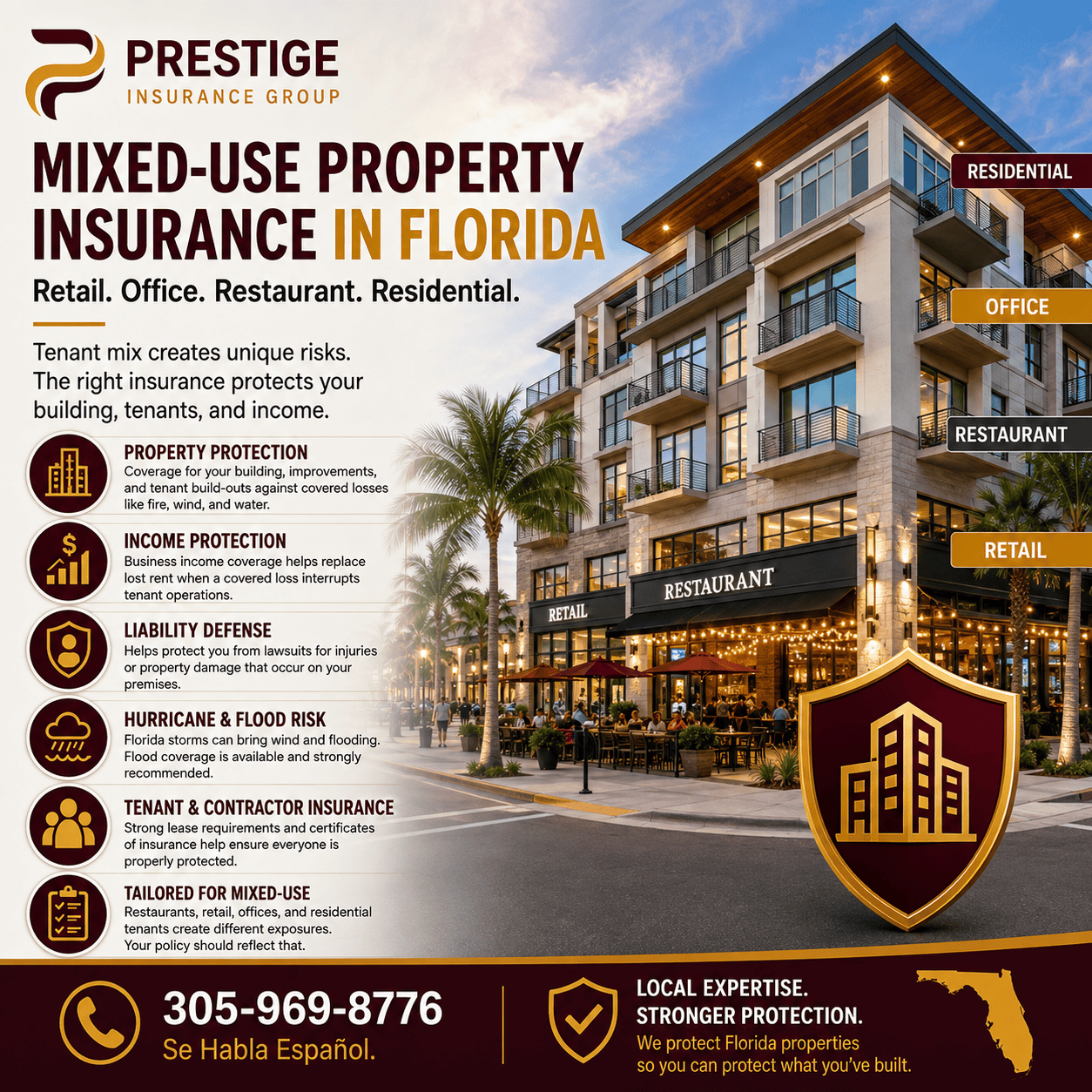
Mixed-Use Property Insurance in Florida: Why Tenant Mix Changes the Risk
Mixed-use properties have become a major part of Florida’s commercial real estate market — a single building with retail on the ground floor, offices above, a restaurant facing the street, and apartments or condominiums on the upper levels. As an investment, that diversity is attractive: multiple income streams, less dependence on any one tenant type.
From an insurance standpoint, that same diversity is exactly what makes mixed-use property more complicated to underwrite than a building occupied by one relatively uniform business type. An insurer isn’t just evaluating construction, square footage, and roof condition — what’s actually happening inside the building matters just as much. Two buildings with identical construction and replacement value can land on very different insurance terms because their tenant mixes are different.
“Mixed-Use” Describes a Category, Not a Single Risk Profile
The term covers real estate that varies enormously: a small building with two retail spaces and a few apartments upstairs, a suburban development combining restaurants, medical offices, and service businesses, or an urban high-rise stacking retail, office, and residential in distinct bands. All three are “mixed-use,” but their actual exposures aren’t remotely the same — which is why asking for a generic “mixed-use property quote” undersells what the underwriter actually needs to know: who occupies the building, how much space each tenant uses, and what they’re actually doing in it.
One Tenant Can Change the Risk Profile of the Entire Building
The clearest illustration: take a building with several professional offices and retail tenants — a relatively straightforward property from an underwriting standpoint. Now replace one retail space with a full-service restaurant. The physical building hasn’t changed, but the operation inside it has. Commercial cooking equipment, grease, open flames or high-heat cooking, refrigeration, food storage, delivery traffic, and possibly alcohol service all enter the picture — along with kitchen exhaust and suppression systems that need their own scrutiny. And critically, a fire starting in that restaurant doesn’t necessarily stay contained to its leased space; smoke, suppression water, and firefighting operations can affect every other tenant in the building.
This is exactly why insurers ask specifically whether a mixed-use property contains restaurants and what share of the building they occupy — and it’s why a lease that looks financially attractive can simultaneously make the building harder or more expensive to insure. That’s not a reason to avoid the tenant; it’s a reason to understand the insurance implications as part of the leasing decision itself, not after the lease is signed.
Even within “restaurant,” the underwriting isn’t uniform — a coffee shop serving prepared food is a different exposure than a full-service kitchen running fryers and grills, and alcohol service adds its own liability layer on top. “Retail” hides similar variation: a boutique, a grocery store, and an electronics retailer carry different inventory values, theft exposure, and customer-traffic patterns even though they’re all technically retail.
Office Tenants Are Usually Lower-Hazard — But Not Automatically
Traditional professional offices — accounting, consulting, administrative businesses — tend to be among the more straightforward commercial occupancies. But “office” can still hide meaningful variation: a medical office brings higher patient traffic and specialized equipment, and a dental office can introduce compressed gases and X-ray equipment that a standard administrative office never sees. The landlord doesn’t need to insure a tenant’s own professional liability, but accurately disclosing what’s actually happening in that space is still the owner’s job — the insurer is evaluating the building as it actually operates, not as its lease category implies.
Residential Units Add an Around-the-Clock, Interconnected Exposure
Once a mixed-use building includes apartments or condos, people are living there — occupying units overnight, cooking, hosting guests, using shared parking, elevators, and access systems at all hours rather than during standard business hours. That changes the water-loss picture specifically: a plumbing failure in an upstairs unit can damage a retail store or office below just as easily as a kitchen fire in an apartment can affect neighboring units and the commercial spaces beneath them. This interconnection — where a loss in one occupancy type routinely crosses into another — is the defining characteristic of mixed-use property, and it’s exactly what a lease boundary can’t actually contain once a serious loss occurs.
One Tenant’s Loss Can Interrupt Income From Every Other Tenant
Picture a three-story building: restaurant and retail on the ground floor, offices on the second, apartments on the third. A restaurant fire, even contained relatively quickly, can spread smoke through the building, trigger suppression water damage to neighboring spaces, force a utility shutdown, displace residents temporarily, and keep office tenants out while inspections and repairs proceed. The owner can lose rent across several tenant spaces that flames never actually touched. This is why evaluating a mixed-use property means asking about the potential severity of a tenant-created loss, not just whether that one tenant happens to carry its own insurance.
Tenant Insurance Is Necessary — It Isn’t a Substitute for the Landlord’s Program
Every tenant should carry insurance appropriate to its own operation — a restaurant with general liability, property, business income, workers’ comp, and liquor liability; an office with business personal property, general liability, and professional liability; a residential tenant with renters insurance. But none of that eliminates the owner’s need for a strong commercial property and liability program of its own. The landlord owns the building, the common areas, the structural components — and has rental income at risk across the whole property if a covered loss makes multiple tenant spaces unusable at once. Tenant coverage and owner coverage protect different interests; one was never meant to substitute for the other.
The Coverage Checklist for a Mixed-Use Building
Commercial property is the foundation, and the building limit should reflect genuine reconstruction cost — not purchase price or market value, which can diverge significantly in Florida given how much of a property’s value sits in the land itself. Major tenant improvements deserve specific attention in the lease: a restaurant or medical tenant that invests heavily in build-out creates a real question of who owns — and who insures — those improvements, which shouldn’t be left to assumption.
Business income coverage matters more here than in a single-tenant building precisely because one loss can interrupt rent from several unrelated tenants simultaneously. Given how much a widespread hurricane can extend repair timelines — contractors and materials in high demand across the whole region — the realistic recovery period is worth evaluating honestly rather than assuming a “normal” repair timeline.
General liability needs to reflect genuinely mixed foot traffic — residents, office employees, patients, shoppers, restaurant customers, delivery drivers, and contractors all moving through the same common areas, parking lots, and stairways. Responsibility for those shared spaces should be clearly divided between ownership, property management, and tenants, with maintenance documentation ready to establish who was responsible for what if a claim arises.
Flood needs its own evaluation, separate from wind — a hurricane can produce both in the same event without triggering the same coverage for each, and ground-floor retail and restaurant tenants are particularly exposed to flood damage to equipment, inventory, and flooring even in buildings that aren’t directly coastal.
Ordinance or law coverage matters more for older mixed-use buildings, where a major loss can trigger current-code requirements — structural, electrical, accessibility — across multiple occupancy types simultaneously, each potentially carrying its own compliance standard.
Equipment breakdown coverage deserves a look wherever elevators, HVAC, or other mechanical systems serve several tenants at once — an internal mechanical failure isn’t always treated the same as damage from an external event like fire or wind, and a single shared-system failure can disrupt every occupancy type in the building without a single traditional “covered loss” occurring.
Umbrella or excess liability becomes more relevant as visitor volume and mixed occupancy grow the property’s overall liability exposure — but it adds height above the underlying policies, it doesn’t fix gaps within them, so the underlying general liability program deserves review before deciding how much additional limit to add on top.
Vendor and Property Manager Insurance Still Needs Its Own Scrutiny
Mixed-use properties typically depend on a wide range of outside contractors — roofers, electricians, HVAC and elevator contractors, landscapers, security and janitorial firms. The landlord’s own policy shouldn’t be treated as a backstop for inadequate contractor coverage; vendor insurance requirements should scale with the actual work being performed, with higher-hazard trades getting more scrutiny. Third-party property managers carry their own separate exposure too — handling tenants, rent, contractors, and sometimes client funds — which is a different risk than the building ownership itself and shouldn’t be assumed to be covered by the owner’s policy.
The Tenant Schedule Is an Underwriting Document
One of the simplest, highest-value things a mixed-use owner can hand an insurer is an accurate, current tenant schedule — name, business type, square footage or occupancy percentage, and any vacant space clearly noted. A generic LLC name on a lease tells an underwriter nothing about whether that space holds an accounting office or a commercial kitchen; the actual occupancy needs to be spelled out. This becomes especially important at renewal, since a building quoted years ago around a low-hazard tenant roster may have quietly shifted toward higher-hazard occupancy since — and the policy needs to reflect the building that exists today, not the one on file from the original application.
Tenant Changes and Vacancy Should Trigger a Review
Replacing one accounting office with another rarely changes much. Replacing it with a restaurant, medical practice, or fitness studio can change the building’s risk profile meaningfully — and that’s a moment to call the insurance professional, not wait for the next renewal. The same logic applies to significant vacancy: a building doesn’t stop needing insurance attention just because it’s “not fully vacant,” and empty spaces still need plumbing, HVAC, electrical, and security monitored even without a tenant present to notice a problem developing.
The Lowest Quote Isn’t Automatically the Right One
Mixed-use properties can produce wide swings between insurance proposals, because carriers have genuinely different appetites for restaurants, residential occupancy, older construction, and coastal locations. A lower premium can reflect a carrier that genuinely likes the risk — or it can reflect a policy that’s quietly more restrictive on water damage, business income, or liability exclusions. The comparison that actually matters isn’t which number is lowest; it’s which proposal provides comparable protection for a property that, by its nature, is rarely as simple as a single occupancy type.
The Bottom Line
A mixed-use property isn’t defined by its construction — it’s defined by the combination of activities happening inside it. A restaurant changes the fire exposure. Residential units change the water-loss and around-the-clock occupancy picture. Retail and office tenants each bring their own variation. The strongest insurance program tracks those differences honestly, keeps clear separation between what the landlord insures and what each tenant is responsible for, and gets revisited whenever the actual tenant mix changes — not just at the annual renewal.
Prestige Insurance Group works with Florida commercial property owners, landlords, and real estate investors to build coverage around a mixed-use building’s actual tenant mix, construction, and risk profile. Call 305-969-8776 or request a quote online to have your mixed-use property program reviewed, or contact our Miami office directly.