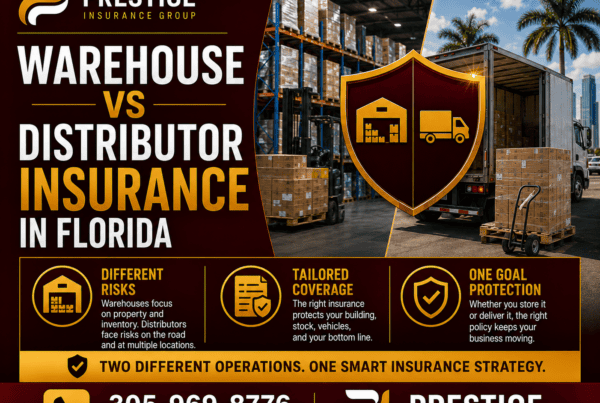



Warehouse insurance costs in Florida can vary significantly depending on the size of the operation, the type of products stored, the location of the warehouse, transportation exposure, employee count, and overall risk profile. Warehouses in Florida often face higher insurance costs than many other states because of hurricane exposure, flooding risks, cargo theft, heavy logistics activity, and rising property values. Warehouses throughout Florida — especially in major logistics markets like Miami, Doral, Medley, Orlando, Tampa, Jacksonville, and Fort Lauderdale — face unique operational risks that insurance companies evaluate carefully during underwriting.
At Prestige Insurance Group, we help warehouse operators, logistics companies, distributors, fulfillment centers, and industrial businesses compare coverage options from multiple insurance companies and specialty commercial markets. Whether you operate a warehouse, logistics company, distribution center, cold storage operation, fulfillment center, 3PL company, import/export warehouse, or transportation and storage business, understanding what affects warehouse insurance costs can help you better protect your operation and avoid unexpected coverage gaps.
What Is the Average Cost of Warehouse Insurance in Florida?
Here are real, current benchmarks worth knowing directly. Warehouse property insurance typically costs $0.50 to $2.00 per square foot annually — for a 50,000-square-foot warehouse, that translates to roughly $25,000 to $100,000 a year for property coverage alone. General liability insurance commonly runs $400 to $1,500 annually for a small warehouse operation, climbing to $2,000 to $10,000 for larger facilities. Warehouse legal liability — the coverage protecting customer-owned goods stored in your facility — is typically priced at $0.10 to $0.50 per $100 of stored inventory value, meaning a warehouse holding $2 million in customer inventory might pay $2,000 to $10,000 annually for that coverage alone. Workers’ compensation for warehouse operations generally runs $1.50 to $4.00 per $100 of payroll under the standard warehouse classification code.
Smaller warehouse operations with limited inventory and lower liability exposure pay substantially less than large distribution centers handling high-value inventory, transportation operations, or temperature-sensitive goods. Bundling multiple coverages into a single Business Owners Policy can save 10% to 15% compared to purchasing each policy separately.
Warehouse insurance pricing is commonly affected by building value, inventory value, payroll, claims history, location, the type of goods stored, transportation exposure, flood exposure, fire protection systems, and security procedures. Warehouses in South Florida often face higher insurance costs specifically because of hurricane exposure, flood risk, cargo theft exposure, dense industrial traffic, and higher property values.
Learn more about Warehousing and Logistics Insurance.
What Types of Insurance Do Warehouses Usually Need?
Most warehouse operations require several different types of insurance coverage working together.
General Liability Insurance
General liability insurance helps protect warehouses against third-party bodily injury and property damage claims, including vendor injuries, slip-and-fall accidents, loading dock incidents, trucking-related liability, and customer injuries. Warehouses with constant shipping activity and heavy truck traffic often face elevated liability exposure. Learn more about General Liability Insurance.
Commercial Property Insurance
Commercial property insurance may help protect warehouse buildings, inventory, equipment, racking systems, machinery, office areas, and forklifts. Property insurance is especially important in Florida because warehouses remain vulnerable to hurricanes, windstorm damage, roof leaks, water intrusion, and fire losses. Learn more about Commercial Property Insurance, Commercial Hurricane Insurance, and Commercial Flood Insurance.
Workers’ Compensation Insurance
Warehouse employees often face physically demanding working conditions involving forklift operations, loading dock activity, heavy lifting, repetitive motion, falling inventory, and slips and falls. Workers’ compensation costs are heavily influenced by payroll, claims history, safety procedures, and the type of warehouse operations involved. Learn more about Workers’ Compensation Insurance.
Inland Marine and Cargo Coverage
Many warehouses and logistics businesses require inland marine or cargo insurance to help protect inventory in transit, customer goods, freight exposure, mobile equipment, and stored cargo. Warehouses handling third-party inventory may face additional exposure and insurance requirements beyond standard property coverage.
Commercial Auto Insurance
Warehouses operating trucks, delivery vans, or transportation fleets may require commercial auto insurance, with costs varying based on vehicle type, driving radius, driver history, cargo exposure, and fleet size. Learn more about Business Auto Insurance.
What Affects Warehouse Insurance Costs in Florida?
Warehouse insurance pricing is highly individualized, and insurance companies evaluate many operational factors before determining premiums.
Warehouse size and property value. Larger warehouses generally cost more to insure because they often contain more inventory, higher property values, additional equipment, and greater liability exposure. Warehouses with expensive tenant improvements or specialized systems may also face higher premiums.
Type of products stored. The type of inventory stored inside the warehouse can significantly impact insurance pricing. Warehouses storing electronics, pharmaceuticals, food products, high-value inventory, hazardous materials, or temperature-sensitive goods often face higher insurance costs because of increased risk exposure.
Hurricane and flood exposure. Florida warehouses face elevated exposure from hurricanes, windstorms, flooding, storm surge, and heavy rainfall. Warehouses located near coastal areas or flood-prone zones may require separate flood insurance coverage and higher property premiums. South Florida industrial areas such as Doral, Medley, Hialeah, and Miami Gardens often experience higher underwriting scrutiny because of storm exposure. Learn more about Commercial Flood Insurance.
Claims history. Prior claims can significantly affect warehouse insurance costs. Frequent claims involving water damage, theft, forklift accidents, fire losses, employee injuries, or cargo losses may reduce carrier options and increase premiums, while warehouses with clean claims histories are often viewed more favorably by insurance companies.
Fire protection systems. Insurance companies commonly review sprinkler systems, fire alarms, fire suppression systems, hydrant access, and building construction. Warehouses with updated fire protection systems may qualify for better pricing opportunities.
Security procedures. Strong security procedures can help reduce warehouse insurance costs. Insurance companies often review security cameras, alarm systems, access control, fencing, lighting, and inventory tracking procedures. Warehouses storing high-value products may require enhanced security systems. Learn more about Crime Insurance.
Transportation and logistics exposure. Warehouses with transportation operations may face additional liability exposure involving cargo handling, delivery operations, fleet vehicles, loading docks, and third-party trucking activity, and often require broader insurance programs as a result.
Common Warehouse Insurance Claims in Florida
Warehouses throughout Florida face a wide range of insurance claims every year. Hurricanes and windstorms remain one of the largest risks, with claims involving roof damage, water intrusion, broken skylights, structural damage, inventory losses, and power outages. Roof leaks are also extremely common in Florida warehouse operations, affecting inventory, packaging materials, machinery, electrical systems, and racking systems.
Forklift accidents may involve employee injuries, structural damage, product damage, and vendor injuries. Cargo theft remains a major concern for logistics and warehouse operations throughout Florida, involving stolen inventory, trailer theft, fraudulent pickups, and organized cargo theft rings. Loading dock operations may create liability exposure involving truck accidents, vendor injuries, falling cargo, and forklift collisions. Learn more about Commercial Umbrella Insurance for protection above your standard policy limits.
How Warehouses Can Help Reduce Insurance Costs
Warehouse businesses may improve long-term insurability by installing security systems, maintaining strong safety procedures, updating fire protection systems, training forklift operators, improving inventory tracking, maintaining roofs and drainage systems, and reducing claims frequency overall. Strong operational controls are consistently viewed favorably by insurance companies during underwriting.
What Warehouse Insurance May NOT Cover
Warehouse insurance policies may contain exclusions and limitations that business owners should review carefully, including flood damage without separate flood coverage, normal wear and tear, mold damage, cyber attacks without dedicated cyber coverage, employee dishonesty limitations, improper inventory reporting, and certain cargo exclusions. Warehouses should carefully review policy wording and reporting requirements to avoid discovering these gaps only after a claim. Learn more about Cyber Liability Insurance.
Warehouse Insurance for Different Types of Operations
We help insure many different warehouse and logistics businesses throughout Florida, including distribution centers, fulfillment centers, cold storage operations, import/export warehouses, food distribution warehouses, retail storage operations, freight forwarding companies, and 3PL operations. At Prestige Insurance Group, we work with multiple insurance companies and specialty commercial markets for warehouse and logistics businesses — different carriers have different underwriting appetites depending on inventory type, flood exposure, transportation operations, claims history, and security procedures.
Why Choose Prestige Insurance Group?
At Prestige Insurance Group, we understand the challenges warehouse and logistics businesses face throughout Florida. We help businesses compare multiple insurance companies, review coverage gaps, evaluate hurricane and flood exposure, structure liability protection, access specialty commercial insurance markets, and customize warehouse insurance programs designed around the operational risks associated with warehousing, logistics, transportation, and distribution throughout the state.
Learn more about Business Insurance and our Warehousing and Logistics Insurance coverage, or see our Miami Warehouse Insurance guide.
Get Warehouse Insurance in Florida
Whether you operate a warehouse, logistics company, distribution center, fulfillment operation, transportation and storage business, or cold storage warehouse, Prestige Insurance Group can help you compare warehouse insurance options designed for Florida industrial and logistics businesses.
Contact Prestige Insurance Group today for a Florida warehouse insurance quote:
Miami: 305-969-8776 Orlando: 407-993-2331
Se Habla Español.