A water mitigation company in Gainesville with two vans and five technicians gets two quotes for its renewal. One is noticeably cheaper, and the owner almost signs it before his agent points out that the cheaper policy excludes mold entirely and has no professional liability. The more expensive quote is the one that would actually respond to the claims this business is likely to have.
Insurance for water mitigation and mold remediation contractors is priced differently from general contracting, because the claims are different. The premium is built from a handful of factors, and comparing quotes only works when the coverage underneath them matches. Here is what drives the cost.
The Mix of Services
The single biggest factor is what the company actually does. Water extraction and structural drying is priced differently from mold remediation, and mold remediation differs from mold assessment, which is a professional service. Fire and smoke restoration, sewage cleanup, contents pack-out and storage, and rebuild work each add their own exposure. Carriers ask for a breakdown of revenue by service, and a company that does mostly emergency water work with occasional mold jobs prices differently from one that does mostly mold. Describing the services accurately matters, because a service left off the application is a service the policy may not cover.
Revenue, Payroll and Subcontractors
General liability and contractors pollution liability are usually rated on revenue, workers’ compensation on payroll, and commercial auto on vehicles and drivers. Subcontracted work counts too: carriers look at how much of the work is done by subcontractors and whether those subcontractors carry their own coverage. Uninsured subcontractor costs are typically added to payroll at the workers’ compensation audit, which can produce a large bill after the policy year ends.
Pollution and Professional Liability Limits
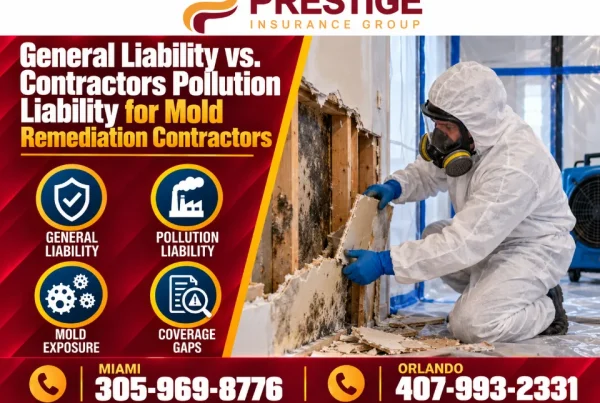
Contractors pollution liability and professional liability are the coverages that separate a real program for this trade from a general contractor’s policy, and they’re a meaningful part of the cost. They are often written together on a combined form. The limits you choose, often driven by what property managers, associations and insurance carrier vendor programs require, affect the price, as do the deductible and whether the policy is written on an occurrence or claims-made basis. Our article on general liability vs. contractors pollution liability explains why both coverages are needed.
Experience, Certifications and Procedures
Underwriters look closely at how the work is done. Years in business, IICRC certifications for technicians, written remediation and drying protocols, containment and air filtration practices, moisture documentation and use of third-party clearance testing all affect both availability and price. A company that can show a consistent, documented process presents as a better risk than one that can’t.
Claims History
Prior claims, especially allegations that mold returned after remediation, that contamination spread during the work or that drying was incomplete, raise the price and narrow the market. Because many carriers decline this class entirely, a company with a difficult history may have only a few options. A clean history, supported by good job files, keeps more carriers interested.
The Rest of the Program
Workers’ compensation is often one of the largest costs, because the work involves lifting saturated materials, confined spaces and respiratory exposure. Commercial auto covers the vans and trailers, and inland marine covers drying equipment, dehumidifiers, air movers and generators that move from job to job. An umbrella sits above general liability and auto. Each of these adds cost, and each fills a gap the others don’t.
How to Lower the Cost
The most effective steps are documenting every job, keeping certifications current, requiring subcontractors to carry their own coverage, choosing limits that match your contracts rather than guessing, and marketing the account to the specialty carriers that actually write this class. A broker with access to several of those markets can often find a better combination of coverage and price than a single carrier offers.
Worth Confirming
-
Every service you perform is listed on the application
-
Mold is covered, not excluded, on the liability program
-
Contractors pollution and professional liability are both in place
-
Limits match your vendor program and contract requirements
-
Subcontractors carry their own coverage
-
Drying equipment is scheduled on an inland marine policy
Talk to Prestige Insurance Group
We write water mitigation, mold remediation and restoration contractors across Florida through specialty markets that offer contractors pollution and professional liability built for this work. Send us your current policies and a description of your services, and we’ll compare programs form to form, not just premium to premium.
Call the office nearest you. Se habla español.
-
Miami: 305-969-8776
-
Orlando: 407-993-2331
-
Stuart: 772-247-3788
Related Resources
-
What Water Mitigation and Mold Remediation Insurance Does Not Cover
-
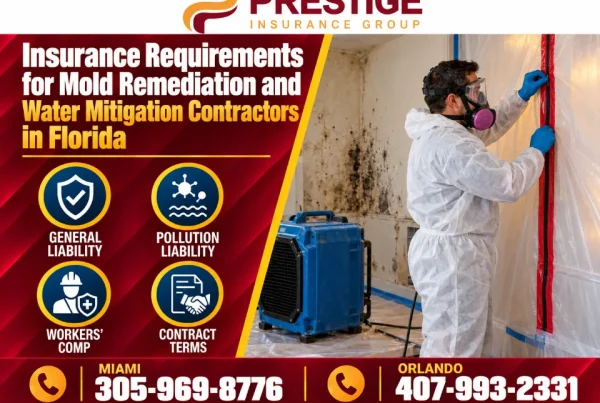
Insurance Requirements for Mold Remediation and Water Mitigation Contractors
-
Biggest Water Mitigation and Mold Remediation Insurance Claims
General information only, not legal advice. Policy forms, exclusions and endorsements vary by carrier and by policy. Florida licensing requirements for mold assessment and remediation and the rules on assignment of benefits can change; confirm current requirements with the Department of Business and Professional Regulation and qualified counsel. Prestige Insurance Group, Florida agency license L057894.