


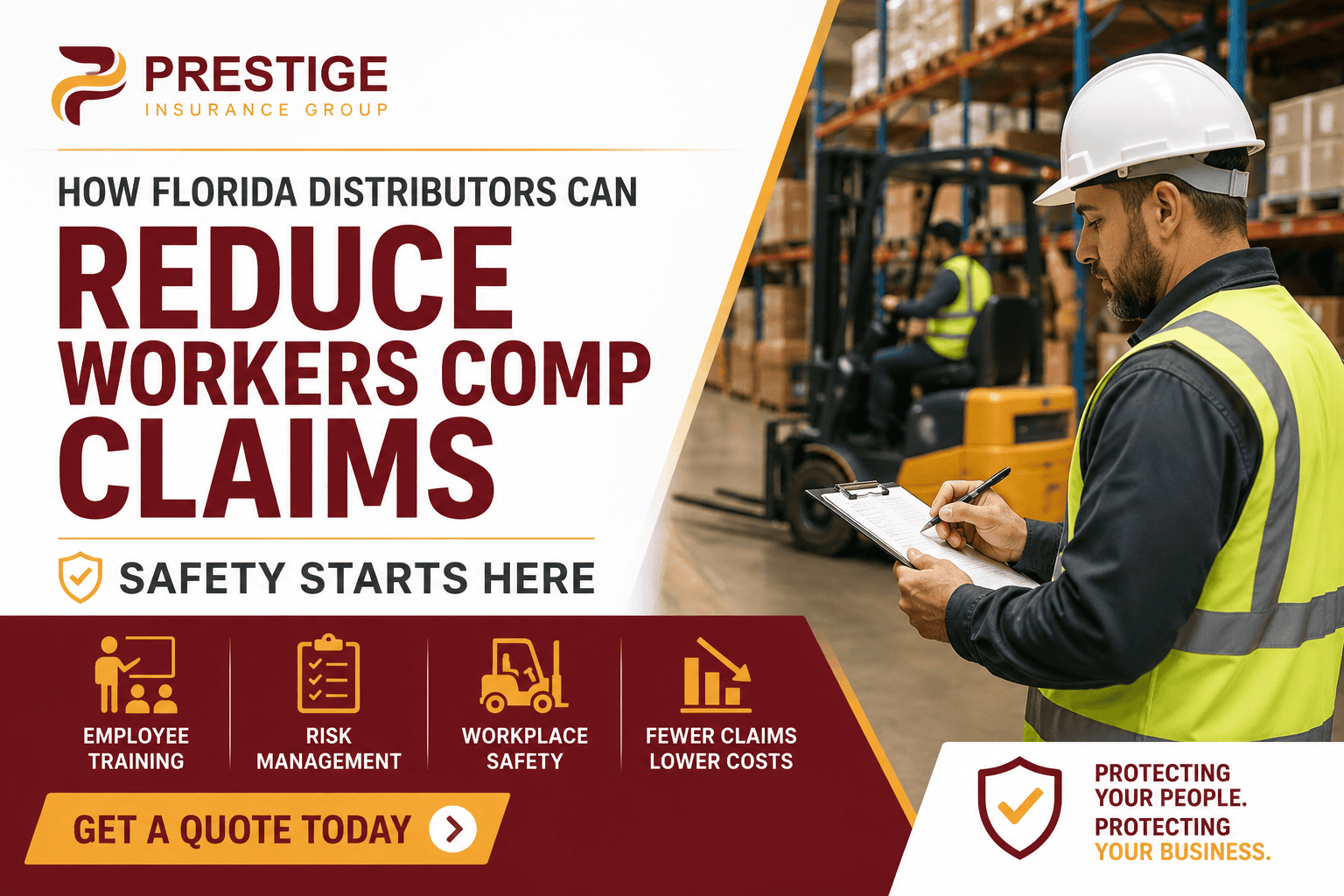
Workers’ compensation claims are one of the largest insurance expenses facing many wholesalers and distributors. A single injury can result in medical expenses, lost productivity, increased premiums, employee absences, and operational disruptions. While workplace accidents cannot always be prevented, many claims can be reduced through proactive safety and risk management practices.
For Florida distributors, reducing workers’ compensation claims is not only about lowering insurance costs. It’s also about improving employee safety, maintaining productivity, and creating a stronger workplace culture.
Why Workers’ Compensation Claims Matter
Distribution operations involve constant movement of inventory, forklifts, pallets, trucks, employees, and equipment, creating injury exposures that can affect both employees and employers. Frequent claims may lead to higher insurance premiums, increased experience modification factors, operational disruptions, employee turnover, and lost productivity — reducing claim frequency often produces long-term financial benefits well beyond the immediate insurance savings.
The Most Common Workers’ Compensation Claims for Distributors
Understanding common injuries helps businesses focus their prevention efforts where they’ll matter most. Lifting injuries remain one of the leading causes of workplace injuries, as employees frequently move boxes, inventory, supplies, and equipment with improper technique. Slip-and-fall accidents commonly stem from wet floors, uneven surfaces, warehouse debris, and loading dock hazards. Forklift incidents may involve collisions, falling inventory, pedestrian impacts, and property damage. Loading docks create a unique combination of vehicle traffic, pedestrian traffic, and material handling that increases accident potential directly. Repetitive motion injuries develop over time from repeated movements, leading to shoulder injuries, wrist injuries, joint problems, and muscle strains.
Start with a Written Safety Program
Many successful distributors implement formal safety programs covering workplace rules, employee responsibilities, training procedures, reporting requirements, and accident investigation procedures. Written policies create genuine consistency throughout the organization, rather than leaving safety practices to individual managers’ discretion or memory.
Forklift Safety Training
Forklifts remain one of the largest injury exposures in many warehouses. Training should address safe operation, load limits, warehouse traffic flow, pedestrian awareness, and equipment inspections — and regular refresher training can help reinforce safe practices that erode over time without reinforcement.
Improve Loading Dock Safety
Loading docks are frequent injury locations, and risk reduction strategies may include clearly marked walkways, adequate lighting, vehicle restraints, anti-slip surfaces, and dock safety inspections. Small improvements in this specific area often reduce accident frequency disproportionately to their cost.
Focus on Proper Lifting Techniques
Many injuries occur simply because employees attempt to lift products incorrectly. Training should include proper body positioning, team lifting procedures, mechanical lifting equipment, and weight limitations — and encouraging employees to ask for assistance, rather than pushing through alone, can genuinely help prevent injuries before they happen.
Conduct Regular Safety Meetings
Safety meetings help keep workplace risks visible rather than fading into the background of daily operations. Topics may include recent incidents, seasonal hazards, equipment safety, housekeeping standards, and emergency procedures — frequent communication often improves safety awareness in a way that a single annual training session cannot.
Maintain Equipment Properly
Equipment failures can contribute directly to injuries, whether involving forklifts, pallet jacks, conveyors, or loading equipment. Routine inspections may help identify issues before they cause an accident rather than after.
Improve Warehouse Housekeeping
A clean warehouse is often a genuinely safer warehouse. Focus on clear aisles, proper storage, spill cleanup, debris removal, and organized inventory — good housekeeping reduces many common injury causes at essentially no direct cost beyond consistent effort.
Create an Early Injury Reporting Process
Employees should know exactly how to report injuries when they occur. Prompt reporting can improve medical outcomes, reduce claim severity, improve documentation, and support investigations — delayed reporting, by contrast, often creates additional challenges that compound the original injury’s cost and complexity.
Implement Return-to-Work Programs
Long absences can increase claim costs substantially. Modified-duty programs may help injured employees return to work sooner when medically appropriate, offering benefits including reduced claim costs, improved morale, faster recovery, and better workforce retention — a genuinely different outcome than an employee sitting home on full disability for months.
Analyze Claims Data
Past claims often reveal real patterns worth acting on. Reviewing injury types, accident locations, job classifications, and contributing factors can help identify trends that guide future prevention efforts — a warehouse that keeps having the same type of injury at the same location has a specific, fixable problem, not just bad luck.
Management Involvement Matters
Safety programs are generally more effective when management participates actively rather than delegating the entire effort to a single safety officer. Leaders should support safety initiatives, attend meetings, enforce procedures, and promote accountability — employees are genuinely more likely to follow safety practices when leadership is visibly engaged rather than just mandating a policy from a distance.
Insurance Programs and Workers’ Compensation
Workers’ compensation should be part of a broader risk management strategy rather than a standalone policy. Many distributors also maintain Commercial Property Insurance, Commercial Auto Insurance, Warehousing and Logistics Insurance, Commercial Umbrella Insurance, and comprehensive Wholesaler and Distributor Insurance programs working together.
Frequently Asked Questions
What is the most common workers’ compensation claim in warehouses? Lifting injuries, slip-and-fall accidents, and forklift-related incidents are among the most common.
Can safety programs reduce insurance costs? Strong safety performance may contribute to improved long-term workers’ compensation results over time.
Why is forklift training important? Forklift accidents often result in serious injuries and expensive claims, making training one of the highest-leverage safety investments available.
What is a return-to-work program? A structured process that helps injured employees return to modified duties when medically appropriate, rather than remaining out of work entirely.
How often should safety training occur? Regular training and refresher sessions are generally recommended rather than a one-time onboarding session.
Creating a Safer Distribution Operation
Reducing workers’ compensation claims starts with proactive risk management. Businesses that focus on employee training, forklift safety, loading dock procedures, housekeeping, equipment maintenance, and injury reporting often experience fewer accidents and lower long-term claim costs.
Prestige Insurance Group helps Florida wholesalers and distributors evaluate workers’ compensation solutions and broader risk management strategies designed to protect employees, operations, and long-term business success.
Contact Prestige Insurance Group today to discuss insurance options for your distribution business:
Distributors that sell products under their own brand can be treated as the manufacturer in a lawsuit. Our page on manufacturer insurance explains how that changes the coverage.
Miami: 305-969-8776 Orlando: 407-993-2331
Se Habla Español.