A former oilfield driver in Tallahassee buys a one-ton dually and a 40-foot gooseneck flatbed, planning to haul construction equipment and building materials for contractors across North Florida and into south Georgia. He already has a personal auto policy on the truck and assumes he can add the trailer and start booking loads. Then a broker asks for his MC number, his certificate of insurance showing cargo coverage and proof of $750,000 in liability, and his personal agent tells him the policy will not cover the truck for hauling freight at all.
Hotshot trucking looks like a lighter, easier version of running a tractor-trailer, and in some ways it is. The insurance side, though, follows many of the same rules as any for-hire motor carrier once the truck and trailer cross certain weights or state lines.
What Makes Hotshot Different
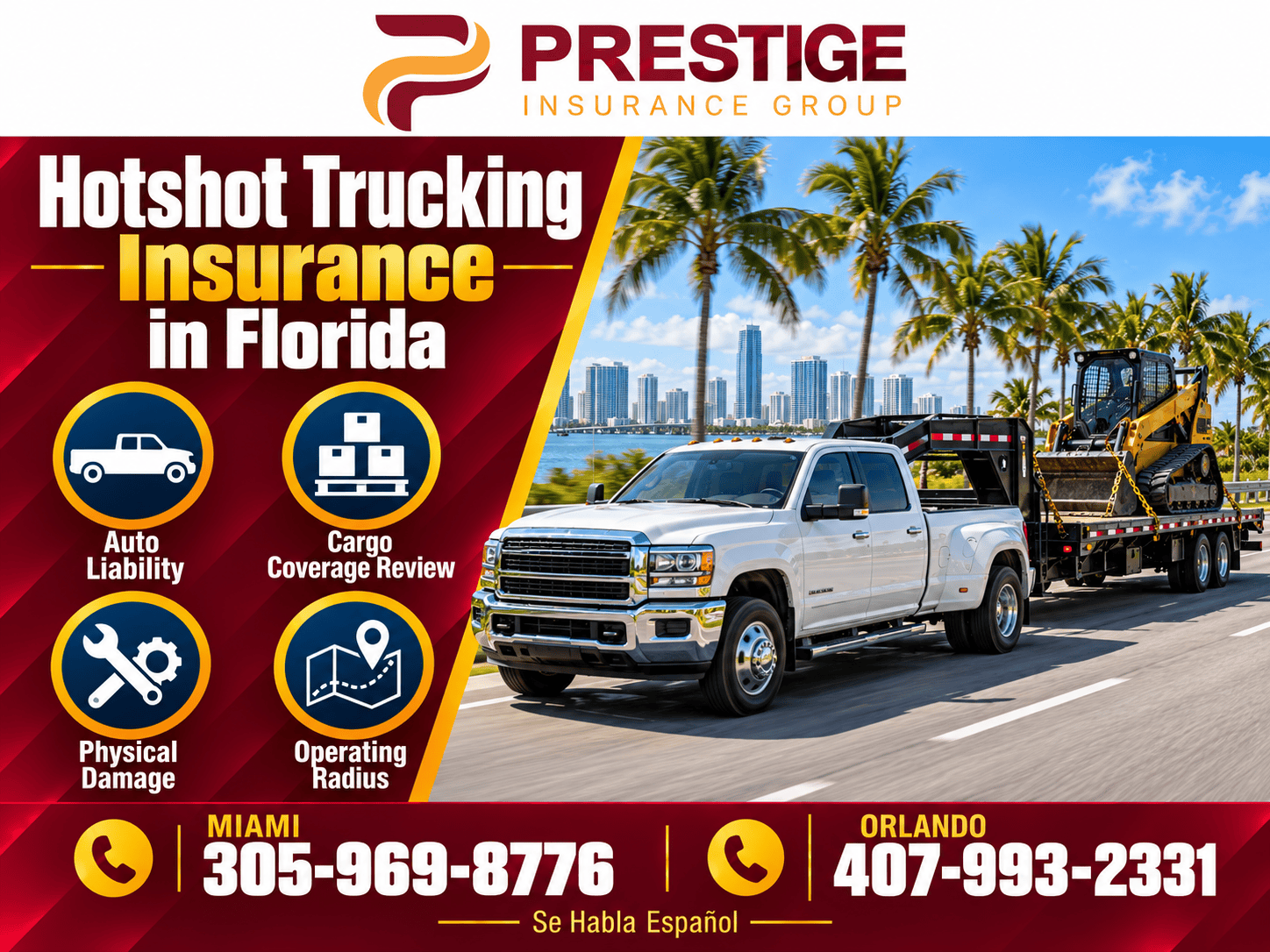
Hotshot operations usually use heavy-duty pickups, typically in the Class 3 to Class 5 range, pulling gooseneck, flatbed or dovetail trailers. The loads tend to be time-sensitive and smaller than a full truckload: equipment, machinery parts, building materials, vehicles and expedited freight. Startup costs are lower than buying a tractor, which attracts new operators, but the exposure on the road is real. A loaded dually and trailer can weigh well over ten tons, and an accident involving one can produce the same kinds of claims as one involving a semi.
When Federal Rules Apply
Federal requirements depend on weight and the type of operation. A USDOT number is generally required for commercial vehicles with a gross vehicle weight rating or gross combination weight rating of 10,001 pounds or more operating in interstate commerce, and a pickup and loaded gooseneck reach that threshold easily. A for-hire carrier hauling regulated freight across state lines also needs its own operating authority, an MC number, unless it is leased onto another carrier.
For-hire interstate carriers of general, non-hazardous freight in vehicles of 10,001 pounds or more must carry at least $750,000 in liability coverage under federal rules, and brokers and shippers often require more. A commercial driver’s license becomes necessary at higher combined weights, generally when the combination exceeds 26,000 pounds and the trailer is rated over 10,000 pounds. Our article on trucking insurance requirements in Florida covers how federal and state minimums fit together.
Florida-Only Hotshot Work
An operator who runs strictly inside Florida, hauling freight that does not continue in interstate commerce, may fall under Florida’s rules rather than federal ones. Florida sets its own minimum liability limits for commercial motor vehicles by weight, beginning at 26,000 pounds. In practice, the line between intrastate and interstate is drawn by the freight’s journey, not just the truck’s route, and much of what moves through Florida ports and distribution centers is interstate even when the truck never leaves the state. Brokers will also set their own requirements regardless of the legal minimum. We explain how that line is drawn in interstate vs. intrastate trucking in Florida.
Why a Personal Auto Policy Will Not Work
Personal auto policies exclude using a vehicle to haul goods for hire, and they are not designed to carry federal filings. A hotshot operator needs a commercial auto or trucking policy written for the operation, with liability limits that satisfy federal rules and broker requirements, and with the necessary filings made by the insurer, such as the BMC-91 or BMC-91X filing and the MCS-90 endorsement for interstate authority. Our article on the MCS-90 endorsement explains what that endorsement does.
Cargo Coverage
Brokers commonly require motor truck cargo coverage, and the limit they ask for depends on the freight. Equipment and machinery loads can be worth far more than typical general freight, so a hotshot operator needs a cargo limit that matches the most valuable loads he accepts. Cargo forms also have exclusions and conditions, including commodity exclusions, securement requirements and theft conditions. Flatbed loads that shift or fall because of improper securement are a common source of claims, and some forms limit coverage in those situations.
Physical Damage for the Truck and Trailer
Physical damage coverage protects the pickup and the trailer against collision, theft, fire, flood and other losses. If either is financed, the lender will require it. Trailers should be scheduled with accurate values, and any equipment permanently mounted on the truck, like a flatbed body or a toolbox, should be included. For an operator whose truck and trailer are the entire business, a physical damage loss without coverage can end the business.
Leased On or Running Your Own Authority
Some hotshot drivers lease onto an established carrier rather than getting their own authority. In that case, the carrier’s policy generally provides primary liability while the truck is operating under dispatch, and the driver needs non-trucking liability for times the truck is used without a load or outside the carrier’s business, plus physical damage on his own equipment. Lease agreements vary in what they require. Our article on bobtail vs. non-trucking liability explains the difference.
What Drives the Cost
New authorities are priced as new ventures, and the first year is usually the most expensive. Underwriters look at the driver’s commercial driving experience and record, the operating radius, the commodities hauled, the value of the equipment and whether the operation is interstate. Experience driving heavier equipment, a clean motor vehicle record and a defined, local radius tend to help. Shopping the account with more than one market matters most in that first year, because carriers differ widely in how they treat new authorities.
Worth Confirming With Your Agent
-
Whether your truck and trailer combination crosses federal or Florida weight thresholds
-
Whether your freight is interstate, and whether you need your own operating authority
-
What liability and cargo limits your brokers require
-
Whether your cargo coverage matches the most valuable loads you accept
-
Whether your truck, trailer and mounted equipment are scheduled for physical damage
-
Whether non-trucking liability is needed if you lease onto a carrier
This article is general information and is not legal advice.
Talk to Prestige Insurance Group
Prestige Insurance Group works with hotshot operators and new authorities across Florida. We write Progressive and GEICO directly and work with specialty trucking markets that write new ventures, and we handle the filings so your authority can activate on time. Call us before you buy the trailer, and we will give you a realistic quote for the work you plan to do.
Call the office nearest you. Se habla español.
Orlando: 407-993-2331
Miami: 305-969-8776
Stuart: 772-247-3788
Prestige Insurance Group, License L057894