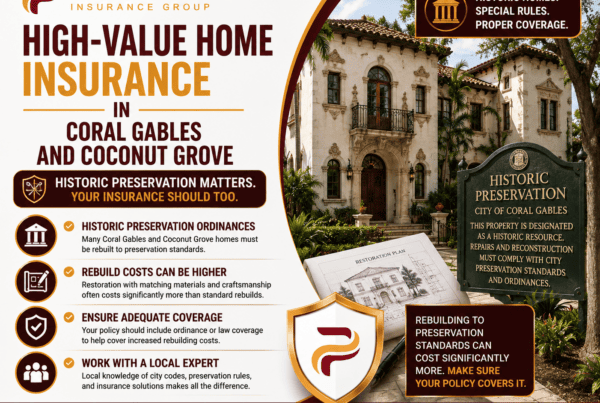



High-Value Home Insurance on Key Biscayne
Key Biscayne is one of the harder residential placements in Miami-Dade County, and the reasons have little to do with the quality of the homes.
A barrier island reached by a single causeway, low in elevation, with coastal high-hazard flood zones and property values that put nearly every home above the state’s residual market thresholds. That combination narrows the field of carriers willing to write, and it means an owner here needs to understand the risk file the way an underwriter reads it.
There Is No Residual Market Here
Most Florida homeowners treat Citizens Property Insurance as the floor beneath them. On Key Biscayne, that floor is generally not there.
A home becomes ineligible for Citizens once its dwelling replacement cost reaches one million dollars in Miami-Dade County. Above that, the property must be insured through the private client or surplus lines market. Given local values, most single-family homes on the island sit above the threshold.
The practical consequence is that carrier relationships matter more here than almost anywhere in the state. A non-renewal is not a matter of falling back on the state program — it is a placement that has to be found, and found before the current policy expires. Our High Net Worth Insurance guide covers how the private client market is structured.
Coastal High Hazard Zones Behave Differently
Portions of the island fall in coastal high-hazard flood zones, designated V or VE. These are FEMA’s highest-risk classifications, defined by exposure to storm surge with wave action of three feet or more.
Wave action is a different loss mechanism than standing water. Waves impose lateral and uplift forces on a structure, which is why V zone construction requires elevation on open piles, posts, or piers rather than slab, and why the building itself can be compromised rather than simply inundated.
The distinction between V and VE is worth knowing: VE zones have detailed coastal flood studies producing a parcel-specific base flood elevation, while V zones lack an assigned BFE. Both carry mandatory flood insurance requirements for federally backed mortgages.
In V zones, elevation is the single largest driver of premium. Every additional foot above base flood elevation matters measurably, which makes the documentation of that elevation the most valuable piece of paper in the file.
The Elevation Certificate Is Decisive
Miami-Dade County has required FEMA Elevation Certificates for permitted construction since 1995. If your home was built or substantially permitted after that, a certificate very likely exists.
It is a standardized record of the building’s elevation relative to base flood elevation, and it does two things a flood map cannot. It establishes the specific building’s position rather than the parcel’s general zone, and it is what actually drives flood insurance rating.
Owners without one on file should obtain it. Owners with an old one should confirm it reflects the current structure, particularly after a renovation. The Flood Insurance guide covers how coverage is structured around these figures.
Substantial Improvement Is the Sleeping Issue
This is the provision most likely to produce an unwelcome surprise, and it applies to both renovation and loss.
If a structure in a special flood hazard area is substantially improved — or substantially damaged — current floodplain requirements apply to the whole building, not just the repaired portion. On a barrier island that generally means elevating to current base flood elevation plus required freeboard, which for new and substantially improved buildings is typically a minimum of one foot above BFE.
For an older, lower-elevation home, that is not a repair. It is a lift, or a rebuild, and the cost difference between restoring what was there and meeting current standards can be enormous.
Ordinance or law coverage is what addresses that gap, and standard limits expressed as a modest percentage of the dwelling amount are frequently inadequate for a barrier island property facing an elevation requirement. This is worth checking on the declarations page specifically rather than assuming it is handled.
What Flood Insurance Will Not Cover Here
Several exposures particular to island property fall outside flood coverage entirely.
Seawalls, docks, and outdoor property. NFIP excludes property outside the insured building — seawalls, docks, landscaping, patios, decks, pools, and fences. On waterfront property these represent substantial value and are among the first things a surge event destroys. Private flood forms vary, and docks and seawalls are difficult to cover under any flood form, which usually means addressing them separately rather than assuming coverage.
Erosion. Gradual shoreline loss is not an insurable event. It matters anyway, because erosion reduces the buffer between structure and water over time and can destabilize the ground supporting foundation piles even when elevation appears unchanged.
Additional living expenses. The federal form pays nothing toward housing you elsewhere during repairs.
Sewer backup. Some residential sanitary sewers on the island back up during heavy rain. That is neither flood nor a standard homeowners peril — it requires a specific endorsement, and backflow prevention devices are a practical mitigation the Village has pointed homeowners toward.
The Causeway Affects Recovery Time
An island with one road in has a recovery profile that a mainland property does not.
After a significant storm, access for contractors, equipment, and materials depends on the causeway being open and passable. Debris clearance, utility restoration, and permitting all queue behind that. A rebuild that would take months on the mainland can take considerably longer here.
That has a direct coverage implication. Additional living expense is frequently written with a twelve-month limit, and a displaced household facing a delayed rebuild can exhaust it before the work is finished. Both the limit and the time period deserve review rather than acceptance of the default.
Condominium Owners Have a Different Problem
The island’s condominium stock carries its own exposures, distinct from single-family ownership.
The association’s master policy covers the building to a defined point. Unit owners typically remain responsible for interior improvements, flooring, cabinetry, appliances, personal property, and their own liability — and for loss assessments, which in Florida have grown substantially following structural reserve requirements and building recertification. A major uninsured or underinsured association loss becomes a unit owner obligation.
High-rise units may also need higher contents limits than a standard condo form contemplates. Our Condo Insurance guide covers the division of responsibility in more detail.
What Strengthens the File
Because placement is the constraint here, presentation matters.
A current wind mitigation inspection on form OIR-B1-1802 documenting roof shape, deck attachment, roof-to-wall connections, opening protection, and secondary water resistance. A current elevation certificate. Documentation of impact glass, shutters, and roof age with permits. A four-point inspection on older construction. And a replacement cost valuation built on the actual structure rather than a percentage of purchase price.
The Village of Key Biscayne participates in the NFIP Community Rating System and provides flood zone information to residents on request, which is worth using — CRS participation produces flood premium discounts for policyholders in the community.
Discuss Coverage With Prestige Insurance Group
Prestige Insurance Group works with homeowners on Key Biscayne and throughout coastal Miami-Dade on high-value placements across the private client and surplus lines markets, including properties the standard market has declined.
For an island property, the useful starting point is the elevation certificate, the current wind mitigation report, and the ordinance or law limit on your existing policy.
Miami: 305-969-8776 Orlando: 407-993-2331 Stuart: 561-983-4333
Se Habla Español.
Related Articles
High Net Worth Insurance in Florida · Flood Insurance in Florida · Homeowners Insurance in Florida · Condo Insurance in Florida