


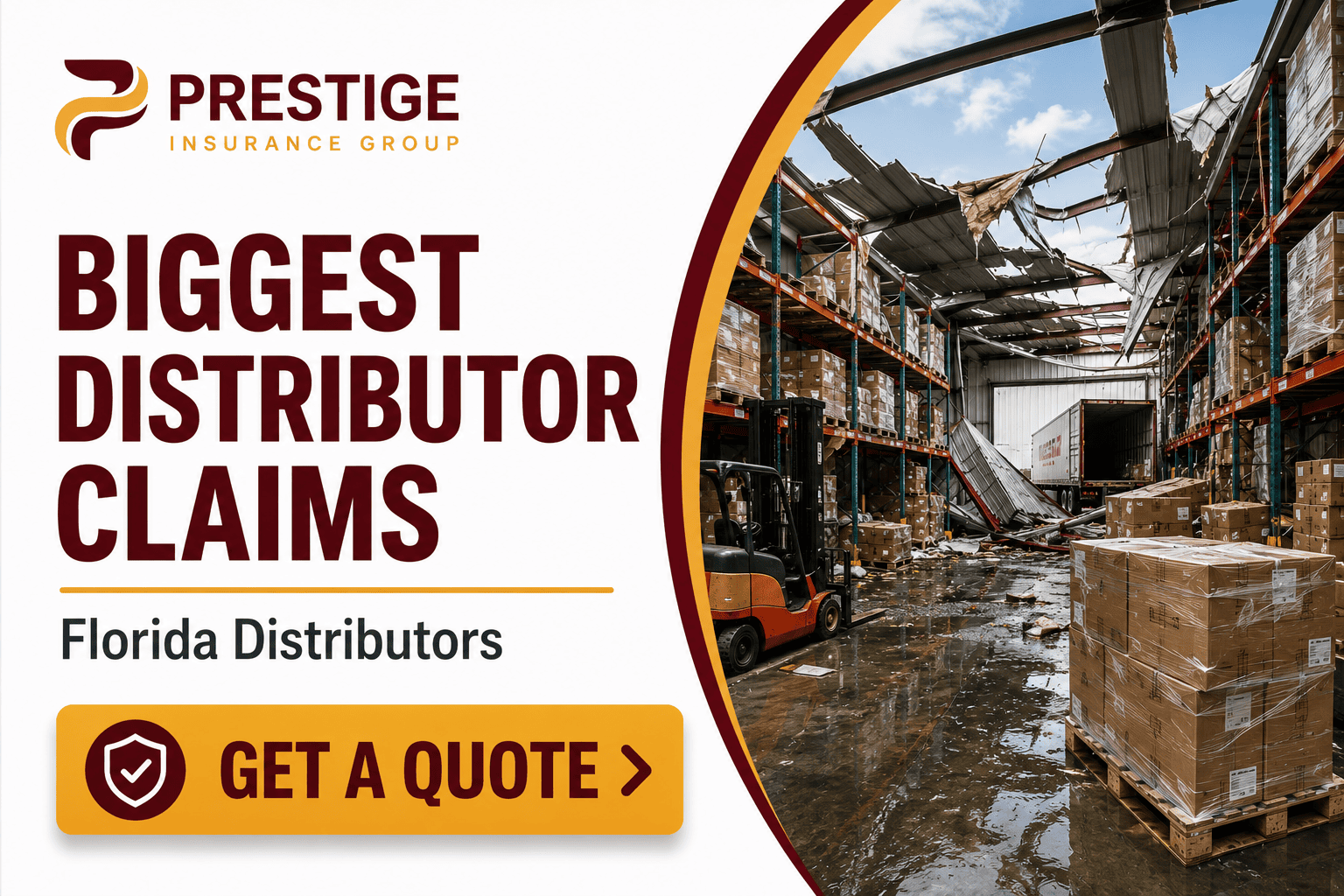
Biggest Distributor Insurance Claims in Florida | Real Loss Examples
Why Understanding Claims Matters
Many wholesalers focus on insurance requirements, premiums, and policy limits. However, one of the best ways to understand risk is to examine the types of claims that actually affect distributors.
The largest losses often involve events that business owners never expected to happen. A warehouse fire, hurricane, theft event, product liability lawsuit, or employee injury can quickly create six-figure or even seven-figure losses. Understanding these risks can help distributors improve both insurance planning and loss prevention efforts.
Why Florida Distributors Face Unique Risks
Florida distributors operate in an environment that creates several unique exposures, including hurricanes, flooding, cargo theft, high property values, transportation risks, product liability exposures, and warehouse operations. Many of the largest claims involve multiple loss categories occurring at the same time, which is exactly what makes them so financially damaging.
Warehouse Fire Claims
Warehouse fires remain one of the largest claims affecting distributors. A fire can damage buildings, inventory, equipment, vehicles, and technology systems all at once, and the loss often extends well beyond the property damage itself — businesses may also face lost revenue, customer disruptions, and temporary relocation costs.
This isn’t hypothetical. In April 2026, a six-alarm fire deliberately set by a disgruntled employee destroyed a 1.2-million-square-foot third-party logistics warehouse in Ontario, California — a facility storing paper products for Kimberly-Clark, not the warehouse operator’s own inventory. Total property damage reached approximately $600 million, and the facility was declared a complete loss. It’s an extreme case, but it illustrates exactly how catastrophic a warehouse fire claim can become when it combines property loss, third-party inventory exposure, and business interruption simultaneously.
Hurricane Damage Claims
Florida distributors face hurricane exposure every year. A major storm may cause roof damage, water intrusion, inventory losses, power outages, and transportation disruptions — the largest losses often involve both property damage and business interruption occurring together. A real example: a hurricane damages a warehouse roof, rainwater enters the building and destroys inventory awaiting shipment, and customer deliveries are delayed while operations remain disrupted for weeks afterward.
Flood Claims
Many business owners assume flood damage is covered under commercial property insurance. In most situations, separate flood insurance is actually required, and floodwater can affect buildings, inventory, forklifts, electrical systems, and warehouse equipment simultaneously.
The scale of this risk in Florida specifically is genuinely striking: the National Flood Insurance Program paid out $629 million to Florida alone in 2024, representing 69% of the total $913 million paid out nationwide that year. A real example: heavy rainfall overwhelms drainage systems near a warehouse, floodwater enters the facility and damages products stored on lower racks, and the warehouse remains partially closed during cleanup.
Cargo Theft Claims
Cargo theft continues to evolve, with modern theft schemes involving trailer theft, fictitious pickups, load diversion, and fraudulent carriers targeting high-value inventory. This is a well-documented, growing problem in Florida specifically — in February 2026, the Florida Attorney General’s office charged members of an organized cargo theft ring responsible for at least 32 incidents across six Florida counties, resulting in nearly $7.8 million in losses. Nationally, cargo theft losses more than doubled year-over-year to $304.6 million in the second quarter of 2026 alone. A real example of the mechanism at work: a distributor releases a shipment to a carrier that appears legitimate, the carrier documentation turns out to be fraudulent, and the shipment disappears before ever reaching its destination.
Product Liability Lawsuits
Many distributors assume manufacturers bear all product liability responsibility. In reality, distributors are often included in lawsuits involving defective products, product injuries, property damage, and product failures — and legal defense expenses alone can become significant even when the distributor is ultimately found not at fault. A real example: a defective product causes property damage after installation, and the resulting lawsuit names the manufacturer, distributor, and contractor all at once, pulling multiple parties into the same litigation.
Employee Injury Claims
Warehouse environments create injury exposure involving forklifts, loading docks, lifting activities, and material handling, and serious injuries can result in long-term claim costs that extend well past the initial incident. A real example: a warehouse employee suffers a back injury while moving inventory, and the resulting claim involves medical treatment, rehabilitation, and lost wages while the employee remains out of work for several months.
Commercial Auto Claims
Many distributors rely on cargo vans, box trucks, and delivery vehicles, and vehicle accidents can result in bodily injury claims, property damage claims, and legal expenses that quickly compound. A real example: a delivery vehicle becomes involved in a multi-vehicle accident, several parties submit injury claims, and the resulting loss exceeds initial expectations by a wide margin.
Equipment Breakdown Claims
Modern distribution centers rely heavily on forklifts, conveyors, refrigeration systems, and electrical equipment, and unexpected failures can disrupt operations directly. A real example: a refrigeration failure damages temperature-sensitive inventory, leaving the distributor facing both equipment repair costs and inventory losses simultaneously.
Business Interruption Claims
Property damage is often only part of the financial impact. Business interruption may involve lost revenue, missed deliveries, customer losses, and ongoing expenses that many distributors genuinely underestimate until they’re living through one. A real example: a warehouse fire causes extensive property damage, and even after cleanup begins, the business remains unable to fulfill customer orders — lost income continues long after the initial event has technically ended.
What Large Claims Often Have in Common
Many major distributor claims involve multiple causes of loss, operational interruptions, inventory damage, customer disruptions, and revenue loss all at once. The largest claims rarely involve only one issue — which is exactly why the Kimberly-Clark case above is instructive, combining arson, property loss, third-party inventory, and total business interruption into a single event.
How Florida Distributors Can Reduce Claim Severity
Regular facility maintenance may help reduce fire risks, water damage, and equipment failures before they become losses. Improved warehouse security — cameras, access controls, and alarm systems — may help reduce theft exposure meaningfully. Investing in employee training may reduce workplace injuries, forklift accidents, and loading dock incidents. And reviewing insurance programs regularly, rather than treating a policy as a set-and-forget purchase, helps coverage keep pace with inventory growth, operational changes, new locations, and additional exposures as the business evolves.
Insurance Coverages Commonly Used by Distributors
Commercial Property Insurance · Warehousing and Logistics Insurance · Commercial Flood Insurance · Business Auto Insurance · Commercial Umbrella Insurance · Wholesaler and Distributor Insurance
Frequently Asked Questions
What is the biggest insurance claim for distributors? Warehouse fires, hurricanes, product liability lawsuits, and cargo theft events are among the largest — real cases like the $600 million Kimberly-Clark warehouse fire show just how large a single loss can become.
Why are hurricane claims so expensive? Many hurricane losses involve property damage, inventory losses, and business interruption simultaneously, compounding the total cost well beyond the initial storm damage.
Can distributors be sued for defective products? Yes. Distributors are often named in product liability lawsuits even when they didn’t manufacture the product themselves.
Why is cargo theft increasing? Organized theft operations and transportation fraud schemes continue to create challenges throughout the industry — national losses more than doubled in a single quarter during 2026 alone.
What is the most overlooked exposure? Business interruption is often underestimated until a major loss occurs, since the lost income often exceeds the direct property damage itself.
Learning from Real Distributor Claims
The largest insurance claims affecting distributors often involve risks that seem unlikely until they happen. Warehouse fires, hurricanes, flood events, cargo theft, product liability lawsuits, employee injuries, and business interruption losses can all create significant financial consequences — and the real cases and figures above make clear these aren’t rare, abstract possibilities but documented, recurring patterns.
Prestige Insurance Group helps Florida wholesalers and distributors evaluate insurance solutions designed to address warehouse exposures, inventory protection, liability risks, transportation operations, and broader business challenges.
Contact Prestige Insurance Group today to discuss insurance options for your distribution business:
Miami: 305-969-8776 Orlando: 407-993-2331 Stuart: 561-983-4333
Se Habla Español.