


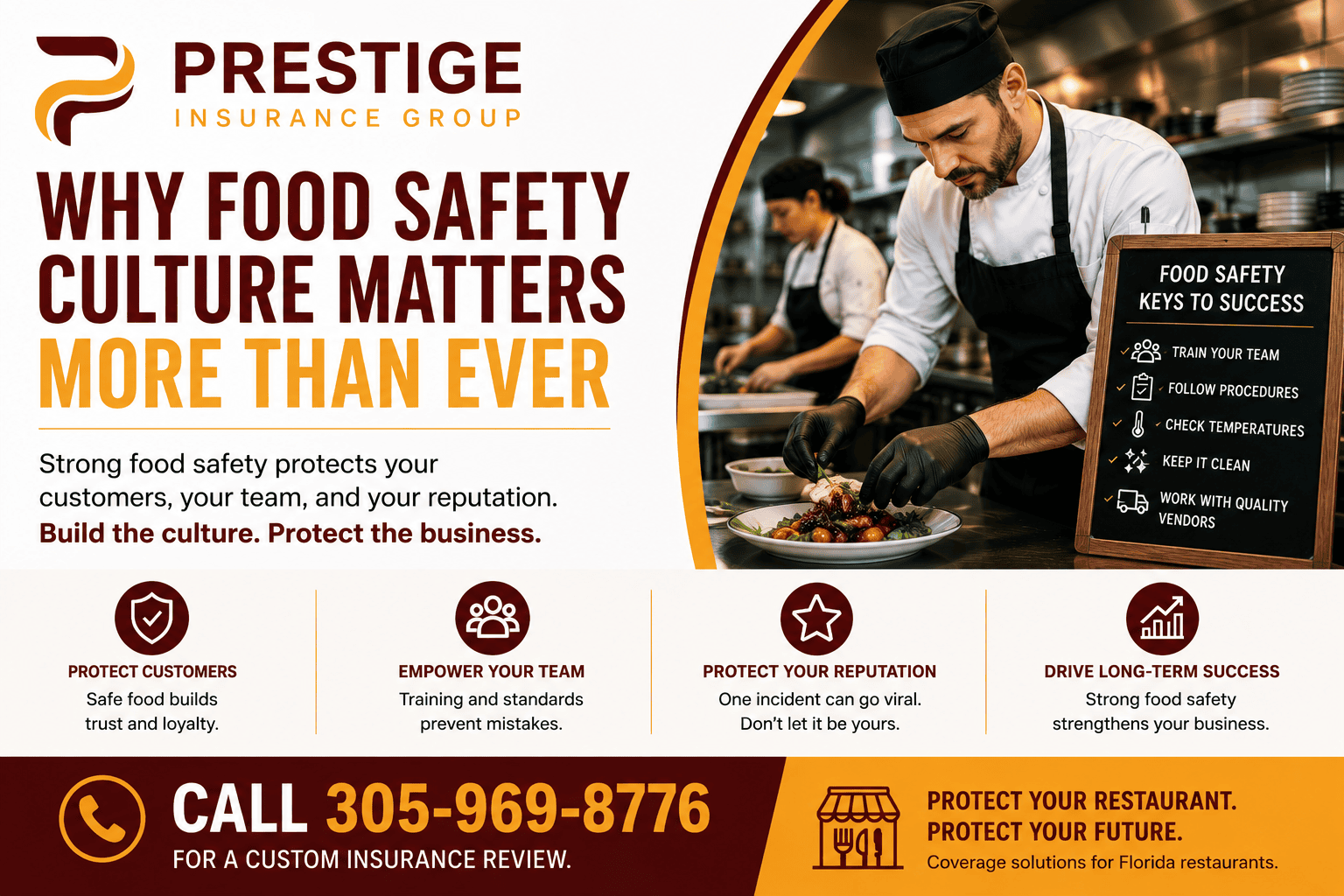
Why Food Safety Culture Matters More Than Ever for Restaurants
Food safety is often discussed as a collection of rules: wash your hands, maintain proper temperatures, prevent cross-contamination, clean equipment and store food correctly. Those procedures are essential, but they do not fully explain why some restaurants consistently follow good food-safety practices while others struggle even though employees have been taught essentially the same rules.
The difference is often culture.
The CDC describes restaurant food-safety culture as the shared beliefs among restaurant personnel that influence practices affecting food safety. Its research involving hundreds of restaurants identified four important components of a strong culture: leadership, management commitment, employee commitment and adequate resources. The CDC also identifies weak food-safety culture as an emerging risk factor associated with foodborne outbreaks.
That makes food safety much more than an inspection-day responsibility. It is something restaurant employees need to practice during every shift, particularly when the restaurant is busy, short-staffed or experiencing the kinds of operational pressures that make shortcuts tempting.
For restaurant owners, the most important question is therefore not simply “Do my employees know the food-safety rules?” It is “Do my employees follow those rules when nobody is watching?”
Food Safety Culture Is Created by What Management Actually Prioritizes
Employees quickly learn what really matters to management. A restaurant can have detailed food-safety policies posted in the kitchen and extensive procedures in an employee handbook, but if a manager regularly tells employees to ignore those procedures because the kitchen is busy, employees receive a very different message.
Imagine a cook recognizes that something needs to be discarded but the kitchen is overwhelmed with orders. If management consistently reinforces proper procedures, the employee is more likely to make the safe decision. If management routinely prioritizes speed or food cost over safety, employees learn that lesson too.
This is why management commitment matters so much. CDC research specifically separates having food-safety policies and training from management actually demonstrating that food safety is a priority in practice. Restaurant owners should therefore evaluate food-safety culture based on what happens during operations rather than what appears in a policy manual — and managers need visibility into what is actually happening in kitchens, storage areas, refrigeration units and receiving areas to know the difference.
The Dinner Rush Is the Real Test of Food-Safety Culture
Most restaurants can follow procedures when business is slow. The real test comes on Friday or Saturday night, when orders are arriving simultaneously from the dining room, takeout and delivery, the kitchen is operating at capacity, a dishwasher calls out, a refrigerator needs attention, and customers are asking why their meals are taking so long.
That is when shortcuts become tempting. Employees may rush handwashing. Preparation areas can become disorganized. Raw and ready-to-eat foods can come too close together. Temperature checks may be delayed. Cleaning procedures can fall behind.
CDC’s work examining restaurant outbreaks emphasizes that root causes can involve people, processes, equipment, economics and environmental factors, specifically identifying inadequate managerial oversight, insufficient staffing, training problems and employees failing to follow established procedures among issues that can contribute to unsafe conditions. Separate CDC research into safe food-preparation practices found that workers identified high business volume and poor staffing as factors that made safe food handling more difficult, while adequate equipment, resources, management support and training helped.
The restaurant’s systems therefore need to be designed for its busiest shift, not its easiest one. Management should observe what actually happens during peak periods — are employees still washing their hands appropriately, are temperatures still being checked, are raw and ready-to-eat foods handled correctly, are managers enforcing standards or helping employees bypass them to increase speed? The answers provide a much better picture of food-safety culture than a policy manual sitting in an office.
Short Staffing and Turnover Can Weaken Food-Safety Culture
Staffing and food safety are more closely connected than restaurant owners sometimes realize. An understaffed kitchen puts additional pressure on every employee working — people move faster, managers fill operational gaps instead of supervising, and employees may take shortcuts simply because there is more work than the available staff can reasonably complete. CDC has specifically identified short staffing as an obstacle to strong restaurant food-safety culture.
Turnover creates a related problem: it continuously removes experienced employees and replaces them with people who need training. CDC research has found relationships between employee turnover and food-safety culture, including lower leadership scores as turnover increased. A restaurant with experienced employees develops shared habits — workers know where equipment belongs, recognize abnormal conditions and understand how management expects problems to be handled. Constant turnover interrupts that continuity.
New employees need restaurant-specific training regardless of prior food-service experience, since equipment, storage, menus and cooling processes all differ between kitchens. Management therefore needs a training system capable of maintaining standards even when employees change frequently — a strong culture cannot depend entirely on one excellent kitchen manager or a handful of longtime employees. See our restaurant workforce management guide for more on this broader staffing challenge.
Training Explains What to Do; Culture Determines Whether It Happens
Restaurant employees need food-safety training covering temperature control, cross-contamination, hand hygiene, cleaning, employee illness and procedures relevant to their positions. But training does not guarantee behavior — an employee may know exactly what should be done and still take a shortcut if management routinely tolerates it.
Employees are also more likely to follow procedures they understand. CDC restaurant research found that workers viewed education and training as important and specifically noted the value of teaching workers why safe food practices matter, not just what to do. A worker who understands the underlying principle is better prepared to recognize a new problem that a checklist never specifically described.
Training should also continue beyond initial orientation. Menus change, equipment changes, employees change, and even experienced workers can gradually develop shortcuts. Short refresher discussions — reviewing a specific issue before a shift, discussing a recent near miss — can keep food safety visible without requiring lengthy formal sessions. Managers need this training as much as hourly employees: they determine staffing, purchasing, scheduling, whether questionable food is discarded, and how the restaurant responds when procedures conflict with speed or profitability. CDC’s research identified both leadership and manager commitment as distinct components of strong culture — a restaurant cannot realistically expect employees to prioritize food safety more strongly than their managers do.
Handwashing and Resources: Management Cannot Demand What It Doesn’t Support
Few food-safety principles are more familiar than handwashing, yet making it happen consistently is difficult in practice. Employees work quickly, sinks can become obstructed, supplies run out, and during a rush an employee may move between tasks without stopping as required.
The FDA’s employee-health guidance emphasizes management’s responsibility for maintaining accessible handwashing sinks with appropriate supplies and monitoring employees’ hand-hygiene practices during shifts. Resource availability was one of the four principal components in CDC’s food-safety-culture research — management cannot tell employees that handwashing is mandatory while allowing sinks to remain inaccessible or supplies to run out. Gloves can also create a false sense of security: an employee wearing gloves may touch equipment or surfaces and continue working as though the gloves remain clean, so employees need to understand when hands need to be washed and when gloves need to be changed, not simply that gloves are available.
The same principle extends to every other procedure the restaurant expects. If employees are expected to monitor temperatures, appropriate thermometers need to be available and functioning. If surfaces need to be sanitized, employees need the proper supplies. Employees cannot consistently follow procedures if the restaurant does not give them the tools to do so.
Sick Employees Create One of the Hardest Management Decisions
Restaurant employees do not always want to report illness. Hourly workers may worry about losing income, a cook may know that calling out will leave coworkers short-staffed, and a manager may desperately need the employee because the restaurant is already understaffed. Those pressures are real, but food safety still has to come first.
CDC research found that some restaurant workers reported working while experiencing vomiting or diarrhea, and recommends stronger written sick-worker policies, proactive management involvement, and scheduling practices that reduce pressure on sick employees to work. CDC’s root-cause framework specifically recognizes economic factors — such as lack of sick leave — leading food workers to work while ill as a potential contributor to foodborne illness.
CDC specifically notes that restaurant managers can discuss relevant foodborne-illness symptoms and diagnoses with employees, and that HIPAA does not prohibit a manager from asking an employee about their own symptoms. Restaurants should establish these procedures before the situation occurs — employees need to understand which symptoms should be reported, and managers need to know what questions they can appropriately ask. The worst time to develop a sick-worker policy is when the kitchen is already short-staffed and a cook calls thirty minutes before dinner service.
Temperature Control and Refrigeration Deserve Systems, Not Guesses
Food is received, stored, prepared, cooked, cooled, reheated and held during service, and each stage creates opportunities for problems when procedures aren’t followed. Temperature problems aren’t always visible — a refrigerator may look perfectly normal while operating outside its expected range. That is why restaurants need systems rather than visual assumptions: employees should know which temperatures need monitoring, how measurements are taken, and what actions to take when something falls outside procedure. CDC research found that workers identified access to thermometers and well-maintained equipment as factors supporting proper holding, reheating and cooling practices.
Documentation has real value beyond satisfying an inspector — if a walk-in cooler repeatedly approaches unacceptable temperatures, the logs may reveal a developing equipment problem before the refrigerator completely fails. Employees should know how to recognize warning signs early: unexpected temperature changes, unusual sounds, condensation, damaged door seals or recurring alarms should not simply be ignored because the equipment is still running.
Restaurants should also have a plan for when equipment does fail: who checks the food, who contacts the repair company, where products can be moved safely, and who decides whether something needs to be discarded. Those decisions are much easier to make before an emergency than during one.
Cross-Contamination Is Often a Workflow Problem, Not Just a Training Gap
Raw products and ready-to-eat foods need appropriate separation, with cutting boards, utensils, storage containers and preparation surfaces used and cleaned correctly. When kitchens become crowded, those controls can break down regardless of how well employees were trained. CDC restaurant research found that workers identified multiple cutting boards and separate work areas among factors that actually helped prevent contamination in practice.
Restaurant owners should evaluate how employees actually move through the kitchen during peak periods — are preparation areas large enough for the volume being produced, are raw products stored appropriately, do employees have easy access to clean utensils and sanitizing supplies? Sometimes the solution is additional training. Other times, the restaurant needs to redesign the process or the physical space.
Cleaning and Sanitizing Are Different From Looking Clean
Customers naturally judge cleanliness visually — a polished dining room and clean restroom matter to the customer experience. Food safety requires deeper operational cleanliness: food-contact surfaces, cutting equipment, preparation areas, storage spaces and ice machines all require appropriate cleaning and sanitizing procedures, with the right products used correctly. Management should avoid allowing cleaning to become something performed only at closing time — many food-safety tasks need to occur continuously throughout the operating day, and if closing employees are expected to complete an unrealistic amount of cleaning in a short period, corners will eventually be cut.
Pest control belongs in this same category. A pest problem can signal weaknesses involving storage, cleaning, building maintenance or waste handling — professional pest control is valuable but shouldn’t be treated as a substitute for good sanitation. Employees should feel comfortable reporting evidence of pest activity rather than hiding it out of fear of management’s reaction, since early identification is far easier to manage than a widespread infestation.
Receiving and Vendors Are Part of the Restaurant’s Food-Safety System
Food safety begins when the restaurant receives an ingredient, not when it reaches the preparation table. Employees accepting deliveries should know what to look for and what conditions justify rejecting a product — temperature-sensitive items need appropriate attention, packaging should be examined, and products should move into proper storage promptly rather than sitting while employees handle more immediate needs.
Restaurant owners should know where products come from and work with reputable suppliers. Price matters, particularly as food costs rise, but buying ingredients solely because they’re cheaper can create problems if the restaurant sacrifices consistency, traceability or reliability. If employees believe they must accept every delivery because refusing it will create a menu problem, the restaurant has created the wrong incentive — management needs to support employees who appropriately reject products that don’t meet the restaurant’s standards. Vendor relationships also become especially important during a product recall, when management needs to identify affected products quickly and remove them from service.
Allergens Require Their Own Communication Chain
A customer’s allergy information may pass from host to server, from server to kitchen and potentially between several employees before the meal reaches the table — every handoff creates an opportunity for misunderstanding. Restaurants should establish procedures for communicating allergy-related requests and determine who has authority to answer questions about ingredients and preparation. Employees should avoid guessing: if a server doesn’t know whether an ingredient is present, the appropriate response is to obtain reliable information rather than provide reassurance without knowing. Cross-contact also deserves attention, since removing an ingredient from a finished dish doesn’t necessarily mean the food was prepared without exposure to the allergen.
Employees Need to Feel Comfortable Reporting Problems
Employees are often the first people to recognize a problem — a line cook notices refrigeration running warm, a dishwasher sees that sanitizer isn’t working correctly, a server notices something unusual about a prepared item. Whether they report it depends heavily on culture.
CDC research has identified employee reluctance to communicate with managers as an obstacle to strong food-safety culture, while two-way communication and management support are associated with stronger practices. If workers believe management will blame them, ignore them, or become angry because addressing the problem could interrupt operations, employees learn to stay silent. If managers take reasonable concerns seriously, employees are more likely to report problems before customers are affected. Discovering that a refrigerator is failing at 3:00 p.m. is inconvenient; discovering the next morning that it failed completely and the food inside is unusable is considerably worse.
Managers Need to Enforce Standards Consistently
A manager who ignores unsafe behavior because the employee is a top performer sends a powerful message to everyone else: rules become optional. This can happen easily in restaurants because strong cooks, bartenders and servers are valuable, and management may hesitate to confront an experienced employee during a staffing shortage. But inconsistent enforcement damages culture — food-safety expectations should apply regardless of an employee’s seniority, productivity or relationship with management, because employees watch what managers tolerate, and what management repeatedly tolerates eventually becomes normal.
CDC outbreak research has identified lack of managerial oversight as an important root cause of foodborne outbreaks. This doesn’t mean a manager needs to watch every employee continuously — it means management should remain sufficiently connected to daily operations to recognize when procedures are beginning to break down, which requires actual presence in kitchens and storage areas rather than managing entirely from an office.
Growth Can Quietly Outpace a Restaurant’s Food-Safety Infrastructure
A restaurant can outgrow its food-safety systems without anyone noticing. Business improves, catering is added, online orders increase, and the kitchen begins preparing far more food than it did when the restaurant opened — but refrigeration capacity, storage, and preparation space haven’t grown to match. Cooling large quantities of food becomes more difficult, storage becomes crowded, and employees have less workspace.
CDC identifies inadequate equipment capacity — including insufficient refrigeration for perishable food — as an example of an equipment-related root cause that can contribute to outbreaks. Restaurant owners should periodically evaluate whether their physical operation and staffing have kept pace with sales growth, rather than simply pushing more food through the same infrastructure that worked at a smaller scale.
Delivery and Catering Extend Food Safety Beyond the Restaurant’s Direct Control
Restaurants increasingly prepare food that customers consume somewhere else, which changes the restaurant’s control over the final product. Packaging, holding time and temperature become particularly important when a meal travels through traffic and sits outside a customer’s door before being eaten. The restaurant can’t control every part of that journey, especially when a third-party platform is involved, but it can control how food is prepared, packaged and handled before it leaves the building.
Catering creates a related but distinct challenge, since employees may work away from their normal kitchen with unfamiliar equipment and limited refrigeration. The restaurant’s food-safety expectations should travel with the employees to the event — a strong culture shouldn’t disappear simply because the venue is a hotel ballroom instead of the restaurant’s own kitchen. Restaurants with meaningful catering operations should develop procedures specifically for off-premises food handling rather than assuming normal restaurant procedures automatically translate.
Near Misses Are Free Warnings
Not every food-safety mistake results in illness, and that doesn’t mean the mistake should be ignored. Suppose an employee discovers a cooler operating incorrectly but catches it before unsafe food reaches customers, or a delivery arrives at an unacceptable temperature but gets caught before use. Those are good outcomes — but management should still ask why the problem occurred. Was equipment maintenance delayed? Were temperature checks missed? Did employees notice warning signs earlier?
A near miss provides an opportunity to strengthen the system without having experienced the consequences of an actual outbreak. That philosophy applies throughout restaurant risk management — the cheapest claim is often the one that never happens.
Multi-Location Restaurants Face an Additional Consistency Challenge
Opening a second restaurant introduces a real food-safety challenge: the owner is no longer physically present in one location most of the time, which makes management more important, not less. Each location should follow consistent food-safety standards even though different managers and employees are implementing them day to day. Training, documentation, equipment maintenance and management accountability become increasingly important as restaurant groups grow — a strong food-safety culture should belong to the organization rather than depend entirely on one exceptional manager. If safety disappears whenever that manager takes a vacation, the restaurant doesn’t yet have a strong system.
Technology Can Support Food Safety but Cannot Create Culture
Restaurants increasingly use digital temperature monitoring, automated alerts and other technology to improve operations, and these tools can be genuinely valuable — a refrigeration sensor can alert management before a temperature problem becomes catastrophic, and digital records can improve documentation. But technology cannot replace management commitment. An alert means little if everyone ignores it. A digital checklist provides little value if employees mark tasks complete without actually performing them. Technology should strengthen good systems rather than disguise weak ones.
Owners Should Measure Food-Safety Culture, Not Assume It Exists
Restaurant owners may believe their food-safety culture is strong because managers say everything is working properly, but employees may see the operation differently. The CDC has developed a food-safety culture assessment tool specifically to help restaurant managers evaluate workers’ beliefs, identify strengths and weaknesses, and track changes over time. That’s a valuable concept even for restaurants that don’t use the formal tool — owners should periodically ask employees whether procedures are practical, whether equipment and supplies are adequate, and whether workers feel comfortable reporting problems.
The most valuable question may be simple: do employees believe management genuinely prioritizes food safety when doing so becomes inconvenient or expensive? If employees would answer no, the restaurant has work to do regardless of what the policy manual says.
A Foodborne Illness Incident Can Create Several Problems at Once
When restaurant owners think about foodborne illness, they may picture a single customer becoming sick and filing a claim. A significant incident can become considerably more complicated — several customers may report similar symptoms, management may need to investigate ingredients, preparation methods, employee schedules and supplier information, food may need to be discarded, health authorities may become involved, and portions of the operation may require cleaning, sanitizing or temporary shutdown.
Then there’s the reputational impact. Customers who hear about an alleged outbreak may avoid the restaurant before investigators have even determined what happened, and online reviews and social media can spread information quickly with little restaurant control over how accurately the situation gets described. Good documentation and food-safety systems matter here — temperature records, supplier information, employee schedules, training records and cleaning procedures can help management understand what actually happened. A restaurant operating safely every day is in a much stronger position than one attempting to reconstruct procedures after an incident. See our online reviews and restaurant reputation guide for more on how quickly this can spread publicly.
Food-Safety Culture Is Never Finished
FDA work on food-safety culture treats it as an ongoing process rather than a project with a completion date, emphasizing continual improvement and the close relationship between shared beliefs and the management systems that translate those beliefs into procedures, training and monitoring. Restaurants change constantly — employees leave, new employees arrive, menus change, equipment ages, customer volume changes. Management needs to continually reinforce and adapt the food-safety system rather than treating it as something completed once during opening.
Insurance Cannot Replace Food-Safety Culture
Foodborne illness allegations can potentially create liability claims, and how insurance responds depends on the particular circumstances and policy. But insurance cannot make unsafe food safe. It cannot undo an outbreak, restore discarded inventory, reverse a health-department action, or immediately rebuild customer confidence after people associate a restaurant with foodborne illness. Even when a policy responds to a covered claim, the operational consequences can extend far beyond the insurance settlement.
This is why food-safety culture needs to come before insurance. The FDA describes a strong food-safety culture as a prerequisite to effective food-safety management, while CDC research identifies leadership, management commitment, employee commitment and adequate resources as central components of a strong restaurant food-safety culture. Insurance can help transfer certain financial risks that remain after a restaurant has taken reasonable steps to manage its operation — it should never become the restaurant’s primary food-safety strategy.
Building a Safer and Stronger Restaurant
A strong food-safety culture is not created by one training class, one manager or one health inspection. It develops when owners, managers and employees repeatedly make food safety part of everyday decision-making — providing employees with adequate resources, maintaining equipment, communicating clearly, training consistently, responding to problems early, and refusing to abandon safe procedures simply because the restaurant is busy.
For restaurant owners, that creates a useful standard: food safety should still work when nobody is watching and when the restaurant is at its busiest.
Prestige Insurance Group works with restaurants and hospitality businesses throughout Florida to help evaluate the financial risks that remain after strong operational controls are in place. For restaurant insurance questions or an insurance review, contact Prestige Insurance Group at 305-969-8776.
Se Habla Español.