


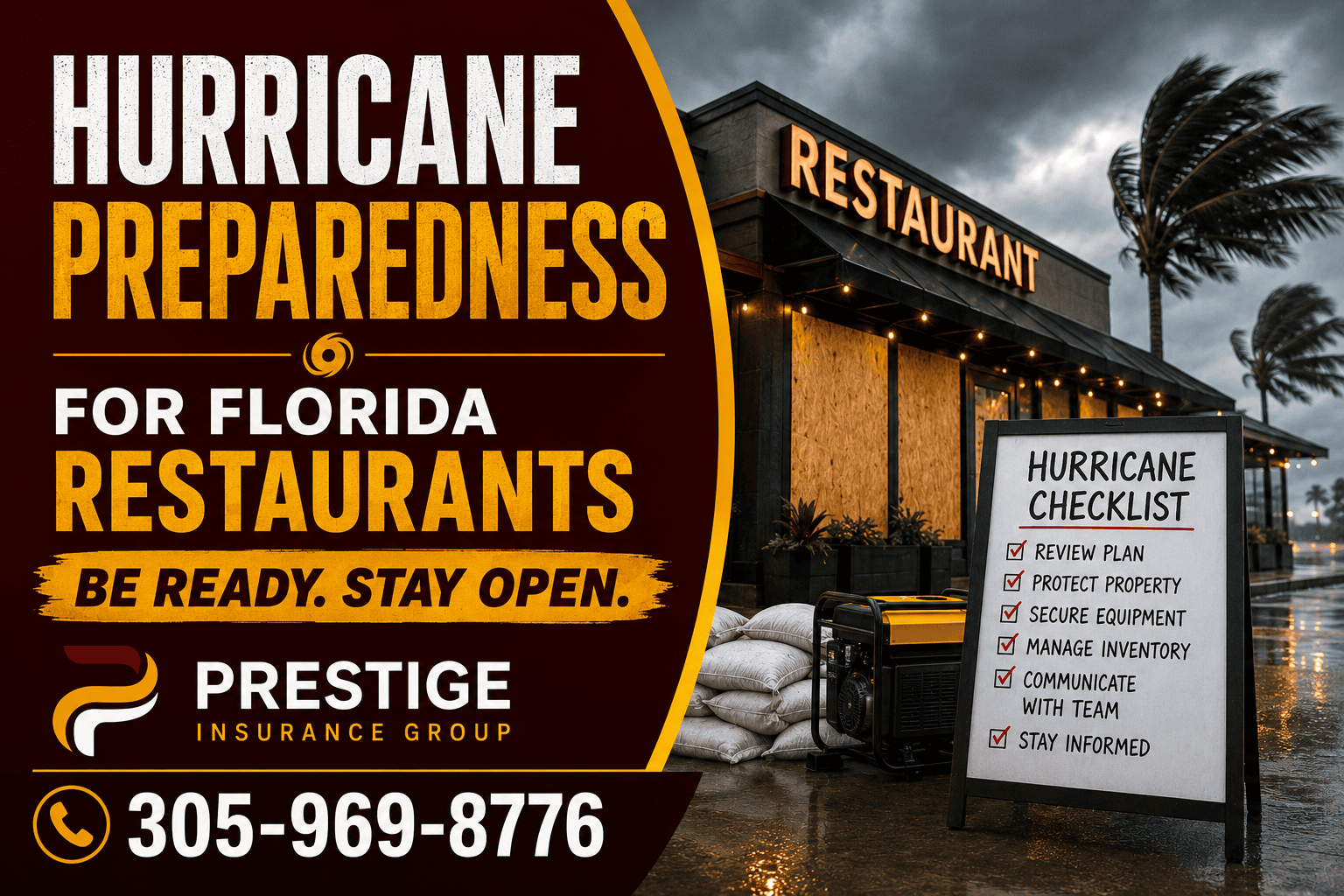
Hurricane Preparedness for Florida Restaurants: Before, During & After the Storm
For Florida restaurant owners, hurricane preparedness is not something that should begin when a storm appears several days away. By that point, employees may already be making plans for their families, suppliers may be adjusting deliveries, customers may be changing reservations, fuel and emergency supplies may become harder to obtain, and management may have limited time to protect the restaurant.
Restaurants are particularly vulnerable to hurricanes because so many parts of the operation depend on systems outside the owner’s control. Electricity keeps refrigeration operating. Water is essential for sanitation and food preparation. Employees need safe transportation to work. Suppliers need functioning roads and distribution facilities. Internet and telecommunications support point-of-sale systems, online ordering and customer communication.
Federal business-continuity guidance specifically encourages businesses to plan around loss of utilities, inability to access the building, employee transportation, payroll interruption, suppliers and communication during recovery. For restaurants, almost every one of those issues can become critical after a major storm.
A hurricane plan should therefore answer a much bigger question than how the restaurant will protect its windows. It should explain how the business will prepare, shut down safely, protect employees and property, evaluate food and equipment after the storm, and eventually reopen.
A Hurricane Is Not One Restaurant Exposure
A hurricane should not be viewed as a single event from a restaurant-management perspective. The National Hurricane Center identifies storm surge, heavy rainfall and inland flooding, high winds and tornadoes among the major hazards associated with tropical cyclones. Importantly, the hurricane category describes wind intensity — it does not measure storm surge or rainfall flooding.
For a restaurant, those hazards can create a chain reaction. Strong winds may damage the building or rooftop equipment and allow rain to enter. Floodwater may affect equipment and inventory at floor level. Electrical service can fail, causing refrigeration to stop operating. Employees may evacuate or be unable to travel safely. Suppliers can experience their own disruptions, and even after the restaurant itself is repaired, surrounding roads and utilities may prevent normal operations.
That is why the most useful hurricane question is not simply, “Will the building survive the storm?” Restaurant owners should also ask, “What will prevent us from reopening afterward?”
Preparing Before the Storm
Hurricane Preparation Should Begin Long Before a Storm Is Named
The most effective restaurant hurricane plans are developed when there is no immediate storm threatening Florida. Management should know who has authority to make important decisions, who communicates with employees, who contacts vendors, who protects records, who documents the restaurant before the storm and who evaluates conditions afterward. Critical contact information should be accessible even if the restaurant cannot be entered.
A written plan doesn’t need to become an enormous manual nobody reads — it should be practical enough that managers understand their responsibilities and can execute them under pressure. The plan should also be reviewed periodically because restaurants change: employees leave, managers change, new equipment is installed, delivery operations expand and vendors change. A hurricane plan created several years ago may contain telephone numbers and responsibilities that no longer reflect the business. Preparedness works best when it becomes part of normal restaurant management rather than an emergency project recreated every hurricane season.
Decide Who Has Authority Before the Emergency
Hurricanes create situations where restaurant owners may not be physically present — one owner may evacuate, another may be traveling, the general manager may live in an evacuation zone, and communication networks can become unreliable. The restaurant should have a clear decision-making structure: who can authorize closing, who can approve emergency expenses, who communicates with employees, who contacts the landlord, who communicates with the insurance agency, and who determines when employees may safely return.
Those decisions should not depend on everyone successfully participating in a group text during a major hurricane. Delegating authority in advance can prevent confusion when time-sensitive decisions need to be made.
Employees Need Time to Protect Their Own Families
Restaurants cannot build a hurricane plan around the assumption that every employee will remain available until the last possible moment. Employees have families, homes, pets and personal responsibilities — some may live in evacuation zones, others may depend on public transportation or have children whose schools close before the restaurant does. Management should communicate expectations early enough for employees to make reasonable plans.
This is both a safety issue and a workforce issue. Employees who believe management is placing revenue ahead of their safety may remember that long after the storm has passed. See our restaurant workforce management guide for more on this broader challenge.
Decide in Advance What Would Cause the Restaurant to Close
Waiting until conditions deteriorate to decide whether to close can create unnecessary risk. Restaurant owners should consider what circumstances would trigger an early closure — local evacuation orders obviously take priority, but management may also need to consider employee availability, public transportation, deteriorating weather, loss of utilities and whether customers can safely travel. The National Hurricane Center notes that emergency managers aim to complete evacuations before tropical-storm-force winds begin, because those winds themselves can make travel dangerous.
The objective should not be squeezing one additional dinner service out of the restaurant before a hurricane. It’s closing in an orderly manner while employees still have time to travel safely and management has time to secure the business.
Inventory Management Should Change as Hurricane Risk Increases
A restaurant normally wants enough inventory to satisfy customer demand. As a storm approaches, that strategy may need to change — continuing to receive large quantities of seafood, meat, dairy and other perishables shortly before a potential prolonged power outage can increase the amount of inventory at risk. Management should communicate with suppliers and adjust purchasing as the forecast becomes more relevant to the restaurant’s location.
The objective isn’t to empty the restaurant every time a tropical system enters the Atlantic — it’s to avoid unnecessarily loading refrigerators and freezers immediately before a credible threat. Restaurants with substantial refrigerated inventory should know approximately how much value they normally have at risk; many owners are surprised when they calculate the replacement cost of everything inside their walk-in coolers and freezers.
Refrigeration Is One of the Most Important Hurricane Vulnerabilities
When electricity fails, temperature becomes a food-safety issue rather than simply an equipment problem. Restaurants should have working thermometers and procedures for monitoring temperatures, with employees knowing who is responsible for making decisions about potentially unsafe food rather than improvising after a prolonged outage.
Florida DBPR’s hurricane guidance specifically warns food-service establishments that food warmed because of lost refrigeration or contaminated by floodwater, storm debris or pollutants can pose a serious foodborne-illness risk, emphasizing safe temperatures, safe water, sanitation and discarding questionable food. A restaurant owner may look at thousands of dollars of inventory after a storm and understandably want to save as much as possible — food-safety decisions should not be driven by the replacement cost of the food. Restaurants that already monitor refrigeration temperatures as part of normal food-safety practices are better positioned after an outage, since management may be able to determine when temperatures began rising and how conditions changed over time. See our food safety culture guide for more on why this everyday discipline pays off during emergencies.
Generators Need to Be Planned Properly, Not Purchased in a Panic
A generator can be extremely valuable to a restaurant, particularly for critical refrigeration, but purchasing one doesn’t automatically solve the problem. Restaurant owners need to understand what equipment the generator can power, how it’s installed, how fuel will be managed, and whether the system complies with applicable electrical, fire and building requirements. Portable generators can also create serious carbon-monoxide hazards when used improperly — Florida health officials specifically warn businesses and residents to take precautions against carbon-monoxide poisoning following hurricanes. Restaurants considering permanent emergency power should address the issue well before a storm approaches with qualified professionals; a generator strategy developed during an outage is usually too late.
Protect Outdoor Property, the Roof, and Business Records
Florida restaurants frequently have patios, outdoor tables, umbrellas, planters and signage that can become dangerous debris in high winds. Management should maintain a list of what needs to be brought indoors or secured, with responsibility assigned in advance rather than decided at the last minute. Restaurants in shopping centers should coordinate with property management on outdoor property, dumpsters and common areas.
The roof also deserves attention before hurricane season — even restaurant tenants who think of the roof as entirely the landlord’s responsibility can be heavily affected by roof damage, since kitchen exhaust systems, HVAC equipment and other restaurant-related systems often interact with rooftop components. A small existing roof problem can become much more consequential under hurricane conditions.
Business records deserve the same advance attention. Owners should maintain accessible copies of insurance policies, leases, vendor contacts, employee information and equipment schedules, with cloud storage or secured off-site backups helping maintain access if computers or physical files are damaged. Federal business-continuity guidance specifically asks businesses to consider whether they could continue operating without access to computers, files, inventory, utilities or the building itself.
Document the Restaurant and Protect Technology Before the Storm
Before significant storm conditions arrive, management can photograph or video the restaurant when it’s safe — the kitchen, dining room, equipment, furniture, bar, refrigeration, storage areas and exterior. Maintaining equipment schedules, serial numbers and purchase records helps identify valuable property later and prevents owners from having to reconstruct an inventory from memory after a major loss.
Restaurants have also become increasingly dependent on technology — point-of-sale systems, online ordering, reservation platforms, and scheduling and payroll systems. Owners should understand which systems are cloud-based versus dependent on equipment physically located at the restaurant, back up important data appropriately, and know how the business will communicate if internet or cellular service becomes unreliable. A restaurant can have electricity and a functional kitchen yet still struggle to operate normally if payment, ordering or communications systems are unavailable.
Communicate With the Landlord Before the Storm
Restaurants operating from leased spaces should understand the landlord’s hurricane procedures in advance: who controls access after the storm, who is responsible for boarding or protecting openings, who handles roof damage, who evaluates building safety, and what happens if the shopping center has electricity but the restaurant unit doesn’t. Commercial leases allocate responsibilities differently, so restaurant owners should not assume that because a task “sounds like a landlord responsibility,” the lease necessarily treats it that way. Clear communication before the storm can reduce conflict during recovery.
Understanding Insurance Before Hurricane Season
Flood and Wind Are Different Hurricane Exposures
This distinction is critical for Florida restaurant owners. The National Hurricane Center identifies high winds and flooding as separate hurricane hazards — storm surge is an abnormal rise in water generated by the storm, while tropical cyclones can also produce destructive rainfall flooding well inland. Restaurant owners should not assume that because a commercial property policy provides hurricane or wind protection, rising water or storm surge is automatically covered under the same policy. Flood damage typically requires separate protection and is not covered by standard commercial property insurance.
This matters particularly for restaurants because so much valuable property — refrigeration equipment, furniture, kitchen machinery, electrical components, food inventory and tenant improvements — is frequently located near floor level. See our complete restaurant flood guide for the full discussion.
A restaurant doesn’t have to sit directly on the beach to experience hurricane-related flooding, either. The National Hurricane Center notes that tropical cyclones can produce widespread torrential rainfall and destructive inland flooding, with rainfall amounts depending on storm size, speed and geography rather than simply hurricane category. Central Florida restaurants can experience serious hurricane effects even far from the immediate coastline, and the same is true near rivers, canals, or drainage systems that can become overwhelmed.
Flood Insurance Does Not Automatically Replace Lost Restaurant Revenue
Standard NFIP commercial flood insurance provides building and contents protection for eligible direct physical flood damage, subject to the policy’s terms, limits and deductibles — but it does not cover financial losses resulting from business interruption or loss of use. That creates an important potential gap: flood insurance might pay for eligible damage to equipment and contents, but the restaurant could remain closed for months while the building is repaired, with rent and other expenses continuing while normal revenue disappears. The physical property loss and the interruption to the business are two separate financial problems. Private commercial flood products may offer different options, so restaurant owners concerned about flood-related interruption should specifically investigate what’s available.
Do Not Assume Every Hurricane Loss Is Covered the Same Way
A hurricane can create multiple types of losses that don’t necessarily fall under the same insurance coverage. Wind damage may be handled differently from flood. Equipment breakdown may be treated differently from direct storm damage. Food spoilage after an off-premises utility failure can depend on whether the restaurant purchased the appropriate coverage extension. Florida’s Department of Financial Services specifically uses the example of a restaurant losing refrigerated food after a storm-related power outage — noting that spoilage is not generally covered under a commercial property policy unless appropriate coverage has been purchased, while business-interruption coverage depends on the policy and circumstances.
A single storm can produce wind, flood, power interruption, equipment failure, spoilage and lost income all at once, with several different policy provisions determining how each loss is handled. That’s why reviewing coverage before hurricane season is so much more valuable than trying to understand it after a storm. See our guide to restaurant coverage gaps for more.
Business Income Coverage, Deductibles, and Tenant Improvements Deserve Advance Review
Business income coverage generally needs to be triggered according to its terms, commonly involving direct physical loss or damage from a covered cause — flood and other excluded causes can create complications even when the restaurant suffers substantial lost revenue. Restaurant owners should understand what causes of loss trigger the coverage, what waiting periods apply, and how long the restoration period can continue, particularly since a widespread hurricane can make recovery much slower than an isolated building fire.
Hurricane deductibles deserve the same scrutiny. Commercial property policies in Florida can contain windstorm or hurricane deductibles structured differently from ordinary property deductibles, and a percentage-based deductible can represent a substantial amount. Owners should know what the deductible means in actual dollars, not just as a percentage on the policy — the worst time to calculate it is after the hurricane has already damaged the property.
Restaurant tenants should also understand tenant improvements under their lease. Commercial kitchens, bars, flooring, plumbing modifications and custom interior finishes can represent a major investment, and a restaurant owner who assumes “the landlord insures the building” may discover that significant portions of the restaurant’s own investment were never the landlord’s responsibility — especially relevant after a hurricane, when damage can involve both the building and the tenant’s improvements simultaneously.
Buying Coverage at the Last Minute Usually Doesn’t Work
Restaurant owners should remember that flood insurance in particular cannot simply be purchased once a storm is approaching. NFIP flood insurance generally has a 30-day waiting period before coverage becomes effective, with limited exceptions such as certain loan closings or recent flood-map changes. Hurricane preparedness therefore needs to happen well before a storm appears on a forecast map, not during the days leading up to it.
During and Immediately After the Storm
Do Not Send Employees Back Into an Unsafe Building
After the storm passes, owners understandably want to see the property immediately, but safety should remain the priority. Downed electrical lines, standing water, damaged roofs, compromised electrical systems and structural damage can create real hazards. Employees should not be asked to enter unsafe conditions simply to assess inventory or begin cleanup — qualified professionals may need to evaluate building systems first, and restaurant owners should follow instructions from local emergency authorities and property management.
Document Damage and Protect Against Further Loss When It’s Safe
Once the property can be accessed safely, owners should photograph and video damaged areas before major cleanup or disposal begins — the kitchen, dining room, equipment, furniture, walls, ceilings and exterior. Contact the insurance professional promptly and follow the carrier’s claims instructions. Temporary measures may be appropriate to prevent additional water intrusion or protect undamaged property, but owners should avoid performing dangerous repairs themselves or making major permanent changes before understanding the insurer’s requirements, and should retain receipts for reasonable emergency expenses.
Floodwater Creates a Food-Safety Problem, Not Just Property Damage
Floodwater should never be treated as ordinary rainwater inside a restaurant — it can introduce contaminants into food-storage and preparation areas, affecting food, packaging, equipment and food-contact surfaces. Florida DBPR advises food-service establishments affected by disasters to use safe water and food, keep food at safe temperatures, separate raw and cooked food, and thoroughly clean, sanitize or disinfect contaminated equipment and surfaces before operating. Restaurant owners understandably want to reopen quickly, but food safety has to come first — opening one day earlier is not worth creating a foodborne-illness incident immediately after a hurricane.
Water service matters just as much as electricity here. Restaurants cannot operate normally without safe water for handwashing, food preparation, cleaning and sanitation, and hurricanes can lead to boil-water notices following disasters or water-system problems. Restaurant managers should monitor official local guidance rather than assuming water from the tap is automatically safe.
Reopening the Restaurant
Employee and Supplier Availability Can Delay Reopening Even When the Building Is Ready
A restaurant can be physically ready to reopen before its workforce or supply chain is. Some employees may have evacuated hundreds of miles away, others may have damaged homes, no electricity, childcare problems or blocked roads. Management should communicate with employees after the storm and determine actual staffing availability before announcing normal operating hours, rather than assuming everyone will return as soon as the building is ready.
Suppliers may be experiencing their own disaster — warehouses can lose electricity, delivery routes can be blocked, and fuel shortages can affect transportation. Restaurant owners should identify their most critical suppliers and understand what alternatives exist if normal distribution is interrupted, particularly for restaurants with a highly specialized menu dependent on particular vendors.
A Reduced Menu Can Be a Smart Recovery Strategy
Reopening doesn’t necessarily mean returning immediately to the full menu. A limited menu can reduce inventory requirements, simplify kitchen operations, and allow the restaurant to function with fewer employees — particularly useful when suppliers are inconsistent or staffing remains limited. Management can focus on dishes using readily available ingredients and equipment known to be functioning correctly, gradually expanding back to normal as conditions improve. Business continuity is about finding ways to operate safely under imperfect conditions rather than waiting for everything to return to normal.
Verify Refrigeration and Systems Before Fully Reopening
Electricity returning doesn’t automatically mean everything inside the restaurant is safe — a refrigeration unit may restart but fail to maintain the correct temperature, or equipment may have been damaged by electrical fluctuations or water. Management should verify equipment operation and food safety before returning products to normal service, and should evaluate whether electricity, refrigeration, water, sanitation and cooking equipment are all functioning appropriately, with any necessary regulatory inspections completed before reopening. A restaurant that reopens prematurely can transform a hurricane property loss into a food-safety or customer-safety problem.
Communicate Clearly With Customers
Restaurant owners should update their website, Google Business Profile and social media when possible, especially if hours are limited or the menu has changed. Customers generally understand that hurricanes create difficult conditions, but if a restaurant accepts online orders it can’t fulfill or repeatedly changes hours without updating information, customers may still leave negative reviews. See our online reviews and reputation guide for more on how this connects to broader reputation management. The objective should be reopening well, not simply reopening first — and avoiding repeated changes to the reopening date, which can create confusion during an already difficult period.
Every Storm Is a Preparedness Lesson
After the restaurant reopens, management should conduct a post-storm review: what worked, what failed, was employee communication effective, was too much perishable inventory on hand, were important records accessible, did the landlord respond effectively, were insurance limits and deductibles understood? Every hurricane provides information that can improve the restaurant’s next disaster plan — even restaurants that sustain no physical damage can learn from the preparation process, since near misses (outdated employee contact information, insurance documents that couldn’t be located remotely, no alternative supplier for a critical ingredient) are valuable discoveries worth correcting before they matter during a direct hit.
Hurricane Preparedness Is a Year-Round Restaurant Responsibility
Florida restaurants cannot eliminate hurricane exposure, but they can become much better prepared for it. The strongest plans address employees, food inventory, refrigeration, outdoor property, suppliers, records, technology, landlord communication, insurance and reopening procedures long before a storm approaches. Then, when a hurricane does threaten Florida, management can focus on executing an established plan rather than inventing one under pressure.
For restaurant owners, that distinction matters because surviving the storm and successfully reopening after the storm are two different challenges.
Prestige Insurance Group works with restaurants and hospitality businesses throughout Florida. Restaurant hurricane planning should begin operationally, but owners should also understand how their insurance program addresses wind, flood, property damage, spoilage, equipment breakdown and business interruption.
For help reviewing hurricane and catastrophe exposures for a Florida restaurant, contact Prestige Insurance Group at 305-969-8776.
Se Habla Español.