


Do I Need Flood Insurance for Airbnb in Florida?
Florida is one of the highest flood-exposure states in the country, and Airbnb properties often carry more of that exposure than owners realize — not because short-term rentals are inherently more flood-prone, but because so many are concentrated in exactly the locations that draw both guests and water: coastal areas, canal-front lots, and low-lying tourist corridors. The short answer is straightforward: flood damage is never covered under a standard homeowners, landlord, or short-term rental policy, and for most Florida hosts, a separate flood policy is worth serious consideration rather than an afterthought.
Wind and Flood Are Always Separate Coverage Questions
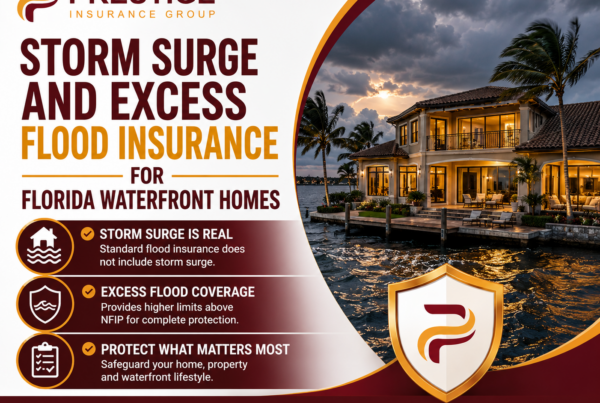
This is the single most important thing to understand, and it trips up hosts constantly. Florida hurricanes routinely cause both wind damage and flood damage in the same event — but insurance treats these as genuinely different causes of loss, typically under entirely different policies. A property policy covering wind damage from a hurricane doesn’t automatically extend to the flooding that same storm caused through storm surge or rainfall. Assuming “my policy covers hurricanes” settles the flood question is one of the most common and costly misunderstandings a host can have.
What a Flood Policy Actually Protects
A proper flood insurance policy — through the National Flood Insurance Program (NFIP) or a private flood carrier — can address the structure itself, electrical and plumbing systems, built-in appliances and fixtures, and depending on the specific policy, furniture and contents as well. Cleanup and restoration costs may also be included. NFIP and private flood options aren’t interchangeable products, though — limits, definitions, and specific terms genuinely differ between them, and the right choice depends on the property’s actual value and risk profile rather than defaulting to whichever option is more familiar.
What Happens Without It
This is where the financial exposure becomes real for a host. Without flood coverage, an owner absorbs the full cost of flood damage out of pocket, loses rental income while repairs are underway, and — critically — remains fully responsible for mortgage payments the entire time, regardless of whether the property can generate any income during that period. For a host who depends on rental income to cover financing costs, an uninsured flood event doesn’t just damage the property; it can create a genuine cash-flow crisis at the exact moment income stops and expenses don’t.
Being Outside a High-Risk Flood Zone Doesn’t Mean the Risk Is Zero
FEMA flood zone designations are a real, useful starting point, but they’re not a guarantee. Flooding can and does happen well outside officially designated high-risk zones — heavy rainfall, storm surge that travels further inland than a map might suggest, and local drainage failures can all produce real flood damage regardless of zone classification. Storm surge specifically threatens coastal Airbnb properties directly, while rainfall-driven flash flooding is a genuine risk for inland properties that might otherwise feel insulated from flood exposure entirely.
When Flood Insurance Deserves Serious Consideration
A handful of factors should push flood coverage from “optional” to “seriously worth doing”: a property located in a FEMA flood zone, proximity to the coast, canals, or other waterways, any history of prior flooding at the property, genuine dependence on Airbnb income to cover expenses, or a lender or HOA requirement mandating it. None of these factors alone is a guarantee flooding will happen — but together, they describe exactly the profile where an uninsured flood loss would be most financially damaging, which is the real question worth asking rather than simply estimating raw probability.
The Business-Interruption Angle Deserves Its Own Attention
A flood doesn’t just damage physical property — it can shut down bookings for weeks or months during restoration, and that lost income is a real, separate financial hit layered on top of the physical repair costs. This matters more for Airbnb properties specifically than for a typical owner-occupied home, precisely because the property’s ability to generate income is central to why it’s owned in the first place. Reviewing whether a flood policy or a companion short-term rental policy actually addresses this lost-income exposure — not just the physical structure — is worth confirming directly rather than assuming it’s automatically included.
AirCover Doesn’t Reach This Exposure at All
Airbnb’s built-in AirCover protection does not include flood coverage, and it was never designed to. Even where AirCover applies to other kinds of damage, large-scale flood events fall well outside what that program addresses, and relying on it as a substitute for real flood coverage leaves a host with no protection at all against exactly the kind of loss most likely to be catastrophic in Florida specifically.
The Bottom Line
For the majority of Florida Airbnb hosts, flood insurance isn’t a marginal add-on — it’s one of the more consequential coverage decisions available, specifically because standard policies exclude it entirely and because Florida’s flood exposure is both widespread and often underestimated relative to how it’s actually distributed across the state. The right approach is evaluating the property’s real location, elevation, and flood history honestly, rather than assuming a flood zone map or a “we’ve never flooded” history settles the question permanently.
Prestige Insurance Group works with Florida Airbnb hosts to evaluate flood exposure alongside the rest of their short-term rental insurance program — not as an isolated afterthought. Call 305-969-8776 or request a quote online to have your Airbnb’s flood exposure reviewed, or contact our Miami office directly.